

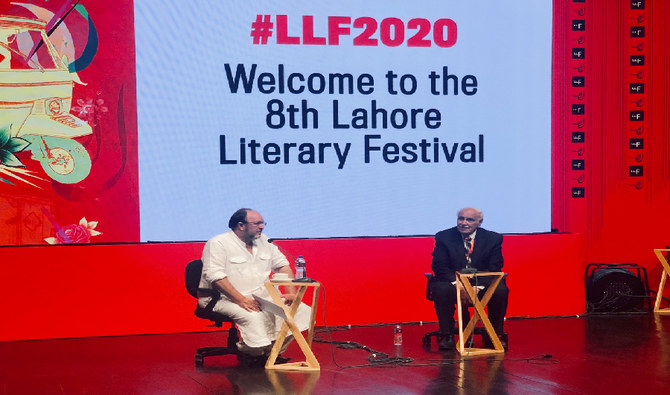

LAHORE: The 8th edition of the Lahore Literary Festival (LLF) which ended its three-day run on Sunday, included a spectacular line-up of authors, and addressed wide-ranging themes about identity within the backdrop of the clash and interlacing of cultures.

Fatima Bhutto in conversation with Fatima Arif at the Lahore Literary Festival, Feb. 22, 2020. (Photo Courtesy: Imran Sheikh Niche Lifestyle)
This weekend, Pakistan’s historic, eastern city of Lahore played host to renowned writers, artists, historians, critics and opinion makers from Pakistan and abroad with over a hundred speakers and 63 sessions. Among the star-studded line-up were winner of the Nobel Prize in Literature, Orhan Pamuk, Pakistani author Fatima Bhutto, Oyinkan Braithwaite, long-listed for the 2019 Man Booker Prize; author Musharraf Ali Farooqi, novelist and poet Nitasha Kaul, who has written on the plight of Kashmir in Modi’s India; and Adrian Hayes, who launched One Man’s Climb, a book about his journey to reach the summit of the world’s second-highest mountain, K2.
Among the myriad of topics and discussions highlighted in the festival, the theme of complex national identity within a multicultural environment struck a chord.

Orhan Pamuk in Lahore, February 2020. (Photo Courtesy: Lahore Literary Festival)
“There is a need to formulate a strong local culture that is a combination, not an imitation of the Eastern past and the Western present,” Nobel prize winner Pamuk said while addressing a full house on Sunday.
The opening and closing sessions featuring Orhan Pamuk were perhaps the most insightful and popular presentations. The Turkish novelist, screenwriter, academic and recipient of the Nobel Prize in Literature, Pamuk is arguably one of Turkey’s most prominent novelists. When he received his Nobel Prize in 2006, he was praised for making Istanbul an indispensable literary territory, equal to Dostoevsky’s St. Petersburg or Marcel Proust’s Paris.
Yet, according to Pamuk, when he decided to be a novelist and started writing in 1974, there were hardly any novels around “because we didn’t have the same individuality as Europeans.”
In his dialogue in Lahore, Pamuk drew parallels between problematic Turkish Muslim identities to complicated postcolonial South Asian, more specifically Pakistani, identity. For centuries, Turkey was the center of the Ottoman Empire, but after its decline, the West became the world’s new ideological center and Turkey receded to the margins. A similar predicament was faced by Lahore-- once the center of arts and culture in the region.
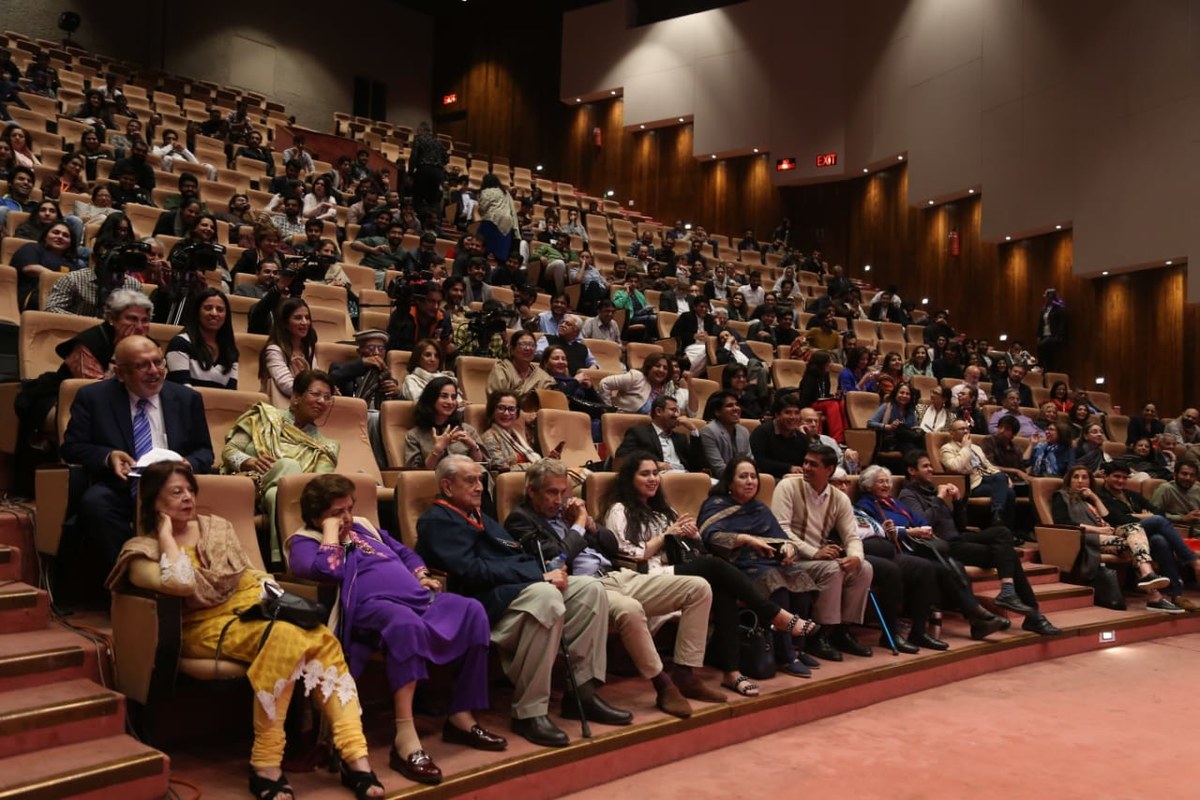
Full house in an auditorium of the Alhamra Art Center during the Lahore Literary Festival. Feb. 2020. (Photo Courtesy: Lahore Literary Festival)
Pamuk expressed that one of the main problems in the East-West encounter is the sense of a collective loss generated by the replacement of the local culture by a foreign one.
He asserted that the blend of the East and West, in spite of its positive features should not take place at the cost of the erosion of national identity.
Outside the halls of the Al-Hamra Arts Center situated in the heart of Lahore, colorful banners, concerts, and food stalls were out in full swing-- as swathes of people of all age groups crowded the grounds.
“We as a nation are thirsty for international presence and a high-quality caliber exchange of ideas, people, art and culture. This edition of the festival, from Nobel laureates to award-winning participants is going to elevate the level of thought and knowledge within the society, a vast improvement from the previous ones and will enable us to further establish Lahore in the global arena,” F.S Aijazuddin, a prominent Pakistani author told Arab News.
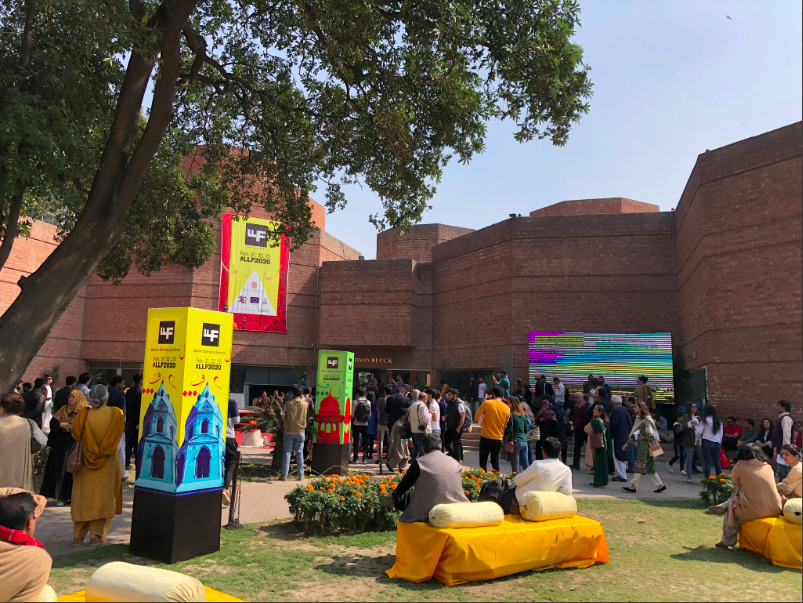
Scenes in the grounds of the Alhamra Arts Centre during the Lahore Literary Festival in Feb. 2020. (Photo Courtesy: Lahore Literary Festival)
Following on from the topic of an Eastern identity crisis resulting from the aim to emulate the West, Pakistani writer Fatima Bhutto’s book launch event on Saturday also highlighted the declining power of the West.
“We have to make our own stories because only we can do justice to them. We can’t leave it to Hollywood,” she said on Sunday.
She elaborated that a vast cultural movement was emerging from beyond the Western world that was truly global in its range and charm and was the biggest challenge yet to America’s soft power supremacy of Hollywood.
Her book, New Kings of the World: Dispatches from Bollywood, Dizi, and K-Pop is a book about these new mediators of mass culture arising from Asia— India’s Bollywood films, Turkish dizi (soap operas), and South Korean pop music.
Relating the discussion to Pakistan, she said the country had an enormously rich culture that was not promoted to its full potential. She said if Pakistan decided to work on its content, there was no doubt that its music, dramas, and films, would be embraced by the rest of the world.
“Many things in western culture, or what I call the American culture, is made on the backs of our cultures,” she said.
She concluded the day’s session by highlighting that her book started in Peshawar and ended in Seoul and that the story that connects them depicts that humans relate to people from other countries and are open to other cultures beyond the West, even when their governments are afraid to do so.


