

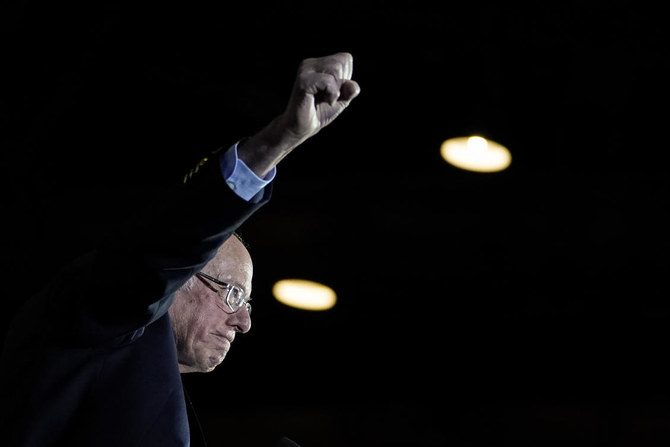

LAS VEGAS: Bernie Sanders strengthened his front-runner position for the Democratic presidential nomination with a decisive victory in the Nevada caucuses on Saturday, while Joe Biden was on track for a second-place finish that would give his struggling campaign new hope.
A self-described democratic socialist, Sanders was backed by a diverse coalition of young and middle-aged voters, Latinos, union members and white college-educated women for the win in Nevada, according to Edison Research, showing signs of expanding support for his surging campaign beyond his longstanding core.
“We have put together a multi-generational, multiracial coalition that is going to not only win in Nevada, it’s going to sweep the country,” Sanders, a US senator from Vermont, told cheering supporters in San Antonio, Texas.
Biden, a former vice president, appeared to score a badly needed strong finish after poor showings in the first two contests in Iowa and New Hampshire for the party’s nomination to face Republican President Donald Trump in the November election.
Sanders’ triumph in the first racially diverse state suggests his unapologetic message of social and economic justice, including his signature pledge to provide universal health care for all Americans, is resonating with a broader coalition of Democratic voters.
For Biden and other moderates who argue that Sanders is too liberal to beat Trump and who have been trying to blunt his momentum, however, the job has become much harder.
Sanders had 47% of the county convention delegates in Nevada with 50% of the precincts reported. Biden was a distant second to Sanders with 19%, but ahead of former Mayor Pete Buttigieg of South Bend, Indiana, in third place with 15%.
“The press is ready to declare people dead quickly, but we’re alive and we’re coming back and we’re gonna win,” Biden told supporters in Las Vegas on Saturday night.
Senator Elizabeth Warren, who had been looking to jump-start her campaign after poor finishes in the first two states, was again trailing in a disappointing fourth with more than 10% in Nevada, where voters poured into more than 250 sites around the state. Senator Amy Klobuchar and activist billionaire Tom Steyer were well back at around 4%.
Buttigieg cautioned Democrats about nominating Sanders, portraying him as an ideologue.
“We can prioritize either ideological purity or inclusive victory. We can either call people names online or we can call them into our movement. We can either tighten a narrow and hardcore base or open the tent to a new, broad, big-hearted American coalition,” Buttigieg told supporters in Las Vegas.
Despite another poor showing in Nevada, Warren said she got a boost in fundraising and support from an aggressive debate performance on Wednesday — which came too late to affect early voting in the state.
“We have a lot of states to go, and right now I can feel the momentum,” Warren said at a rally in Seattle.
The race now begins to broaden across the country, with the next primary on Feb. 29 in South Carolina, followed by the Super Tuesday contests in 14 states on March 3 that pick more than one-third of the pledged delegates who will help select a Democratic nominee.
Bloomberg looms in race
Biden, vice president under former President Barack Obama, is counting on a strong showing in South Carolina, which has a large bloc of black voters. In Nevada, entrance polls showed Biden led among African Americans with 36%, followed by Sanders with 27%.
The Super Tuesday states will bring former New York Mayor Michael Bloomberg, who has not been competing in the four early voting states but has been rising in opinion polls, into the race.
“The Nevada results reinforce the reality that this fragmented field is putting Bernie Sanders on pace to amass an insurmountable delegate lead,” Bloomberg campaign manager Kevin Sheekey said in a statement.
On Twitter, Trump appeared to be enjoying the Democratic race.
“Looks like Crazy Bernie is doing well in the Great State of Nevada. Biden & the rest look weak, & no way Mini Mike,” Trump wrote, the last a reference to Bloomberg.
Nevada caucus officials and voters at multiple sites on Saturday reported voting rules confusion, calculation glitches and delays in reporting tallies — despite efforts to avoid the issues that plagued Iowa’s caucuses earlier this month.
After a technical meltdown delayed results in Iowa, state officials promised a revised reporting system using a telephone hotline and photos of caucus reporting sheets would ensure a smoother process. Nevertheless, precinct chairs at some caucuses experienced long waits on the phone lines.
In the final result of a caucus at the famed Bellagio hotel on the Las Vegas strip, Sanders finished with 76 votes, Biden had 45 and no other candidate ended with a vote.
Workers at the hotel, who are members of the Culinary Workers Union, streamed out of the caucus after backing Sanders despite their leadership expressing reservations about his health care plan.
“I went for Bernie. I’m not big into politics, but I like the things he’s going for: student loan debt, schools, free health care,” said Aleiza Smith, 22, a housekeeper at the Bellagio.
Sanders was aided in Nevada by strong support from the six in 10 voters who said they backed a government-run Medicare for All, the Edison entrance poll showed.
It showed that Sanders led across all age groups except for those older than 65. Around 54% of Latino voters said they backed him, while 24% of college-educated white women and 34% of those who have a union member in their families supported him.


