

9 dead after magnitude 5.7 quake hits Turkey-Iran border area

1 / 2
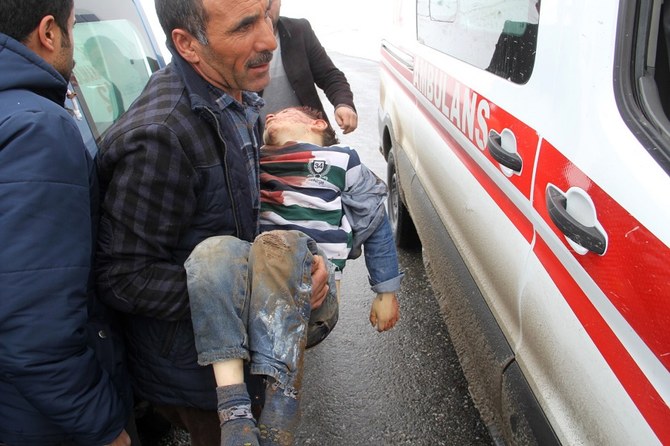
A man carries a wounded boy to an ambulance after an earthquake hit Baskale town in Van province Turkey, at the border with Iran on Sunday, Feb. 23, 2020. (IHA via AP)
2 / 2
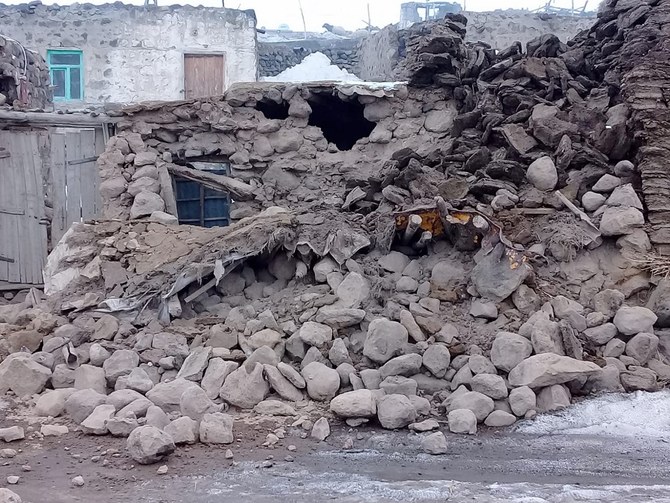
Houses are reduced to rubble after an earthquake hit Baskale town in Van province Turkey, at the border with Iran on Sunday, Feb. 23, 2020. (IHA via AP)
Short Url
Updated 24 February 2020
Follow

9 dead after magnitude 5.7 quake hits Turkey-Iran border area

  • The earthquake had a depth of 6 kilometers
  • Criss crossed by major fault lines, Iran and Turkey are among the most earthquake-prone countries in the world

ISTANBUL: A magnitude 5.7 earthquake in northwestern Iran on Sunday killed at least nine people in neighboring Turkey and injured dozens more on both sides of the border, authorities said.
The epicenter of the quake, which struck at 9:23 a.m., was near the Iranian village of Habash-e Olya, less than 10 km from the border, according to the US Geological Survey.
The earthquake had a depth of 6 km, said Tehran University’s Seismological Center.
In Turkey, it was felt mostly in the eastern district of Baskale in Van province on the Iran border.
Interior Minister Suleyman Soylu said nine people were killed, speaking to reporters from the quake scene in Van. Four of the dead were children.
“We have right now no citizens trapped under the rubble,” he said.

NUMBER

37 - people were injured in Turkey, nine of them were in critical condition, according to Turkish Health Minister Fahrettin Koca.

Images showed collapsed adobe houses in several snow-covered villages in Van province.
In Gurpinar village, search and rescue teams were seen on top of the rubble pile, watched by anxious locals.
Van, which was hit by a 7.1 magnitude quake in 2011 killing more than 500 people, was struck by tragedy again this month when two avalanches left 41 people dead.

It injured at least 51 people in Iran’s West Azerbaijan province, 17 of whom had been hospitalized, the country’s emergency services said.
The same source also said there was damage to buildings in 43 villages. Sunday’s earthquake was felt in several Iranian cities, including Khoy, Urmia, Salmas and Osku, state media reported, citing West Azerbaijan’s crisis management center.
Both Iran and Turkey sit on top of major tectonic plates and see frequent seismic activity.
In November 2017, a 7.3-magnitude quake in Iran’s western province of Kermanshah killed 620 people.

In 2003, a 6.6-magnitude quake in southeastern Iran decimated the ancient mud-brick city of Bam and killed at least 31,000 people.
Iran’s deadliest quake was a 7.4-magnitude tremor in 1990 that killed 40,000 people in northern Iran, injured 300,000 and left half a million homeless.
In December and January, two earthquakes struck near Iran’s Bushehr nuclear power plant.
Iran’s Gulf Arab neighbors have often raised concerns about the reliability of the country’s sole nuclear power facility, which produces 1,000 megawatts of power, and the risk of radioactive leaks in case of a major earthquake.
Turkey is also prone to earthquakes and over 40 people died in January after a 6.8-magnitude quake struck Elazig in eastern Turkey.
In 1999, a devastating 7.4 magnitude earthquake hit Izmit in western Turkey, killing more than 17,000 people including about 1,000 in the country’s most populous city, Istanbul.


Iraqi lawmakers to elect president Tuesday, PM appointment next

Updated 25 January 2026
Follow

Iraqi lawmakers to elect president Tuesday, PM appointment next

  • Parliamentary speaker Haibat Al-Halbussi announced on Sunday that the new parliament will convene on Tuesday to elect a president

BAGHDAD: Iraq’s parliament will meet on Tuesday to elect the country’s new president, who will then appoint a prime minister expected to be Nouri Al-Maliki after he was endorsed by the largest Shiite bloc.
By convention, a Shiite Muslim holds the post of prime minister, the parliament speaker is Sunni and the largely ceremonial presidency goes to a Kurd.
Parliamentary speaker Haibat Al-Halbussi announced on Sunday that the new parliament will convene on Tuesday to elect a president, according to the official INA press agency.
The president will then have 15 days to appoint a prime minister, who is usually nominated by the largest Shiite bloc formed through post-election alliances.
On Saturday, the Coordination Framework alliance — whose Shiiite factions have varying links to Iran — endorsed former prime minister and powerbroker Al-Maliki as the country’s next premier.
The alliance, to which Al-Maliki belongs, spoke of his “political and administrative experience and his record in running the state.”
Kurdish parties have yet to agree on a presidential candidate, who must be endorsed by other blocs and win a two-thirds majority in parliament.
The presidency is usually held by the Patriotic Union of Kurdistan (PUK). This year, the rival Kurdistan Democratic Party (KDP) named its own candidate: Foreign Minister Fuad Hussein.
Although Maliki’s endorsement effectively guarantees him the post, forming a new government remains a daunting challenge that could drag on for months and still fail.
The designated premier has one month to form a government and present it to parliament for a vote of confidence.
The 75-year-old Maliki, a shrewd politician, is set to return to power at a time of seismic changes in the Middle East, as Tehran’s regional influence wanes and tensions with Washington rise.
Government formation in Iraq must balance internal political dynamics and power-sharing among major parties, all under the continued influence of Iraq’s two main allies: Iran and the United States.
A close Iran ally, Al-Maliki will be expected to address Washington’s longstanding demand that Baghdad dismantle Tehran-backed factions, many of which are designated terrorist groups by the US.
Last month, Iraqi officials and diplomats told AFP that Washington demanded the eventual government exclude Iran-backed armed groups, even though most of them hold seats in parliament, and have seen their political and financial clout increase.
But Iraq is struggling with weak economic growth and cannot risk punitive measures by the US, which has already sanctioned several Iraqi entities, accusing them of helping Tehran evade sanctions.