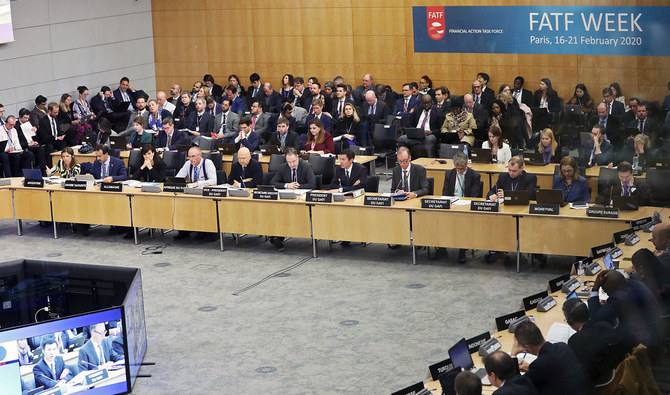
KARACHI: The Financial Action Task Force (FATF), a global money-laundering and terror financing watchdog, on Friday gave Pakistan time until June 2020 to improve its anti-terrorism financing measures.
“The FATF strongly urges Pakistan to swiftly complete its full action plan by June 2020,” the global body said in a statement issued at a plenary meeting in Paris.
This is the second four-month extension given to Pakistan to implement the agreed action plan.
The global watchdog decided to keep Pakistan on its grey list until the country’s next progress review in June.
FATF said it would “take action” if Pakistan fails to make progress in prosecuting and penalizing terrorism financing.
In response to the FATF decision, the Pakistani government reiterated its commitment to taking all necessary action required.
“A strategy in this regard has been formulated and is being implemented,” Pakistan’s ministry of finance said in a statement.
“FATF reviewed progress made by Pakistan toward implementation of the Action Plan, while acknowledging the steps taken by Pakistan toward implementation of the Action Plan and welcoming its high level political commitment,” the statement read.
The ministry said that during the last reporting period, Pakistan made “significant progress” in the implementation of the 27-point FATF plan, which was demonstrated by the completion of nine additional action items.
While noting the improvements, the FATF expressed concerns over Pakistan’s failure to complete the action plan in line with the agreed timelines and “in light of the TF (terrorism financing) risks emanating from the jurisdiction.”
“Pakistan was required to completely ban terror outfits, take measures to control cash flows, and make laws to curb money laundering,” Muzamil Aslam, senior Pakistani economist, told Arab News. “Now it is political will to take measures by June 2020 to get the country out of grey list.”
Ahead of the FATF meeting, Pakistan has sentenced Lashkar-e-Taiba and Jamaat-ud-Dawa leader Hafiz Saeed to five and a half years in prison on terrorism financing charges. The move was seen as a demonstration of compliance with FATF recommendations.
Pakistan managed to avoid FATF’s blacklisting thanks to support from friendly countries, including Malaysia, Turkey and especially China.
Ahead of the FATF summit, Pakistan’s de facto finance minister, Abdul Hafeez Shaikh, said that “China and other brotherly countries have supported Pakistan throughout the process in terms of guiding the country to improve its frameworks.”
Pakistan was placed on FATF’s grey list of countries with inadequate control over curbing money laundering and terrorism financing in 2018.


![]()

FATF gives Pakistan until June to improve terror funding controls
Short Url
https://arab.news/zbmcq
FATF gives Pakistan until June to improve terror funding controls
- FATF urges Pakistan to swiftly complete its full action plan by June 2020
- Says will ‘take action’ if Pakistan fails to comply
Latest updates




Recommended


© 2026 SAUDI RESEARCH & PUBLISHING COMPANY, All Rights Reserved And subject to Terms of Use Agreement.