BERLIN: German ministers promised on Friday to ramp up security and put more police on the streets to quell public fears, two days after a racist gunman killed nine people.
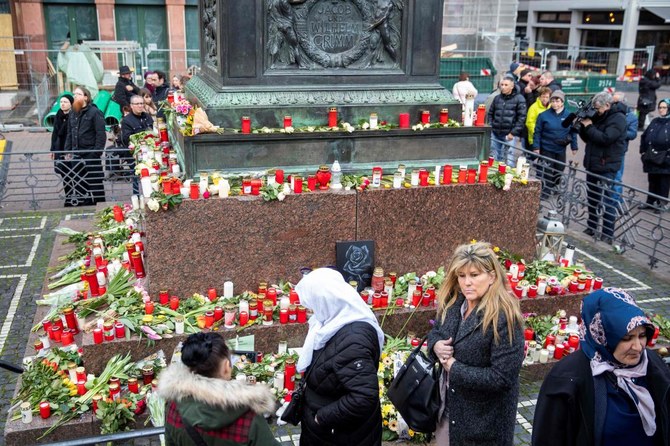
Thousands joined vigils on Thursday night to show solidarity with the victims of the right-wing extremist attack at a shisha bar and cafe in the city of Hanau, which sparked debates over gun laws and protection of migrants and minorities.
Announcing an “increased police presence” at mosques, train stations, airports and borders, Interior Minister Horst Seehofer said right-wing extremism was the “biggest security threat facing Germany.”
He said it had left “a trail of blood” in recent months — two died in an attack on a synagogue in the city of Halle in October and a pro-migrant politician was murdered at his home in June.
Separately, 12 men were arrested across Germany a week ago on suspicion of planning attacks on mosques aimed at bringing about “a civil-war-like situation” in Germany.
Seehofer insisted that “in this government... no-one is blind” to the threat from the extreme right.
He and justice minister Christine Lambrecht highlighted that Germany has updated its law on firearms licensing in recent weeks and a new bill targeting online hate speech is being considered.
In December, Seehofer also announced hundreds of new posts for federal police and security services to strengthen surveillance of the far-right scene.
But he warned that “despite all our efforts, we cannot completely rule out such terrible crimes.”
Federal police chief Holger Muench said “around half” of those who carry out attacks with extreme-right motivations were previously unknown to his officers.
Suspects in both the Halle synagogue attack and the Hanau shootings appear to have been radicalized largely online, publishing racist screeds only shortly before their attacks.
“The problem is perpetrators who act almost without any structure behind them, practically with only an Internet connection... how can potential perpetrators be identified, that’s the big challenge,” Muench said.
Such people were “time bombs,” justice minister Lambrecht said.
King’s College London counter-terror expert Peter Neumann told Die Welt daily that “what is already happening regarding jihadism must happen regarding right-wing extremism.”
“Security services should infiltrate and surveil forums” where people with far-right leanings gather, he said.
The Hanau shooter legally owned firearms, dragging Germany’s gun licensing laws into the focus of public debate.
People demonstrating Thursday night at Berlin’s Brandenburg gate held signs calling to “disarm fascists.”
There are thought to be around 5.4 million weapons in circulation in Germany, according to Bild newspaper.
Increasing numbers of guns are being seized from radical-right suspects, mounting to 1,091 in 2018 compared with 676 the previous year.
Even members of the Chancellor Angela Merkel’s conservative CDU party have argued for tougher controls, in a country where hunting and sport shooting remain popular pastimes.
The role far-right political party AfD, in parliament since 2017, has also come under scrutiny — some arguing that they provide the ideological foundations for extremists.
The anti-immigrant outfit, whose leaders denounce Germany’s culture of remembrance for Nazi crimes, should be “placed under surveillance” by security services, Social Democratic Party (SPD) secretary general Lars Klingbeil said.
“One man opened fire in Hanau, but there were many who provided him with ammunition,” Klingbeil told public broadcaster ARD.


Germany races to act on far-right threat after deadly shootings
https://arab.news/2xxeh
Germany races to act on far-right threat after deadly shootings

- Thousands joined vigils to show solidarity with the victims of the right-wing extremist attack at a shisha bar and cafe in the city of Hanau
- Separately, 12 men were arrested across Germany a week ago on suspicion of planning attacks on mosques


Federal judge rules Kilmar Abrego Garcia can’t be re-detained by immigration authorities
- Abrego Garcia has an American wife and child and has lived in Maryland for years
U.S. Immigration and Customs Enforcement cannot re-detain Kilmar Abrego Garcia because a 90-day detention period has expired and the government has no viable plan for deporting him, a federal judge ruled on Tuesday.
The Salvadoran national’s case has become a focal point in the immigration debate after he was mistakenly deported to his home country last year. Since his return, he has been fighting a second deportation to a series of African countries proposed by Department of Homeland Security officials.
The government “made one empty threat after another to remove him to countries in Africa with no real chance of success,” U.S. District Judge Paula Xinis, in Maryland, wrote in her Tuesday order. “From this, the Court easily concludes that there is no ‘good reason to believe’ removal is likely in the reasonably foreseeable future.”
Homeland Security did not immediately respond to a request for comment on Tuesday.
Abrego Garcia has an American wife and child and has lived in Maryland for years, but he immigrated to the U.S. illegally as a teenager. In 2019, an immigration judge ruled that he could not be deported to El Salvador because he faced danger there from a gang that had threatened his family. By mistake, he was deported there anyway last year.
Facing public pressure and a court order, President Donald Trump’s administration brought him back in June, but only after securing an indictment charging him with human smuggling in Tennessee. He has pleaded not guilty. Meanwhile, Trump officials have said he cannot stay in the U.S. In court filings, officials have said they intended to deport him to Uganda, Eswatini, Ghana, and Liberia.
In her Tuesday order, Xinis noted the government has “purposely — and for no reason — ignored the one country that has consistently offered to accept Abrego Garcia as a refugee, and to which he agrees to go.” That country is Costa Rica.
Abrego Garcia's attorney, Simon Sandoval-Moshenberg, argued in court that immigration detention is not supposed to be a punishment. Immigrants can only be detained as a way to facilitate their deportation and cannot be held indefinitely with no viable deportation plan.
“Since Judge Xinis ordered Mr. Abrego Garcia released in mid-December, the government has tried one trick after another to try to get him re-detained,” Sandoval-Moshenberg wrote in an email on Tuesday. “In her decision today, she recognized that if the government were truly trying to remove Mr. Abrego Garcia from the United States, they would have sent him to Costa Rica long before today.”
The government should now engage in a good-faith effort to work out the details of removal to Costa Rica, Sandoval-Moshenberg wrote.


