IMF experts visit Lebanon amid worsening economic crisis

1 / 2
The long-brewing economic crisis spiraled last year as capital flows into the country slowed and protests erupted against the ruling elite. (AFP)
2 / 2
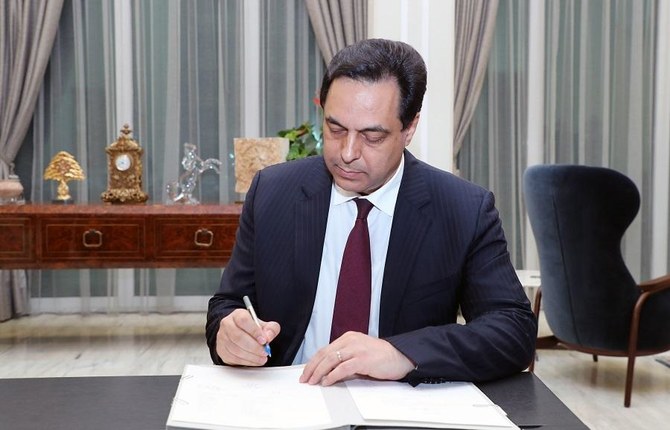
Prime Minister Hassan Diab is meeting with IMF experts amid Lebanon’s economic crisis. (File/AFP)
Short Url
Updated 20 February 2020
Follow

IMF experts visit Lebanon amid worsening economic crisis

  • IMF team will provide broad technical advice
  • Lebanon has not requested IMF financial assistance

BEIRUT: A team of IMF experts met Prime Minister Hassan Diab on Thursday at the start of a visit to provide Lebanon with advice on tackling a deepening financial and economic crisis, an official Lebanese source said.

The IMF has said the team will visit until Feb. 23 and provide broad technical advice. Lebanon has not requested financial assistance from the Fund.

The long-brewing economic crisis spiraled last year as capital flows into the country slowed and protests erupted against the ruling elite over decades of corruption and bad governance.

Diab’s government, which took office last month, must decide what to do about upcoming debt payments, notably a $1.2 billion dollar-denominated sovereign bond due on March 9.

Lebanese President Michel Aoun meanwhile said on Thursday measures would be taken to hold to account all those who contributed to Lebanon’s financial crisis through illegal actions be they transfers abroad, manipulation of Eurobonds or other acts.

“There is information that we are still in need of with regards to the banking situation. There are measures that we will take to hold to account all who participated in bringing the crisis to where it is,” Aoun said, according to his Twitter account.

Opinion

This section contains relevant reference points, placed in (Opinion field)

One of Lebanon’s most influential politicians, Parliament Speaker Nabih Berri, said on Wednesday that debt restructuring was the best solution for looming maturities.

Lebanon will on Friday review proposals from firms bidding to give it financial and legal advice on its options, a source familiar with the matter said on Thursday. The government aims to take a quick decision on who to appoint, the source said.

So far, firms bidding to be Lebanon’s legal adviser are Dechert, Cleary Gottlieb, and White and Case, the source said.

Lebanon has issued requests for proposals to seven firms to provide it with financial advice.

The government on Wednesday formed a committee tasked with preparing an economic recovery plan that includes ministers, government officials, a central bank representative and economists, according to a copy of a decree seen by Reuters.


Saudi Arabia leads outcome-based education to prepare future-ready generations: Harvard Business Review

A Harvard sign is seen at the Harvard University campus in Boston, Massachusetts, on May 27, 2025. (AFP)
Updated 10 February 2026
Follow

Saudi Arabia leads outcome-based education to prepare future-ready generations: Harvard Business Review

  • The Riyadh-based school group developed a strategy that links every classroom activity to measurable student competencies, aiming to graduate learners equipped for the digital economy and real-world contexts

RIYADH: Saudi Arabia’s education system is undergoing a sweeping transformation aligned with Vision 2030, shifting from traditional, input-focused methods to outcome-based education designed to equip students with future-ready skills, Harvard Business Review Arabic reported.

The transformation is being adopted and spearheaded by institutions such as Al-Nobala Private Schools, which introduced the Kingdom’s first national “learning outcomes framework,” aimed at preparing a generation of leaders and innovators for an AI-driven future, the report said.

Al-Nobala has leveraged international expertise to localize advanced learning methodologies.

The Riyadh-based school group developed a strategy that links every classroom activity to measurable student competencies, aiming to graduate learners equipped for the digital economy and real-world contexts. The school’s group approach combines traditional values with 21st-century skills such as critical thinking, communication, innovation and digital fluency.

According to the report, the shift addresses the growing gap between outdated models built for low-tech, resource-constrained environments and today’s dynamic world, where learners must navigate real-time information, virtual platforms, and smart technologies.

“This is not just about teaching content, it’s about creating impact,” the report noted, citing how Al-Nobala’s model prepares students to thrive in an AI-driven world while aligning with national priorities.

The report noted that Saudi Arabia’s Ministry of Education has paved the way for this shift by transitioning from a centralized controller to a strategic enabler, allowing schools such as Al-Nobala to tailor their curriculum to meet evolving market and societal needs. This is part of the long-term goal to place the Kingdom among the top 20 global education systems.

Al-Nobala’s work, the report stated, has succeeded in serving the broader national effort to link education outcomes directly to labor market demands, helping to fulfill the Vision 2030 pillar of building a vibrant society with a thriving economy driven by knowledge and innovation.

Last February, Yousef bin Abdullah Al-Benyan, Saudi Arabia’s minister of education, said that the Kingdom was making “an unprecedented investment in education,” with spending aligned to the needs of growth and development. He said that in 2025, education received the second-largest share of the state budget, totaling $53.5 billion.