

Poll recount confirms Ashraf Ghani as Afghan leader

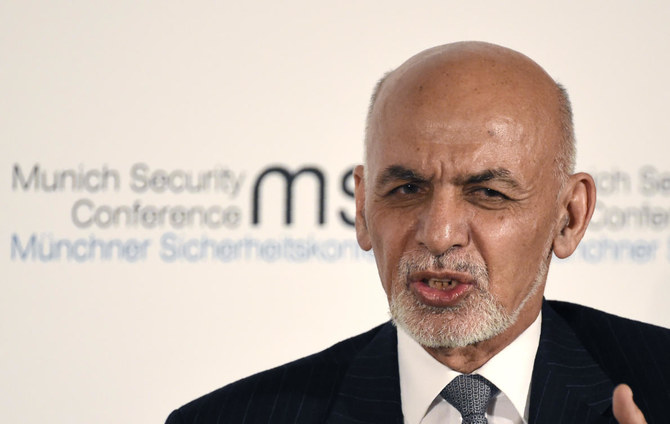
Afghan President Ashraf Ghani speaks on the second day of the Munich Security Conference in Munich, Germany, Saturday, Feb. 15, 2020. (AP)
Short Url
Updated 19 February 2020
Follow

Poll recount confirms Ashraf Ghani as Afghan leader

  • Audit ends five months after election marred by fraud, intimidation claims

KABUL: Afghanistan’s Independent Election Commission (IEC) on Tuesday confirmed President Ashraf Ghani as the winner of last year’s elections, more than five months after the polls closed.

IEC chief Hawa Alam Nuristani told a news conference in Kabul that Ghani had secured 923,592 votes, or 50.64 percent of the total.

Ghani’s rival, Afghanistan Chief Executive Abdullah Abdullah, gained 720,841 or 39.53 percent of the vote, she said.

The Sept. 28 election was disrupted by Taliban attacks, and marred by claims of intimidation, voting irregularities and fraud.

The IEC had failed on numerous occasions to announce the results in accordance with its election timeline. Two months ago, it said Ghani was on course to win a second term, prompting Abdullah to contest the long-delayed preliminary results.

HIGHLIGHT

Ashraf Ghani and Abdullah Abdullah have been sharing power based on a deal brokered by Washington following a highly disputed election in 2014.

He appealed to the Independent Electoral Complaints Commission, demanding the removal of about 300,000 votes allegedly fraudulent votes.

Nuristani said the IEC had declared Ghani the winner following a special audit and recount of the disputed ballots.

The declaration of Ghani’s win and leadership for another five years comes amid announcements by Taliban and US negotiators that a peace deal is expected to be signed within a few days. The agreement follows more than a year of talks in Doha, Qatar.

Ghani and Abdullah have been sharing power based on a deal brokered by Washington following a highly disputed election in 2014.

Both have had sharp differences over the issue of peace talks with the Taliban.


Ukraine toils to restore power and heat, Zelensky warns of new attack

Updated 8 sec ago
Follow

Ukraine toils to restore power and heat, Zelensky warns of new attack

  • Russia has systematically attacked Ukraine’s energy system since it invaded its neighbor in 2022 and the air strikes have intensified in recent months

KYIV: Emergency crews toiled to restore heat and power to beleaguered Kyiv residents on Monday, more than ​three days after Russian strikes on energy targets, and President Volodymyr Zelensky warned that new air attacks could be imminent.
Officials said hundreds of apartment blocks in the capital remained without heat despite round-the-clock efforts by the crews. Humanitarian centers, dubbed “resilience points,” were open for people to keep warm and charge electronic devices.
Russia has systematically attacked Ukraine’s energy system since it invaded its neighbor in 2022 and the air strikes have intensified in recent months.
Zelensky, speaking in ‌his nightly video ‌address, said a program was being launched to ‌raise ⁠wages ​and provide ‌support for participants in emergency work brigades.
He issued a new warning to heed air raid alerts as night-time temperatures sank to minus 15 Celsius (5 F) or lower.
“There is intelligence information. The Russians are preparing a new massive strike,” he said.
“Drones to exhaust air defense systems and missiles. They want to take advantage of the cold. The strike may occur in the coming days. Please take care of ⁠yourselves. Protect Ukraine.”
Deputy Prime Minister Oleksiy Kuleba, writing on Telegram, said 90 percent of Kyiv’s apartment buildings ‌have had heating restored, leaving fewer than 500 dwellings ‍still to be connected.
Mayor Vitali Klitschko ‍put the number with no heating at 800, most on the west ‍bank of the Dnipro River. He said a meeting of the Kyiv city council would be convened on Thursday to debate the most pressing issues facing residents.
Prime Minister Yulia Svyrydenko, presenting the program for bonus payments, said the work conducted by emergency ​crews stood “at the very limit of human endurance, often involving life-threatening risks across the entire country.
“This applies to specialists who, in freezing ⁠conditions, go directly to the sites of strikes and restore supplies of heat, electricity, water and gas.”
Residents made their way to one of the humanitarian centers on the east bank of the river in the evening — two tents pitched on a small area of open ground.
They charged their devices and chatted, while outside, the din of whining generators filled the air.
“It’s dark in the apartment. I have an electric stove, so it’s impossible to heat up lunch or dinner, or make tea,” said Kateryna Zubko, 67, an engineer who has lived without power, heating and water since the latest attack.
“We support each other. Ukrainians are such ‌resilient people, I think that this war will end someday, it can’t go on forever.”