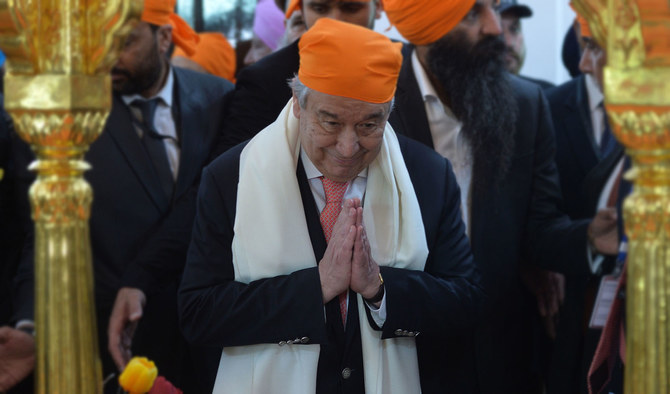
ISLAMABAD: United Nations Secretary General Antonio Guterres on Tuesday visited Pakistan’s flagship interfaith initiative, the Kartarpur Corridor, and paid homage to Guru Nanak who founded Sikhism five centuries ago.
“This is the best symbol that we can give for a world in peace and for a world (where) there is mutual respect and acceptance of what is different,” the UN Chief said while addressing a pool of journalists and officials.
Opened last year, the four-kilometer Kartarpur Corridor connects the Sikh shrine of Dera Baba Nanak Sahib in India’s Punjab region to the Gurdwara Darbar Sahib in Kartarpur, Pakistan. It allows Sikhs to visit the shrine in Pakistan without a visa. Some 5,000 Indian Sikhs have been allowed access daily.
“Recognizing the diversity is a blessing, is a richness not a threat which we see in so many parts of the world fighting in the name of religion. It is necessary to say that religions unite us for peace and the best symbol is this shrine,” Guterres said, adding that his visit was “to pay tribute to the contribution of the Sikh community all over the world for our planet.”
Guterres was given a tour of the gurdwara complex by a team of government officials led by Religious Affairs Minister Pir Noorul Haq Qadri.
The UN Chief arrived in Islamabad on Sunday as part of his four-day visit to the country to attend an international conference on Afghan refugees, held to mark four decades since Pakistan started hosting displaced persons escaping conflict plaguing neighboring Afghanistan.

UN chief visits Kartarpur Corridor, terms it 'symbol of peace'
https://arab.news/y63mu
UN chief visits Kartarpur Corridor, terms it 'symbol of peace'
- Guterres says the visit pays tribute to the contribution of Sikh community all over the world
- He arrived in Pakistan to attend a UN summit on Afghan refugees
Pakistan vaccinates over 44.6 million in final anti-polio drive of 2025
- Pakistan has reported 30 polio cases so far this year, underscoring fragile progress against virus
- Pakistan and Afghanistan are the only two countries in the world where polio remains endemic
ISLAMABAD: Pakistan has vaccinated 44.6 million children against poliovirus in the last nationwide immunization campaign of the year, health authorities said on Monday.
The seven-day anti-polio campaign was launched on Dec. 15, targeting children under the age of five. It was conducted simultaneously in Pakistan and Afghanistan, according to Pakistan’s National Emergency Operations Center (NEOC), which oversees eradication efforts.
Pakistan and neighboring Afghanistan are the only two countries where transmission of the wild poliovirus has never been interrupted, posing a risk to global eradication efforts. The virus, which can cause irreversible paralysis, has no cure and can only be prevented through repeated oral vaccination.
“The final National Polio Eradication Campaign of 2025 has been successfully concluded,” the EOC said in a statement. “During the national polio campaign, vaccination of more than 44.6 million children was successfully completed.”
Giving a breakdown of the numbers, the EOC said approximately 22.9 million children have received polio drops in Pakistan’s eastern Punjab province, around 10.6 million in Sindh, more than 7.1 million in the northwestern Khyber Pakhtunkhwa (KP) province and more than 2.54 million children in Balochistan.
In Pakistan’s capital Islamabad, over 450,000 children received polio drops while in the northern Gilgit-Baltistan region, approximately 274,000 children have been vaccinated, the NEOC said.
In Azad Jammu & Kashmir, over 714,000 children received polio drops.
Pakistan has reported 30 polio cases so far in 2025, underscoring the fragility of progress against the virus. The country recorded 74 cases in 2024, a sharp increase from six cases in 2023, reflecting setbacks linked to vaccine hesitancy, misinformation and access challenges in high-risk areas.
Health officials say insecurity remains a major obstacle. Polio workers and their security escorts have repeatedly been targeted in militant attacks, particularly in parts of Khyber Pakhtunkhwa and Balochistan, complicating efforts to reach every child.
A gun attack targeting a polio vaccination team in Pakistan’s northwestern Bajaur district on Dec. 16 left one police constableand a civilian dead.
Natural disasters, including flooding, have also disrupted vaccination campaigns in recent years.
“Polio workers and security personnel who served during the national campaign are the true heroes of the nation,” the EOC said.


