

IMF begins talks with Lebanese officials in effort to resolve nation’s financial crisis

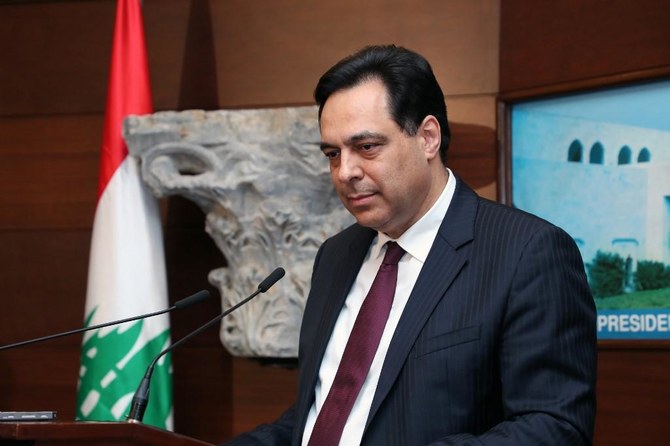
Prime Minister Hassan Diab will meet a delegation from the International Monetary Fund to discuss Lebanon's waning economy. (File/AFP)
Short Url
Updated 18 February 2020
Follow

IMF begins talks with Lebanese officials in effort to resolve nation’s financial crisis

  • International Monetary Fund will give advice but final decision rests with Lebanon’s government
  • As financial chaos continues, money changers are accused of profiteering, and robberies are more common

BEIRUT: Meetings between Lebanese officials and a delegation from the International Monetary Fund began on Tuesday in an attempt to find a solution to the nation’s financial crisis.

Lebanon asked the IMF six days ago for help to develop an economic rescue plan in light of a $1.2billion Eurobond debt that is due for repayment on March 9. It is the first of three looming debts due between now and June, worth $2.5bn in total, plus an additional $2bn in interest on a $30 billion debt portfolio.

The participants in the meetings will include Lebanese Prime Minister Hassan Diab, central bank Governor Riad Salameh and representatives of the Banking Control Commission of Lebanon.

“Lebanon’s economic and financial crisis is being addressed to mitigate its repercussions,” President Michel Aoun told the UK’s Senior Defense Adviser for Middle Eastern Affairs, Lt. Gen. Sir John Lorimer. “The IMF will provide its technical expertise in setting up a plan.

“The unstable situation in several Middle Eastern countries in general, and in Syria in particular, has negatively affected Lebanon.”

Amal Movement MP Yassin Jaber said: “Lebanon will wait for what the IMF delegation has to say. It will advise Lebanon and will not impose anything. It will then be up to the 20-minister cabinet to decide whether or not to take the advice.”

The economic uncertainty has caused chaos in the money markets, and anger at what many see as profiteering by the banks and money changers. They have hiked the exchange rate against the dollar to 2,500 Lebanese pounds, even though the official exchange rate remains at 1,507, and in defiance of an agreement to limit the rate to 2,000 pounds.

“The banks’ practices are a form of systematic fraud. They are confiscating the depositors’ money after having (imposed) high interest rates and reaped huge profits,” said MP Mohammad Kabbara.

Mahmoud Murad, the head of the Syndicate of Money Changers in Lebanon, said: “The 2,000 Lebanese pounds price that was agreed upon between the (syndicate) and Salameh after the new government received the parliament’s confidence did not last for more than a week. This is due to the competition from illegal money changers found on roads and in homes.”

Opinion

This section contains relevant reference points, placed in (Opinion field)

Judge Ali Ibrahim, Lebanon’s financial public prosecutor, on Tuesday filed charges against 18 money changers accused of “violating the currency-exchange law and harming the state’s financial prestige.”

“In its report published two years ago, the IMF said that the exchange rate of the Lebanese pound to the dollar is higher than its actual rate,” said economist Nassib Gabriel.

“In the opinion of the IMF, the political authority has to make a decision on paying the due debt and undergoing reforms. What is important is for the government to have a comprehensive rescue plan, and I do not think that we have enough time to decide on anything else other than paying the due amount.”

The dire economic situation in the country has provoked widespread protests, including demonstrations outside the Central Bank.

It has also sparked an increase in thefts and robberies, which was highlighted during the most recent Central Security Council meeting.

In one incident reported by the National News Agency, gunmen broke into the house of a man in Baalbek, in Bekaa Region, on Monday night and took him to a gas station he owns where they forced him to empty the safe.


Australia seeks charges over a 2024 Israeli airstrike in Gaza that killed an Australian aid worker

Updated 3 sec ago
Follow

Australia seeks charges over a 2024 Israeli airstrike in Gaza that killed an Australian aid worker

  • Australian Zomi Frankcom was one of four aid workers killed by an Israeli drone on April 1, 2024
MELBOURNE: Australia is demanding criminal charges over a 2024 Israeli airstrike on an aid convoy in Gaza that killed seven people, including an Australian aid worker, the country’s prime minister said Wednesday in a case that has drawn sweeping condemnation and strained relations between the two countries.
Prime Minister Anthony Albanese said he conveyed the request to visiting Israeli President Isaac Herzog during a meeting earlier in the day.
Australian Zomi Frankcom was one of four World Central Kitchen aid workers killed by an Israeli drone on April 1, 2024. The other aid workers were an American-Canadian dual citizen, a Palestinian and a Polish national. Three British security staff were also killed in the same airstrike.
There was no immediate response on Albanese’s request from Herzog, who visited the national capital, Canberra, on Wednesday after spending two days in Sydney, where he comforted Jews reeling from an antisemitic attack at Bondi Beach in December that left 15 dead.
Herzog’s visit triggers controversy
Though Australia’s major political parties largely back Herzog’s visit, Albanese spoke in Parliament on Wednesday to several lawmakers who opposed it, accusing the Israeli leader of inciting genocide in Gaza and inflaming community tensions within Australia.
The prime minister defended the visit and said it was an opportunity to “raise the issue” of the killed aid workers.
“That’s one of the reasons why you have dialogue in a respectful way; to get outcomes and to advance Australia’s national interests,” he told Parliament.
Four months after the aid convoy strike, an Australian inquiry found the airstrike resulted from procedural failures and errors on the part of the Israeli military.
Albanese said it was a “tragedy and an outrage” and that he made clear Australia’s “expectation that there be transparency about Israel’s ongoing investigation into the incident.”
“We continue to press for full accountability, including any appropriate criminal charges,” he added.
Israel’s president describes a ‘very emotional’ visit
Herzog told reporters that his visit has been “very emotional” in the wake of the suffering the Bondi massacre had caused Sydney’s Jewish community.
“It’s also an opportunity to bring the relations between our nations on a new beginning and a better future,” Herzog said outside Albanese’s office.
“I think the relations between us do not depend only on the issue of Israel and the Palestinians and the conflict but has a much broader base,” he added. “We should, together, make sure that it’s uplifted to new directions.”
Mainstream Jewish groups in Australia have welcomed the visit of Herzog, a former leader of the centrist Labour Party who now plays a largely ceremonial role.
Albanese and Herzog dined on Tuesday night at the prime minister’s official residence on Sydney Harbor before flying together to Canberra on Wednesday morning in an Australian air force jet.
Protests against Israel mark Herzog’s visit
Hundreds of demonstrators, some waving Palestinian flags, and several lawmakers gathered outside Parliament House to protest Herzog’s presence.
On Monday, as Herzog arrived in Sydney, thousands of demonstrators rallied there and also in downtown Melbourne. Australia’s two largest cities are home to 85 percent of Australia’s Jewish population.
Mehreen Faruqi, the Muslim deputy leader of the influential Greens party, told protesters outside Parliament House on Wednesday that Herzog was not welcome in Australia.
She condemned Albanese and New South Wales state Premier Chris Minns for police using pepper spray and aggressive tactics in clashes with protesters in Sydney on Monday. Police were given increased powers to arrest protesters due to Herzog’s visit.
“It is shameful that the premier of New South Wales and the prime minister of Australia are offering warm handshakes, photo opportunities and canapés to a war criminal, to a war criminal who has incited genocide, while those who are fighting for peace, who are protesting against the genocide, are attacked and assaulted and thrown to the ground,” Faruqi told the crowd, many of whom chanted “arrest Herzog.”
David Pocock, an independent senator and former captain of Australia’s rugby team, also joined the demonstration outside Parliament.
“It was the wrong decision to invite President Herzog at this time when we have seen so much strain on communities and tension in communities across the country,” Pocock told Australian Broadcasting Corp.
A heavy police presence at the Sydney rally on Monday prevented demonstrators marching from the Sydney Town Hall. Police arrested 27 demonstrators and charged nine, mostly with assaulting police.
Minns defended the police actions, saying that if the protesters had marched from the town hall, they might have clashed with thousands of mourners of the Bondi massacre who had gathered at an event with Herzog nearby.
Before returning to Israel, Herzog will visit Melbourne, where protests are planned for Thursday afternoon. In Melbourne, the Israeli president is to visit the ruins of the Adass Israel Synagogue, torched in late 2024.
Australia accused Iran of directing that arson attack and expelled Iranian Ambassador Ahmad Sadeghi last August.