

UN chief lauds Pakistan's 'generosity' at Islamabad summit on Afghan refugees

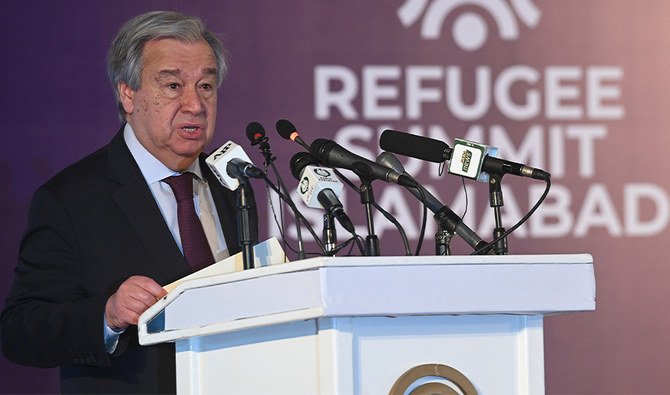
United Nations Secretary-General Antonio Guterres delivers a speech during the Refugee Summit Islamabad to mark 40 years of hosting Afghan refugee in Islamabad on February 17, 2020. (AFP)
Short Url
Updated 17 February 2020
Follow

UN chief lauds Pakistan's 'generosity' at Islamabad summit on Afghan refugees

  • Guterres praised Pakistan’s ‘exceptional generosity’ in sheltering refugees
  • Pakistan is the world’s second-largest host of refugees with over 2 million Afghans living in different parts of the country

ISLAMABAD: The United Nations chief urged the world to support Pakistan more in its efforts to shelter and protect Afghan refugees, as he spoke during a UN conference which started in Islamabad on Monday.
“I not only saw compassion in words but in deeds,” UN Secretary-General Antonio Guterres said while addressing the summit – “40 years of Afghan Refugees Presence in Pakistan – organized by the UN High Commissioner for Refugees (UNHCR).

“We must recognize that international support for Pakistan has been minimal compared to own national efforts,” Guterres said, as he acknowledged Islamabad’s efforts to provide access to education and health care to the refugee community, despite limited resources and little international support.

Pakistan is the world’s second-largest host of refugees with over 2 million Afghans living in different parts of the country since 1979 when the Soviet Union invaded Afghanistan.

“We have come together to recognize a remarkable story of solidarity and compassion ... it is important to do so because it is a story that spans over decades,” the UN chief said and observed that Pakistan’s compassion toward the displaced Afghans is “missing from much of the world.”

Top politicians and officials from 20 countries attend the conference, including UN High Commissioner for Refugees Filippo Grandi, US Special Envoy for Afghan Reconciliation Zalmay Khalilzad, and Afghan vice presidents Yunus Qanuni and Sarwar Danish.
In his opening remarks, Grandi said that “for Afghans, the story of their exile has been a long and painful one” and it “will not be complete until solutions can be found back in their own country.”

Only 8,000 refugees were able to return home through the voluntary repatriation program, he said. “For some refugees, nonetheless, solutions can be possible, even in these difficult circumstances. And I commend the commitment of the government of Afghanistan to the return and reintegration of its nationals.”
Speaking on the occasion, Prime Minister Imran Khan said that Pakistan too wanted their “honorable repatriation,” while it was doing its best to provide all the necessary facilities to the refugees as well as “the best ever support” to the Afghan peace process. 
In reference to comments by Sarwar Danish, Afghanistan’s second vice president, who during the conference accused Pakistan of allowing insurgents to recruit fighters from Afghan refugee camps in the country, Khan said Pakistan is no longer a “safe haven” for militants. 

“Whatever the situation might have been in the past, right now, I can tell you ... there is one thing we want: peace in Afghanistan,” he said.


Pakistan cricket chief says boycott of India match aimed at restoring Bangladesh’s dignity

Updated 7 sec ago
Follow

Pakistan cricket chief says boycott of India match aimed at restoring Bangladesh’s dignity

  • Mohsin Naqvi says Pakistan sought to highlight Bangladesh’s grievances in World Cup dispute
  • His comments come a day after Pakistan reversed decision to boycott the Feb. 15 India clash

ISLAMABAD: Pakistan’s decision to briefly threaten a boycott of its Twenty20 World Cup match against India was intended to highlight what it saw as unfair treatment of Bangladesh and to press for the concerns raised by Bangladeshi officials to be addressed, Pakistan Cricket Board Chairman Mohsin Naqvi said on Tuesday.

Pakistan withdrew its decision a day earlier to skip the Group A clash scheduled for Feb. 15 in Colombo, ending a week-long standoff with the International Cricket Council (ICC) that had drawn intervention from several member boards amid fears of disruption to the tournament.

“Our objective was only to ensure that Bangladesh was treated with dignity and that the injustice done to them was highlighted,” Naqvi told journalists in Peshawar. “You saw that whatever points Bangladesh raised were accepted. That’s it. We had no personal agenda of our own in this.”

Bangladesh had raised security concerns about playing its World Cup matches in India amid political tensions between the two countries and sought the relocation of its fixtures to Sri Lanka, a request that was turned down by the ICC. Subsequently, Bangladesh chose to withdraw from the tournament and were replaced by Scotland instead.

Pakistan cited Bangladesh’s removal from the original schedule as unjust when it initially instructed its team not to face India, a move that would have resulted in a forfeiture.

The decision led to a crisis situation since the India-Pakistan match is the biggest and most lucrative clash in the world of cricket, leading to a frantic weekend of negotiations.

The reversal allows Pakistan to proceed with the marquee India match after Bangladesh’s concerns were accommodated by the ICC, Naqvi said.

Pakistan, who edged past the Netherlands in their opening game, face the United States today in Group A, with India set to travel to Colombo for the Feb. 15 clash.

Pakistan and India, bitter political rivals, have not played bilateral cricket for more than a decade and meet only at global tournaments at neutral venues.