

UN chief lauds Pakistan's 'generosity' at Islamabad summit on Afghan refugees

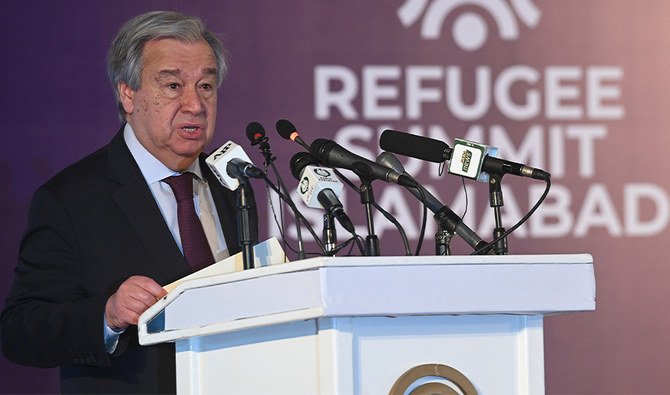
United Nations Secretary-General Antonio Guterres delivers a speech during the Refugee Summit Islamabad to mark 40 years of hosting Afghan refugee in Islamabad on February 17, 2020. (AFP)
Short Url
Updated 17 February 2020
Follow

UN chief lauds Pakistan's 'generosity' at Islamabad summit on Afghan refugees

  • Guterres praised Pakistan’s ‘exceptional generosity’ in sheltering refugees
  • Pakistan is the world’s second-largest host of refugees with over 2 million Afghans living in different parts of the country

ISLAMABAD: The United Nations chief urged the world to support Pakistan more in its efforts to shelter and protect Afghan refugees, as he spoke during a UN conference which started in Islamabad on Monday.
“I not only saw compassion in words but in deeds,” UN Secretary-General Antonio Guterres said while addressing the summit – “40 years of Afghan Refugees Presence in Pakistan – organized by the UN High Commissioner for Refugees (UNHCR).

“We must recognize that international support for Pakistan has been minimal compared to own national efforts,” Guterres said, as he acknowledged Islamabad’s efforts to provide access to education and health care to the refugee community, despite limited resources and little international support.

Pakistan is the world’s second-largest host of refugees with over 2 million Afghans living in different parts of the country since 1979 when the Soviet Union invaded Afghanistan.

“We have come together to recognize a remarkable story of solidarity and compassion ... it is important to do so because it is a story that spans over decades,” the UN chief said and observed that Pakistan’s compassion toward the displaced Afghans is “missing from much of the world.”

Top politicians and officials from 20 countries attend the conference, including UN High Commissioner for Refugees Filippo Grandi, US Special Envoy for Afghan Reconciliation Zalmay Khalilzad, and Afghan vice presidents Yunus Qanuni and Sarwar Danish.
In his opening remarks, Grandi said that “for Afghans, the story of their exile has been a long and painful one” and it “will not be complete until solutions can be found back in their own country.”

Only 8,000 refugees were able to return home through the voluntary repatriation program, he said. “For some refugees, nonetheless, solutions can be possible, even in these difficult circumstances. And I commend the commitment of the government of Afghanistan to the return and reintegration of its nationals.”
Speaking on the occasion, Prime Minister Imran Khan said that Pakistan too wanted their “honorable repatriation,” while it was doing its best to provide all the necessary facilities to the refugees as well as “the best ever support” to the Afghan peace process. 
In reference to comments by Sarwar Danish, Afghanistan’s second vice president, who during the conference accused Pakistan of allowing insurgents to recruit fighters from Afghan refugee camps in the country, Khan said Pakistan is no longer a “safe haven” for militants. 

“Whatever the situation might have been in the past, right now, I can tell you ... there is one thing we want: peace in Afghanistan,” he said.


ADB, Pakistan sign over $300 million agreements to undertake climate resilience initiatives

Updated 30 December 2025
Follow

ADB, Pakistan sign over $300 million agreements to undertake climate resilience initiatives

  • Pakistan ranks among nations most vulnerable to climate change and has seen erratic changes in weather patterns
  • The projects in Sindh and Punjab will restore nature-based coastal defenses and enhance agricultural productivity

ISLAMABAD: The Pakistani government and the Asian Development Bank (ADB) have signed more than $300 million agreements to undertake two major climate resilience initiatives, Pakistan’s Press Information Department (PID) said on Tuesday.

The projects include the Sindh Coastal Resilience Sector Project (SCRP), valued at Rs50.5 billion ($180.5 million), and the Punjab Climate-Resilient and Low-Carbon Agriculture Mechanization Project (PCRLCAMP), totaling Rs34.7 billion ($124 million).

Pakistan ranks among nations most vulnerable to climate change and has seen erratic changes in its weather patterns. In 2022, monsoon floods killed over 1,700 people, displaced another 33 million and caused over $30 billion losses, while another 1,037 people were killed in floods this year.

The South Asian country is ramping up climate resilience efforts, with support from the ADB and World Bank, and investing in climate-resilient infrastructure, particularly in vulnerable areas.

“Both sides expressed their commitment to effectively utilize the financing for successful and timely completion of the two initiatives,” the PID said in a statement.

The Sindh Coastal Resilience Project (SCRP) will promote integrated water resources and flood risk management, restore nature-based coastal defenses, and strengthen institutional and community capacity for strategic action planning, directly benefiting over 3.8 million people in Thatta, Sujawal, and Badin districts, according to ADB.

The Punjab project will enhance agricultural productivity and climate resilience across 30 districts, improving small farmers’ access to climate-smart machinery, introducing circular agriculture practices to reduce residue burning, establishing testing and training facilities, and empowering 15,000 women through skills development and livelihood diversification.

Earlier this month, the ADB also approved $381 million in financing for Pakistan’s Punjab province to modernize agriculture and strengthen education and health services, including concessional loans and grants for farm mechanization, Science, Technology, Engineering and Mathematics (STEM) education, and nursing sector reforms.