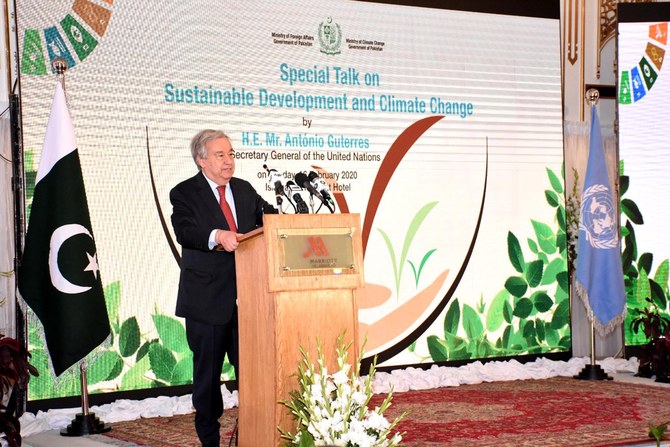
ISLAMABAD: United Nations chief Antonio Guterres, who arrived in Islamabad on Sunday morning, said that waters shared by Pakistan and India must be a tool for peace and not war while addressing a conference on climate change in the capital.
Last year, when tensions between the two countries reached a tipping point, the UN chief was told by Foreign Minister Shah Mahmood Qureshi that India had hinted toward abandoning the 1960 water-sharing agreement brokered by the World Bank-- the Indus Waters Treaty-- which could potentially start a water war.
“Water must be an instrument of peace and not an instrument of conflict,” the UNSG said, referring to heightened security issues between the two nuclear-armed South Asian neighbors-- which have historically resulted in allegations of the critical river sharing agreement is being violated.
“I would ask the two countries to have clear cooperation in relation to water. And I have some moral authority,” the UN chief went on to say and added that as Prime Minister of Portugal, he had spearheaded a water-sharing agreement with neighboring Spain.
“If one country thinks [it can] solve the problem by letting others in a bad situation... in the end, things turn against everybody.”
On Sunday, Guterres said 80 percent of the water used for agriculture by Pakistan-- an agriculture-based economy-- was at risk because of climate change.
He added it was unfair that Pakistan was at the frontline of climate change’s negative impacts while contributing little to global environmental damage.
Guterres also appreciated Pakistan’s hospitality for hosting Afghan refugees for four decades and expressed solidarity with the people of Pakistan. He commended Pakistan for being the first to embrace sustainable global development goals but warned that there was an urgent need to meet the 2030 deadline in order to offset a grave climate crisis.
“SDGs must be fulfilled by 2030. The world needs to reduce carbon emission levels. Our planet is burning and too many politicians continue to fiddle. We have to move from grey to a green economy,” the UNSG said, terming it a “climate emergency.”
Following an opening keynote speech by the Minister for Climate Change, the adviser to PM on the topic, Amin Aslam, highlighted the dangers Pakistan faces and the government’s five-point agenda to address the core issues of climate change.
Speaking to a house full of climate change activists, officials, foreign dignitaries, and journalists, Aslam said the Prime Minister’s first priority was to set an agenda for climate change as part of his party’s manifesto before coming to power with the ‘Billion Tree Tsunami Project’ for reforestation verified as an achievement by global environment agencies.
Pakistan has a 2030 goal to achieve 30 percent clean energy through renewable projects and 30 percent through hydro projects.
Guterres arrived in Islamabad for his first visit as part of a four-day visit to the country to attend an international conference on Afghan refugees which is being hosted by Pakistan.
The two-day event, from February 17 to 18, will mark four decades since the refugees first moved to Pakistan to escape a decades-old conflict plaguing neighboring Afghanistan after the Soviet invasion of 1979.


![]()

Water must be 'instrument of peace' between India, Pakistan — UN chief
Short Url
https://arab.news/wxn9x
Water must be 'instrument of peace' between India, Pakistan — UN chief
- Last year, Pakistan told UN chief India had hinted at abandoning 1960 water-sharing treaty
- Says 80 percent of country’s water for agriculture at risk due to climate change
Latest updates


© 2026 SAUDI RESEARCH & PUBLISHING COMPANY, All Rights Reserved And subject to Terms of Use Agreement.