

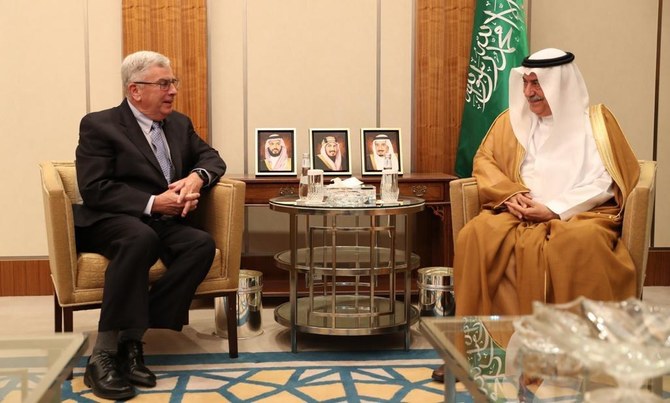

RIYADH: “We have a good marriage,” said US Ambassador John Abizaid, summing up Saudi-American ties during a roundtable discussion with journalists to mark the 75th anniversary on Feb. 14 of the historic meeting between King Abdul Aziz and US President Franklin D. Roosevelt on board the USS Quincy.
“This isn’t to say we’ve had the perfect marriage. We’ve had a normal marriage, more good than bad. But we look forward to another 75 years of a great relationship.”
The passage of time has naturally seen up and downs in the relationship, but since that meeting between Saudi Arabia’s founding monarch and the US president, Washington has been a steady strategic partner of Riyadh.
“Of course there are always fits and starts in any relationship, but we look to the future. We want to be your primary partner as you move forward in achieving the crown prince’s Vision 2030 goals,” Abizaid said. “We’re very confident that we can be your partner.”
Vision 2030 is built on three pillars — a vibrant society, a thriving economy and an ambitious nation — that draw on Saudi Arabia’s intrinsic strengths to help its citizens realize their aspirations and potential.
The National Transformation Program aims to develop governmental work and establish the needed infrastructure to achieve Vision 2030’s ambitions and 96 strategic objectives.
With the Kingdom opening up and businesses thriving, more countries want to take part in the transformation and help Saudi Arabia realize its reform objectives.
“We know we have to compete with the Chinese, the Russians, the French, the British and everybody else, but that’s OK because we’ve had a special partnership for so long,” Abizaid said.
“We’ve been through so many things together. We’re very comfortable that we can move through all the challenges that we have, and 75 years from now we’ll be having the 150th anniversary, so we look forward to that.”

Regarding the tourist e-visa that saw the Kingdom open its doors to visitors in October 2019, Abizaid said: “The last time I checked, we were in third place (in terms of the number of tourists). (In) first (position were) the Chinese.”
Pointing to the recent visit by a group of Americans from Houston, Texas, on tourist visas, he said: “They came for a cultural enrichment tour of Saudi Arabia. We shared with them some of our perspectives on what’s going on here. People are coming (to the Kingdom).”
With the coronavirus threat casting a long shadow over international air travel, tourism might not be at its peak right now, he said, adding: “Once we get past the coronavirus issue, I think you’ll see a pickup in American tourism.”
Abizaid said he is working with Princess Reema bint Bandar, Saudi Arabia’s ambassador to the US, to make sure more Americans get a chance to experience the Kingdom first-hand.
American tourists “come with an idea that’s shaped by some negative publicity,” but “they quickly see that people are friendly, people are extremely hospitable, that there are changes that are making Saudi Arabia a better place for its own people. And they leave impressed,” he added.
Looking to the future of Saudi-US ties, Abizaid said: “As we go into the next 75 years, we want there to be a more equal exchange of people.”
Currently, there are 40,000 Saudi students in the US and a very small number of American students in the Kingdom.
“Some of your universities have achieved extremely high levels of capability,” Abizaid said, citing King Abdullah University for Science and Technology (KAUST) as an example.
“It’s time that we bring in American students over here to study, learn the language, learn the culture.”
Abizaid spoke of commemorating the 75th anniversary of US-Saudi ties in a novel way. “I was at KAUST the other day. It’s a world-class university. See this theme of 75, (we’re) looking to get 75 Americans to come over in 2021 to be part of the experience of KAUST. We very much support that,” he said.


