

DiplomaticQuarter: Mauritius ambassador praises Kingdom’s humanitarian efforts

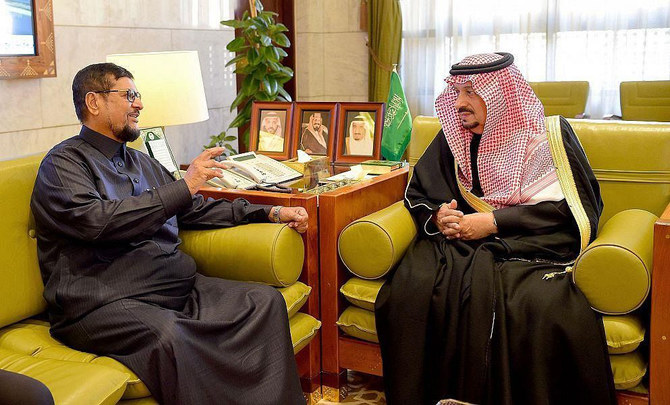
Mauritius ambassador meets Riyadh Gov. Prince Faisal bin Bandar. (SPA)
Short Url
Updated 13 February 2020
Follow

DiplomaticQuarter: Mauritius ambassador praises Kingdom’s humanitarian efforts

RIYADH: Mauritius Ambassador to Saudi Arabia Shaukat Ali Soudhan held talks with Riyadh Gov. Prince Faisal bin Bandar on strengthening cooperation between the two countries.

Soudhan also met Abdullah Al-Rabeeah, supervisor general of the King Salman Humanitarian Aid and Relief Center (KSRelief) to discuss joint issues in humanitarian and relief efforts and to review KSRelief programs in Mauritius.

The envoy praised KSRelief’s delivery of aid to crisis-affected people around the world, and thanked the Kingdom for its assistance to the people of Mauritius.

Saudi Arabia is among the largest global donors of aid. In November 2019, the Kingdom confirmed that it has provided nearly $18 billion of humanitarian assistance to help refugees.

The Mauritius ambassador also met Saudi Minister of State for Foreign Affairs Adel Al-Jubeir.

Saudi Arabia and Mauritius are developing closer ties, with Soudhan saying his country had benefited from a 400 percent increase in the number of Saudi tourists in the past two years following the opening of direct flights.

Soodhun said the Kingdom had changed dramatically since 2015. “There is more justice, liberty and discipline, and a more responsible population is evolving as Saudi youth join the labor market, occupying different jobs and standing on their own feet,” he said.


Saudi Arabia has told Iran not to attack it, warns of possible retaliation, sources say

Updated 08 March 2026
Follow

Saudi Arabia has told Iran not to attack it, warns of possible retaliation, sources say

Saudi Arabia has told Tehran that while it favors a diplomatic settlement to Iran’s conflict with the United States, continued attacks on the kingdom and ​its energy sector could push Riyadh to respond in kind, four sources familiar with the matter told Reuters.

The message was conveyed before a speech on ‌Saturday in which Iranian President Masoud Pezeshkian apologized to neighboring Gulf states for Tehran’s actions – an apparent attempt to defuse regional anger over Iranian strikes that hit civilian targets.

Two days earlier, Saudi Foreign Minister Prince Faisal bin Farhan spoke to Iranian Foreign Minister Abbas Araghchi and set out Riyadh’s position with clarity, the sources said.

Saudi Arabia is open to any form of mediation aimed at de‑escalation and a negotiated settlement, the sources quoted ​the minister as saying, underlining that neither Riyadh nor other Gulf states had let the US use their airspace or territory to launch airstrikes on Iran.

But Prince ​Faisal was also quoted by the sources as saying that if Iranian attacks persisted against Saudi territory or energy infrastructure, Saudi Arabia would ⁠be forced to permit US forces to use their bases there for military operations. Riyadh would retaliate if attacks on the kingdom’s critical energy facilities continued, he said.

The sources said ​the kingdom had remained in regular contact with Tehran through its ambassador since the US and Israeli military campaign against Iran began on February 28 following the collapse of talks on ​Iran’s nuclear program.

The Saudi and Iranian foreign ministries did not respond to requests for comment.

Drone and missile attacks on Gulf states

The United Arab Emirates, Kuwait, Qatar, Bahrain and Saudi Arabia have all come under heavy drone and missile fire from Iran over the past week.

Iran’s Supreme Leader, Ayatollah Ali Khamenei, was killed on the first day of the war. Tehran responded by hitting Israel and Gulf Arab states hosting US military installations, ​and Israel has attacked Lebanon’s Iran-backed Hezbollah armed group.

Araghchi said in an interview on Saturday that he remained in constant contact with his Saudi counterpart and other Saudi officials, adding ​that Riyadh had assured Tehran it was fully committed to not allowing its territory, waters or airspace to be used for attacks against Iran.

Pezeshkian said Iran’s temporary leadership council had approved suspending attacks on ‌nearby countries – unless ⁠an attack on Iran came from those nations.

“I personally apologize to neighboring countries that were affected by Iran’s actions,” he said.

To what extent Pezeshkian’s remarks signal a change is unclear. There were further reports of strikes directed at Gulf states on Saturday.

Also, in a sign of possible divisions within Iran’s leadership, Khatam Al-Anbiya Central Headquarters – the unified combatant command of the Iranian armed forces – said in a statement afterwards that US and Israeli bases and interests across the region would remain targets.

The command said Iran’s armed forces respected the sovereignty and interests of ​neighboring states and had not taken action against ​them so far. But it said US ⁠and Israeli military bases and assets on land, at sea and in the air across the region would be treated as primary targets and face “powerful and heavy” strikes by Iran’s forces.

US President Donald Trump said in a social media post that Iran had “apologized and surrendered to its Middle ​East neighbors, and promised that it will not shoot at them anymore. This promise was only made because of the relentless US ​and Israeli attack.”

Two Iranian ⁠sources confirmed that a call had taken place in which Riyadh warned Tehran to halt attacks on Saudi Arabia and neighboring Gulf states. Iran, they said, reiterated its position that the strikes were not aimed at Gulf countries themselves but at US interests and military bases hosted on their territory.

One Iranian source said that Tehran had in response demanded that US bases in the region be ⁠closed and ​some Gulf states stop sharing intelligence with Washington that Iran believes is being used to carry out attacks against it.

Another ​Iranian source said some military commanders were pressing to continue the strikes, accusing the US of using bases in Gulf states and these countries’ airspace to conduct operations against Iran.

Iran had in recent years mended fences with its ​Gulf neighbors, including former regional archrival Saudi Arabia. The diplomatic campaign imploded in the blitz of drones and missiles launched by Iran’s Revolutionary Guards in the past week.