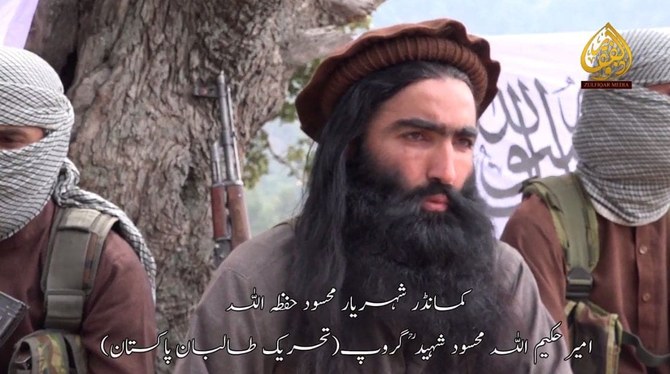
PESHAWAR: Days after the killing of two Tehrik-e-Taliban Pakistan (TTP) commanders in Afghanistan, another dreaded leader of the group, Sheheryar Mehsud, died in a blast in the eastern Afghan province of Kunar on Wednesday evening, tribesman and militants confirmed.
“Sheheryar (Mehsud) is also gone,” a Mehsud tribesman, who received confirmation about the death, told Arab News on condition of anonymity.
The militant was killed by a roadside improvised explosive device (IED).
Last week, two top TTP commanders – Sheikh Khalid Haqqani and Qari Saifullah Peshawari – were killed, reportedly in a clash with security forces in Afghanistan.
According to a statement by Nusratullah Nusrat, self-proclaimed spokesman of the TTP’s Hakimullah Mehsud group, “the leader of Hakimullah Mehsud group, Sheheryar Mehsud has achieved the status of martyr.”
He added the group had appointed Maulana Wali Muhammad alias Umari as its new chief.
Journalist Adnan Bitani who has extensively covered militancy in the region said that the killing of Mehsud will deal a severe blow to his faction within the TTP.
He said Mehsud was relatively close to Lashkar-e-Jhangvi and Al-Qaeda remnants because of his matchless trust and reputation within the TTP.
“After Sheikh Khalid Haqqani, Sheheryar Mehsud had strong position within the group. His killing has left huge vacuum,” Bitani said.
Mehsud, a South Waziristan native in his early 40s, rose to prominence in TTP following the killing of Hakimullah Mehsud in a drone strike in North Waziristan tribal district in November 2013, after which Mullah Fazlullah took over as the group’s top commander.
Aggressive and well-built, he was closely associated with Hakimullah, the tribesman said. The recent killing will ultimately strengthen the position of Mehsud’s rival, Noor Wali Mehsud.
Noor Wali took over TTP leadership in 2018, following the killing of Fazlullah in Afghanistan.
Last year, the United States designated him as a global terrorist.

Top Pakistani Taliban leader killed in Afghanistan
https://arab.news/mnebs
Top Pakistani Taliban leader killed in Afghanistan
- Two other TTP commanders were killed in Afghanistan last week
- Mehsud’s death will strengthen the position of his rival, Noor Wali
Pakistan has ruled out military operation in northwestern Tirah Valley
- Residents in northwestern Tirah Valley fled their homes this month fearing a military operation against militants
- Defense minister says army conducting intelligence-based operations in area, residents’ migration “routine” practice
Islamabad: Defense Minister Khawaja Asif on Tuesday clarified that the military was not conducting a military operation in the northwestern Tirah Valley, saying that the ongoing residents’ migration from the area was a routine practice that has been going on for several years.
The defense minister’s clarification came as residents of Tirah Valley in Pakistan’s northwestern Khyber Pakhtunkhwa (KP) province bordering Afghanistan fled their homes this month, fearing a planned military operation by the army against militants, particularly the Tehreek-e-Taliban Pakistan (TTP) group.
Pakistan’s information ministry on Sunday issued a clarification that the armed forces were not involved in the “depopulation” of the valley. It pointed to a notification from the provincial Khyber Pakhtunkhwa Relief, Rehabilitation and Resettlement Department in December which demanded the release of funds, reportedly Rs4 billion [$14.24 million], for the voluntary movement of people from Tirah Valley.
Speaking to reporters at a news conference alongside Information Minister Attaullah Tarar and Special Assistant to the PM for Information and KP Affairs Ikhtiar Wali Khan, Asif said the last military operation in the area was conducted several years ago. He said the military had decided that intelligence-based operations (IBOs) were more effective than military operations as they resulted in lower civilian casualties.
“So over a long period of time, the army gave up [military] operation in favor of IBOs,” Asif said. “For many years this practice has been continuing. Hence, there is no question of an operation there.”
The defense minister described the migration of residents from Tirah Valley as a “routine” practice due to the harsh cold.
He criticized the provincial government, led by the Pakistan Tehreek-e-Insaf (PTI) party for not serving the people of the area, accusing it of not building any schools, hospitals, or police stations in Tirah Valley.
Asif said around 400-500 TTP members lived in the valley with their families, alleging that hemp was being harvested there on over 12,000 acres of land. He said that while hemp is also used for medicinal and construction purposes, its dividends were going to militants and politicians.
“All of this hemp is harvested there and the dividends from it either go to the people associated with politics or the TTP,” the minister said.
“We have initiated the process to stop this so that the people benefit from this harvest and so that schools and hospitals are constructed there.”
The minister said that a district-level jirga or tribal council met representatives of the KP government on Dec. 11, 24 and 31 to decide matters related to the residents’ migration in the area.
Holding up the KP Relief, Rehabilitation and Resettlement Department notification, Asif said:
“In the presence of this notification, in the presence of this tribal council and in the presence of all of these things, where do you see the army?“
The minister accused the provincial government of deflecting its “failures” in the province to the armed forces or to a military operation that did not exist.
The migration has exposed tensions between the provincial government and the military establishment over the use of force in the region.
KP Law Minister Aftab Alam Afridi said earlier this month that the provincial government will not allow a military operation to take place in the area, arguing that past military campaigns had failed to deliver lasting stability.


