

US accuses Iran of developing missiles through satellite bid, vows ‘enormous pressure’

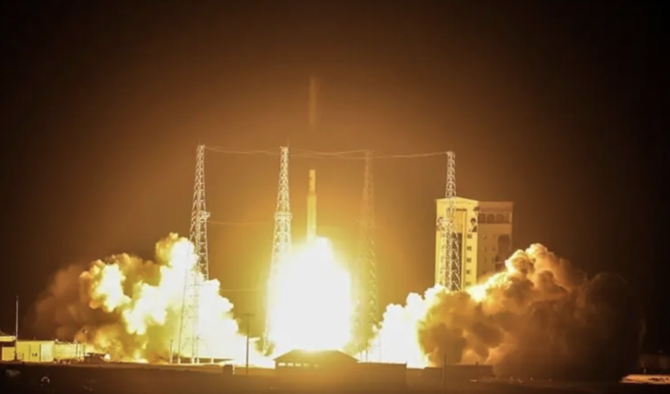
Iranian "Phoenix" rocket launched from Khomeini Spaceport in the country's Semman province failed to put the Zafar 1 communications satellite into orbit. (Iranian Defense Ministry via AP)
Short Url
Updated 11 February 2020
Follow

US accuses Iran of developing missiles through satellite bid, vows ‘enormous pressure’

  • On Sunday, an Iranian "Phoenix" rocket failed to launch a satellite
  • Pompeo releases statement on Iran's "reckless ballistic missile activity"

WASHINGTON: The US accused Iran of developing missiles through satellite bid and vowed 'enormous pressure' on Tuesday.

On Sunday, an Iranian "Phoenix" rocket launched from Khomeini Spaceport in the country's Semman province failed to put the Zafar 1 communications satellite into orbit due to low speed.

In a State Department statement, US Secretary of State Mike Pompeo said: "The Iranian regime uses satellite launches to develop its ballistic missile capabilities, the technologies used to launch satellites into orbit are virtually identical and interchangeable with those used in longer range systems, including intercontinental ballistic missiles. 

“Each launch, whether failed or not, further allows Iran to gain experience using such technologies that could benefit its missile programs under the guise of a peaceful space program.

Pompeo further criticised the 2015 Joint Comprehensive Plan of Action nuclear deal, which President Donald Trump pulled the US out of in 2018 while slapping sweeping sanctions on Iran.

“Iran’s series of space launches reflects the failure of the Iran deal to constrain testing that could support further advancement of Iran’s ballistic missile program, the Iran deal lifted the prohibition on Iran’s missile testing and development of systems capable of delivering nuclear weapons and we are seeing the dangerous consequences today. 

Tensions between Washington and Tehran soared last month after Trump ordered a drone strike that killed a top Iranian general, Qassem Soleimani, as he visited Iraq, where Iranian-allied Shiite militias had fired rockets on bases housing US troops.

“The world’s leading state sponsor of terrorism should not be allowed to develop and test ballistic missiles. This common sense standard must be restored by the international community.

“The United States will continue to build support around the world to confront the Iranian regime’s reckless ballistic missile activity, and we will continue to impose enormous pressure on the regime to change its behavior,” he added.

(With AFP)


UN rights chief shocked by ‘unbearable’ Darfur atrocities

Updated 10 min 31 sec ago
Follow

UN rights chief shocked by ‘unbearable’ Darfur atrocities

  • Mediation efforts have failed to produce a ceasefire, even after international outrage intensified last year with reports of mass killings, rape, and abductions during the RSF’s takeover of El-Fasher in Darfur

PORT SUDAN: Nearly three years of war have put the Sudanese people through “hell,” the UN’s rights chief said on Sunday, blasting the vast sums spent on advanced weaponry at the expense of humanitarian aid and the recruitment of child soldiers.
Since April 2023, Sudan has been gripped by a conflict between the army and the paramilitary Rapid Support Forces that has left tens of thousands of people dead and around 11 million displaced.
Speaking in Port Sudan during his first wartime visit, UN Human Rights commissioner Volker Turk said the population had endured “horror and hell,” calling it “despicable” that funds that “should be used to alleviate the suffering of the population” are instead spent on advanced weapons, particularly drones.
More than 21 million people are facing acute food insecurity, and two-thirds of Sudan’s population is in urgent need of humanitarian aid, according to the UN.
In addition to the world’s largest hunger and displacement crisis, Sudan is also facing “the increasing militarization of society by all parties to the conflict, including through the arming of civilians and recruitment and use of children,” Turk added.
He said he had heard testimony of “unbearable” atrocities from survivors of attacks in Darfur, and warned of similar crimes unfolding in the Kordofan region — the current epicenter of the fighting.
Testimony of these atrocities must be heard by “the commanders of this conflict and those who are arming, funding and profiting from this war,” he said.
Mediation efforts have failed to produce a ceasefire, even after international outrage intensified last year with reports of mass killings, rape, and abductions during the RSF’s takeover of El-Fasher in Darfur.
“We must ensure that the perpetrators of these horrific violations face justice regardless of the affiliation,” Turk said on Sunday, adding that repeated attacks on civilian infrastructure could constitute “war crimes.”
He called on both sides to “cease intolerable attacks against civilian objects that are indispensable to the civilian population, including markets, health facilities, schools and shelters.”
Turk again warned on Sunday that crimes similar to those seen in El-Fasher could recur in volatile Kordofan, where the RSF has advanced, besieging and attacking several key cities.
Hundreds of thousands face starvation across the region, where more than 65,000 people have been displaced since October, according to the latest UN figures.