

PetroChina cuts crude runs as coronavirus hits demand

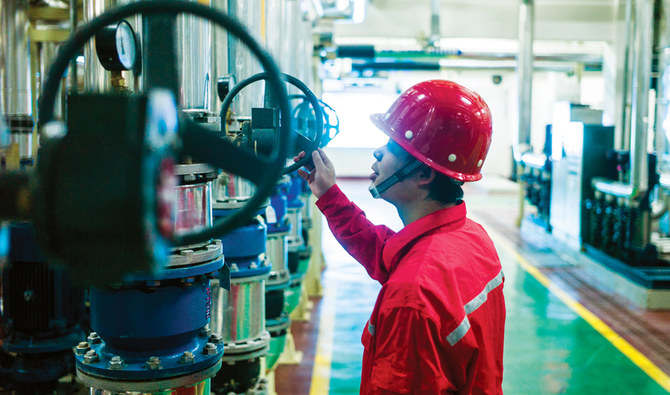
Chinese state-run energy giant Sinopec, Asia’s largest refiner, is cutting its throughput by 600,000 bpd, or 12 percent of its average crude runs, its deepest reduction in more than a decade. (AFP)
Short Url
Updated 11 February 2020
Follow

PetroChina cuts crude runs as coronavirus hits demand

  • State refiner in talks with suppliers such as Saudi Arabia and UAE about deferring cargo loadings

SINGAPORE: PetroChina, China’s second-biggest state refiner, plans to reduce its crude throughput by 320,000 barrels per day (bpd) this month versus its original plan as the coronavirus hits fuel demand, a company official told Reuters on Monday.

PetroChina’s planned February cut is equivalent to about 10 percent of the refiner’s average production rate of about 3.32 million bpd.
This would bring total production scalebacks by state refiners, include Sinopec Corp. and China National Offshore Oil Company, to about 940,000 bpd for this month.

The cuts from PetroChina are likely to be deepened to 377,000 bpd in March, said the senior company official with direct knowledge of the matter. He declined to be named as he is not authorized to speak to the press.

Reuters reported last week that Sinopec Corp, Asia’s largest refiner, is cutting its throughput this month by 600,000 bpd, or 12 percent of its average crude runs, its deepest reduction in morer than a decade. Independent Chinese refiners in Shandong, meanwhile, have slashed output to below half their capacity.

“The production cuts are mostly on refineries in northeast and north China, where demand is hit harder than in the western parts of the country,” said the PetroChina official.

PetroChina started the production cuts at the beginning of the month, but deepened them on Monday, the official said.

PetroChina did not immediately respond to a request for comment.

PetroChina is talking with its key long-term suppliers such as Saudi Arabia, Kuwait and the UAE about possibly deferring cargo loadings or trimming loading volumes, the official said, without giving further details.

“We’re monitoring the market on a daily basis. But from what we’ve observed now, there seems little chance for a fuel demand recovery in March,” the official said.


QatarEnergy secures offshore exploration license in Libya

Updated 11 sec ago
Follow

QatarEnergy secures offshore exploration license in Libya

RIYADH: QatarEnergy has secured a marine exploration license in Libya following the conclusion of the “Libya Bid Round,” marking its entry into the country’s energy sector.

In a statement, QatarEnergy said Libya’s National Oil Corp. announced the results of the competitive bidding process, the first licensing round held in the country since 2007.

Exploration and production rights for Block O1 were awarded to a consortium comprising QatarEnergy, which holds a 40 percent participating interest, and Italy’s Eni, the operator, with a 60 percent stake.

Commenting on the development, Qatar’s Minister of State for Energy Affairs and President and CEO of QatarEnergy, Saad Sherida Al-Kaabi, said: “We are pleased to have been awarded exploration rights in this area and are encouraged by the potential of Libya’s offshore sector and the opportunities to expand our footprint in North Africa.”

He added: “I would like to thank and congratulate the Libyan authorities on the success of this licensing round. We look forward to working closely with the Libyan authorities and Eni to ensure the successful execution of the exploration program.”

Block O1 is located in the offshore Sirte Basin and spans approximately 29,000 sq. km, with water depths reaching up to 2,000 meters.

Beyond Libya, QatarEnergy continues to expand its global presence, particularly in Asia. The company recently signed a 20-year sales and purchase agreement with Malaysia’s Petronas to supply 2 million tonnes per annum of liquefied natural gas starting in 2028.

The agreement, signed during the LNG2026 conference in Doha, represents the first long-term LNG deal between the two state-owned energy companies. QatarEnergy said the partnership reflects “continued confidence and trust between the two organizations” and underscores their shared vision for a sustainable energy future.

Al-Kaabi noted that the agreement “highlights our continued commitment to supporting Malaysia’s growing energy needs, as well as those of our customers worldwide.”

On the sidelines of the same conference, QatarEnergy also signed a memorandum of understanding with Japan’s Ministry of Economy, Trade and Industry and JERA to supply additional LNG volumes during emergencies, such as natural disasters.