

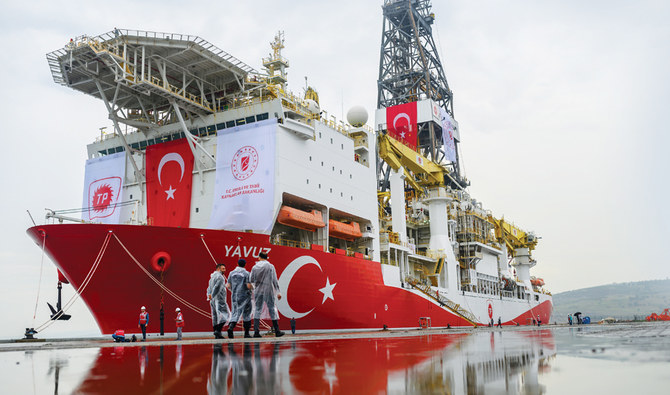

MISSOURI: Turkey has steadily increased its efforts over the past year to claim recently discovered deposits of natural gas in the eastern Mediterranean Sea.
Maritime laws include some ambiguous elements regarding borders and “exclusive economic zones” extending from the shoreline of maritime states, and Ankara has been attempting to use these ambiguities to forcefully assert its claim to almost half the Mediterranean.
Most recently, Turkey signed an agreement with one of the warring administrations in Libya that unilaterally divided much of the Mediterranean between the two countries.
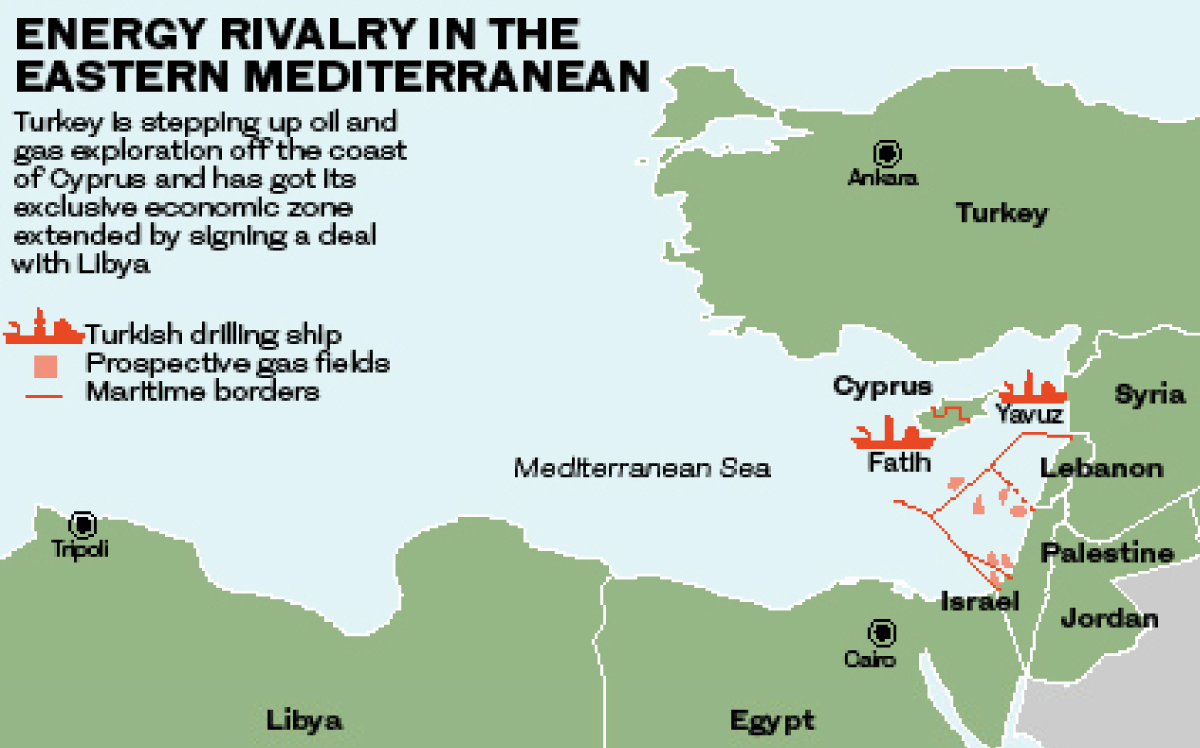
Ankara’s deal with the Tripoli-based Government of National Accord (GNA) drew a diagonal line from Libya’s continental shelf and waters to Turkey’s, with Turkey claiming the waters east of the line right up to the coast of Cyprus and beyond.
The delimitation of “exclusive territorial waters” ignored and displaced recognized claims by Cyprus and Greece. Turkey claimed this was legal because, in contrast to the EU and the UN, it did not recognize islands (such as the Greek islands and Cyprus) as being entitled to territorial waters beyond their immediate coastline.
Following its distinctive interpretation of maritime laws, Turkey was one of only four countries that did not sign the UN Convention on the Law of the Sea in 1982.
Ankara can therefore now claim that it shares a maritime border with Libya and Egypt and completely ignore Greece’s maritime border with Cyprus.
In return for the maritime borders deal with the Libyan GNA and the right to drill in Libyan waters as well, Turkey has dispatched military aid to Tripoli.
The Turkish support apparently included deployment of Syrian mercenary proxy forces that Turkey had also used in its incursions into northern Syria.
The GNA in Tripoli is fighting a Tobruk-based rival government supported by Egypt and several other countries.
INNUMBERS
122 - Estimated recoverable gas in trillion cubic feet in the Levant Basin.
223 - Estimated recoverable gas in trillion cubic feet in the Nile Delta Basin.
French President Emmanuel Macron accused Turkey of violating the Berlin peace conference with its military aid to the GNA, since signatories had agreed to stay out of the Libyan civil war.
Tensions in the Mediterranean as a result of the newly discovered gas reserves there go far beyond Libya, however.
Turkey’s moves appear to come as a result of Cypriot, Greek and Israeli joint ventures to develop the underwater gas reserves and build a pipeline for the gas from Israel’s new Leviathan gas project in the Mediterranean to Greece.
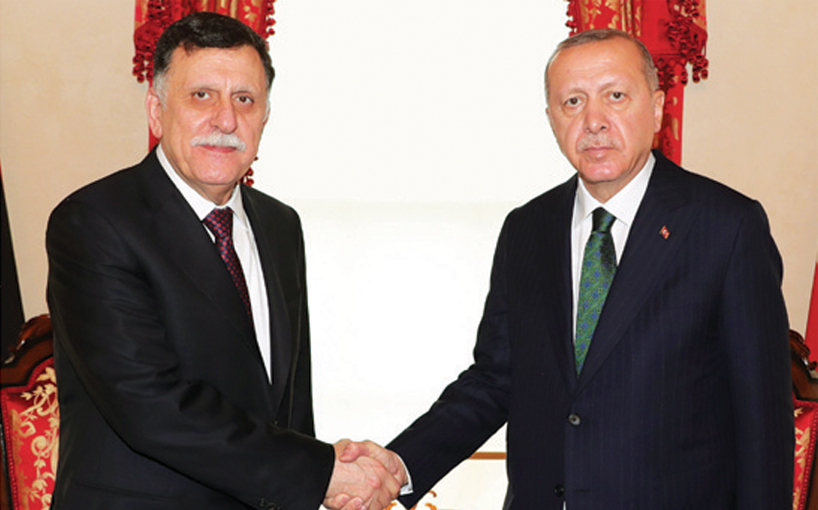
Recep Tayyip Erdogan (R) and Libya’s GNA PM Fayez Al-Sarraj. (AFP)
The pipeline would bypass Turkey, a self-proclaimed energy hub of the area with aspirations to be the central transit point of oil and gas to Europe.
The pipeline would likewise decrease European energy dependence on Russia, which has built a competing pipeline project in cooperation with Turkey.
The gas from the Israeli project has also already begun supplying Egypt and Jordan.
However, Turkey’s President Recep Tayyip Erdogan, mimicking Beijing’s actions in the South China Sea, has concluded that force can determine law.
Turkish naval ships were therefore dispatched to accompany Turkey’s drilling vessels operating in what most of the world views as Cypriot territorial waters.
Turkey’s navy has regularly threatened and pushed out rival drilling ships from other countries, including Cypriot ones considered by many to be operating in their own waters.
For months, Turkey’s aggressive posturing on the seas was largely ignored by Europe (with the exception of Greece and Cyprus) and other powers.
Seeing little resistance to a fairly bellicose strategy in the eastern Mediterranean, Turkish leaders began pushing even harder.
The latest confrontation occurred on Dec. 15 last year, when Turkish naval forces accosted an Israeli exploration ship, the Bat Galim, off the coast of Cyprus.
The Bat Galim was conducting oil and gas exploration under contract from the Greek Cypriot government, but Turkish naval vessels forced it out of the area.
Greece quickly sent its own naval forces and issued a strong warning to Turkey, while Israeli F-16 and F-35 fighter aircraft began buzzing Turkish ships in the area.
France likewise responded by sending some of its own warships to the flash point — in support of Cypriot claims to these waters. France, Italy, Greece, and Cyprus engaged in joint naval exercises in the area as well.
By all accounts, Turkey is isolated on the issue. In addition to France, Egypt, Israel, Cyprus, Italy and Greece, other powers such as the EU, Saudi Arabia, the US and the UAE have vocally condemned Turkey’s moves in the Mediterranean and its recent deal with the Libyan GNA.
According to experts, Turkey’s legitimate rights in the Mediterranean are indisputable but these are not exclusive and must be balanced with the recognized rights of other states in the area – including smaller ones such as Cyprus.
Regional powers without any self-interest in the Mediterranean — such as Saudi Arabia and the UAE — thus have an important role to play here. They find themselves on the right side of history as they back a multilateral legal regime for the laws of the sea and discourage the kind of brinksmanship Turkey appears to be engaged in.
The EU has said Turkey’s activity “infringes upon the sovereign rights of third states, does not comply with the Law of the Sea and cannot produce any legal consequences for third states.”
Traditional Turkish allies such as Qatar and Azerbaijan have remained largely silent.
While Russia may appreciate Turkish moves to block the Greek-Cypriot-Israeli competing gas pipeline in the Mediterranean, Moscow backs the Tobruk-based government in Libya rather than the Tripoli-based one that Turkey signed a deal with and is arming.
Ankara shows no signs of backing off, however. In December 2019, Mevlut Cavusoglu, Turkey’s minister of foreign affairs, told a local news channel that Turkey had “the right to prevent” what it viewed as “unauthorized drilling” in waters it considered to be part of its continental shelf.
When pressed about whether or not this included Turkey using force to assert its claims in the eastern Mediterranean, Cavusoglu replied “of course.”
Tensions such as these have a way of getting out of hand quickly if not addressed seriously right away.
The situation in the eastern Mediterranean has already been allowed to degenerate to very dangerous levels.
If hawkish powers like Turkey can get away with unilaterally reinterpreting maritime laws to the detriment of smaller states such as Cyprus, things may get a lot worse yet.


