

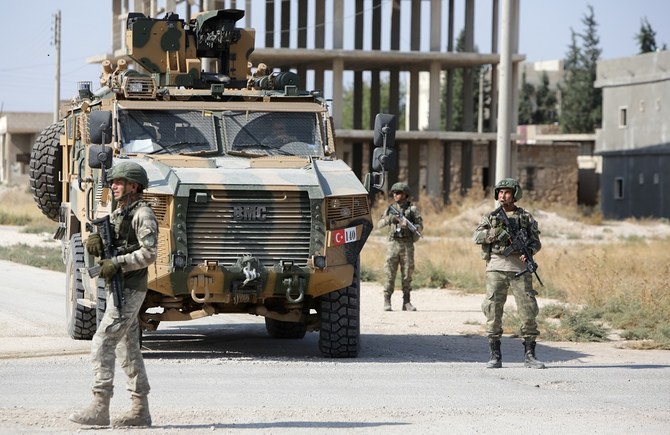

ANKARA: A direct confrontation between Turkish forces and the Assad regime drew closer on Monday when five Turkish soldiers were killed in a regime attack in northwest Syria.
The assault on a newly established Turkish military base in Taftanaz in Idlib province came a week after eight Turkish troops were killed by regime bombardment.
The rapid offensive by regime forces in Idlib has driven nearly 700,000 people from their homes toward the Turkish border. Turkey, which already hosts 3.6 million Syrian refugees, says it can take no more and is ready for military action to halt the regime advance.
“The Assad regime’s attacks against our posts have made an operation necessary,” said Omer Celik, spokesman for President Recep Tayyip Erdogan’s political party, the AKP.
Turkey has poured 5,000 troops across the border with convoys of at least 1,000 tactical vehicles equipped with aerial defense and fire capabilities. However, it has no good options, said Aaron Stein, Middle East program director at the Foreign Policy Research Institute.
HIGHLIGHTS
• The rapid offensive by regime forces in Idlib has driven nearly 700,000 people from their homes toward the Turkish border.
•Turkey, which already hosts 3.6 million Syrian refugees, says it can take no more and is ready for military action to halt the regime advance.
“Ankara can basically choose to annex the territory it governs in Syria and defend it, or surrender as part of a dialogue with Moscow,” he told Arab News.
“It isn’t going to march to Damascus, even a new defensive line it establishes in consultations with Russia won’t ease the pressure to agree to some mechanism that Russia can live with to end the war.”
Turkey could take further military action in Idlib but at the risk of ending its accord with Moscow, Stein said. “It is a losing bet.”
Navvar Saban, a military expert from the Omran Center for Strategic Studies in Istanbul, said he expected further bloodshed in Idlib.
“There is no going back. I’m very concerned for the safety of the civilians in the region,” he told Arab News.
Saban said only contacts between Russian and Turkish delegations or their presidents may come up with a positive plan.
As the conflict escalated in Idlib, Turkish and Russian officials met in Ankara for talks. The two countries back opposing sides in Syria. “This is a war of attrition between Moscow and Ankara in which they are testing limits,” said Galip Dalay, a visiting scholar at Oxford University.
Alexey Khlebnikov, an expert at the Russian International Affairs Council, said the Russia-Turkey talks were preparatory ones and they did not intend to reach a deal.
“Turkey won’t risk a direct clash with Russia,” he said. “Moscow is in control of the sky over Idlib, which makes it doubtful that Turkey will use its airpower. An escalation will only increase the flow of refugees, which is exactly what Turkey wants to avoid.”


