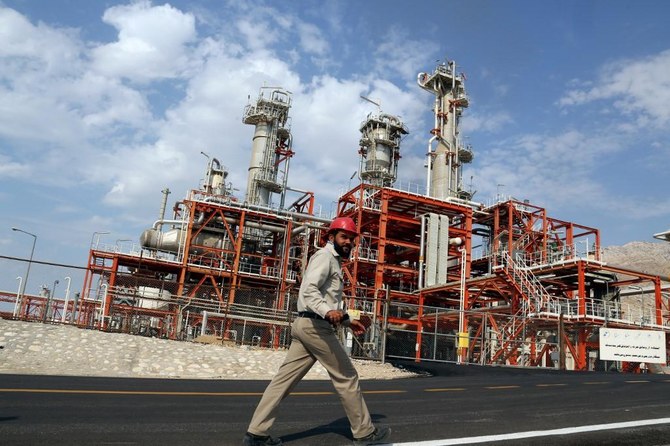
BAGHDAD: The United States has signaled to Iraq its willingness to extend sanctions waivers enabling the country to continue importing vital Iranian gas and electricity imports, three Iraqi officials said this week, a move that would be a key test of Baghdad-Washington ties.
The decision comes amid strained US-Iraqi ties following last month’s Washington-directed airstrike in Baghdad that killed a high-profile Iranian general and a senior Iraqi militia leader.
A previous waiver, granted in October, is set to expire on Feb. 13. The three officials said the US State Department, which issues such waivers, has conveyed its readiness to extend the waiver for another three months — if Iraq is able to formulate a timeline by the end of the week, detailing a plan to wean itself off Iranian gas dependence.
“The American side has announced to us their readiness,” said one of the officials.
The officials interviewed are all senior members of Iraq’s government, including one who is close to the negotiations with the Americans. They spoke on condition of anonymity because they were not authorized to speak publicly about the matter before it becomes official.
Iraqi officials said the new waiver would be a test of Baghdad-Washington ties after tensions soared following a Jan. 3 US airstrike near the Baghdad airport that killed a top Iranian general, Qassem Soleimani, and senior Iraqi militia leader Abu Mahdi Al-Muhandis. Since then, Iraqi Shiite political leaders have pushed a non-binding resolution through parliament to pressure the government to oust US troops from the country.
Washington has responded to Iraq’s requests to initiate troop withdrawals with blunt refusal, even threatening primary sanctions that could cripple Iraq’s economy. Tensions have cooled in recent weeks, with both sides stepping back from saber-rattling rhetoric. rival Iraqi blocs in parliament have also selected a prime minister-designate, Mohammed Allawi, to replace outgoing Premier Adel Abdul-Mahdi.
Iraq remains highly dependent on Iranian natural gas to meet electricity demands, especially during the scorching summer months when imports account for a third of consumption. Late payments by Baghdad for Iranian power and gas have resulted in interruptions in recent years. In the summer of 2018, that was one factor that lead to destabilizing protests in the southern oil-rich province of Basra.
The US waiver enable Iraq to avoid penalties while paying Iran billions of dollars for energy imports. It has been granted successively since November 2018, when the Trump administration re-imposed sanctions on Iran.
Washington has used the threat of sanctions as leverage to push the Iraqi government to build up domestic power supplies and reduce dependence on Iran. Iraq currently flares vast quantities of gas because it lacks the infrastructure to capture it. It also has two gas fields in Anbar and Diyala provinces but development of those suffered major setbacks after the Daesh group overran the areas in the summer of 2014.
The threat of sanctions had presented Iraqi officials with a difficult choice: end a vital source of electricity or be denied access to US currency. Iraq has billions of dollars in oil revenue at the Federal Reserve Bank in New York. Oil accounts for 90 percent of Iraq’s state revenue.
The Iraqi Cabinet moved toward placating Washington’s conditions to renew the sanctions waiver in late January, by approving six oil contracts awarded by the Oil Ministry in April 2018 that would boost domestic gas supply in over two years, according to a Cabinet statement on Jan. 23.
The contracts were passed, “within the framework of the government’s efforts to enhance self-sufficiency in energy and reduce dependence on imported gas,” the statement said.
Iraq’s caretaker government approved the contracts, which would include fields that could produce over 750 million standard cubic feet of gas per day in 36 months, the statement added.
“We expect to sign soon,” said an industry official from one of the three companies awarded the contracts. The official spoke on condition of anonymity in order not to compromise ongoing talks with the government.


US will grant vital Iran sanctions waiver: Iraqi officials
https://arab.news/cvqe3
US will grant vital Iran sanctions waiver: Iraqi officials

- The decision comes amid strained US-Iraqi ties following last month’s Washington-directed airstrike in Baghdad
- Iraq remains highly dependent on Iranian natural gas to meet electricity demands


Family of Palestinian-American shot dead by Israeli settler demand accountability
- Relatives say Abu Siyam was among about 30 residents from the village of Mukhmas who confronted armed settlers attempting to steal goats from the community
LONDON: The family of a 19-year-old Palestinian-American man reportedly shot dead by an Israeli settler in the occupied West Bank have demanded accountability, amid mounting scrutiny over a surge in settler violence and a lack of prosecutions.
Nasrallah Abu Siyam, a US citizen born in Philadelphia, was killed near the city of Ramallah on Wednesday, becoming at least the sixth American citizen to die in incidents involving Israeli settlers or soldiers in the territory in the past two years.
Relatives say Abu Siyam was among about 30 residents from the village of Mukhmas who confronted armed settlers attempting to steal goats from the community. Witnesses said that stones were thrown by both sides before settlers opened fire, wounding at least three villagers.
Abu Siyam was struck and later died of his injuries.
Abdulhamid Siyam, the victim’s cousin, said the killing reflected a wider pattern of impunity.
“A young man of 19 shot and killed in cold blood, and no responsibility,” he told the BBC. “Impunity completely.”
The US State Department said that it was aware of the death of a US citizen and was “carefully monitoring the situation,” while the Trump administration said that it stood ready to provide consular assistance.
The Israeli embassy in Washington said the incident was under review and that an operational inquiry “must be completed as soon as possible.”
A spokesperson for the Israeli Defense Forces said troops were deployed to the scene and used “riot dispersal means to restore order,” adding that no IDF gunfire was reported.
The military confirmed that the incident remained under review and said that a continued presence would be maintained in the area to prevent further unrest.
Palestinians and human rights organizations say such reviews rarely lead to criminal accountability, arguing that Israeli authorities routinely fail to prosecute settlers accused of violence.
A US embassy spokesperson later said that Washington “condemns this violence,” as international concern continues to grow over conditions in the occupied West Bank.
Palestinians and human rights groups say Israeli authorities routinely fail to investigate or prosecute settlers accused of violence against civilians.
Those concerns were echoed this week by the UN, which warned that Israel’s actions in the occupied West Bank may amount to ethnic cleansing.
A UN human rights office report on Thursday said that Israeli settlement expansion, settler attacks and military operations have increasingly displaced Palestinian communities, with dozens of villages reportedly emptied since the start of the Gaza war.
The report also criticized Israeli military tactics in the northern West Bank, saying that they resembled warfare and led to mass displacement, while noting abuses by Palestinian security forces, including the use of unnecessary lethal force and the intimidation of critics.
Neither Israel’s foreign ministry nor the Palestinian Authority has commented on the findings.