

Not so fast: US orders Netanyahu to delay annexation of West Bank land

1 / 2
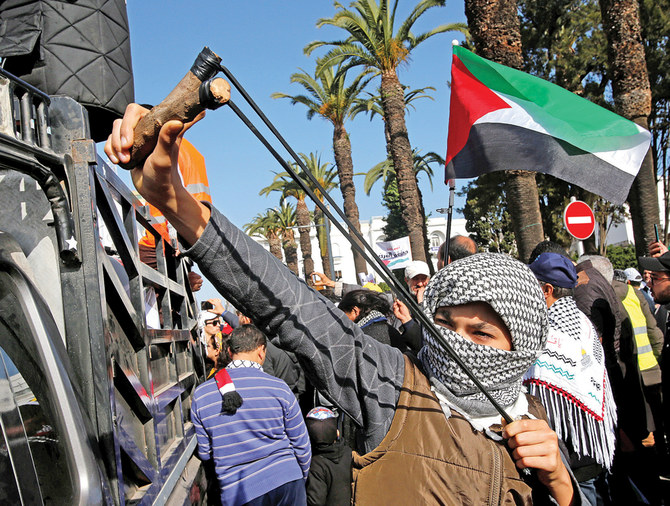
A demonstrator poses with an empty slingshot during a protest against the US Mideast peace plan, in Rabat, Morocco, on Sunday. (Reuters)
2 / 2
Tens of thousand pro-Palestinian Turkish demonstrators take part in a protest rally in Istanbul on Feb. 9, 2020 against US President Donald Trump's proposed peace plan for Palestinians. (AP Photo/Emrah Gurel)
Short Url
Updated 10 February 2020
Follow

Not so fast: US orders Netanyahu to delay annexation of West Bank land

  • Palestinian leaders: Netanyahu had no option but to do what Washington told him

AMMAN, Jordan: Israeli Prime Minister Benjamin Netanyahu was forced on Sunday to backtrack on plans for a rapid annexation of occupied West Bank land after an unprecedented warning from the US that he was moving too quickly.

Under pressure from far-right extreme nationalists in his coalition government, Netanyahu had pledged quick “application of Israeli law” to illegal Jewish settlements, and to the Jordan Valley.

The prime minister had been given the green light to act by US President Donald Trump’s Middle East peace plan, unveiled on Jan. 28, which proposes that Israel retain vast areas of occupied land required by the Palestinians for an independent state.

But David Friedman, the US ambassador to Israel and a key supporter of the Trump plan, warned on Sunday: “Israel is subject to the completion (of) a mapping process by a joint Israeli-American committee. Any unilateral action in advance of the completion of the committee process endangers the plan, and American recognition.

BACKGROUND

The Israeli prime minister had been given the green light to act by US President Donald Trump’s Middle East peace plan, unveiled on Jan. 28, which proposes that Israel retain vast areas of occupied land required by the Palestinians for an independent state.

“With the news out that the Israeli Cabinet was about to be pushed in a direction that was potentially adverse to our view of the process, we just let people know where we stand.”

Palestinian leaders told Arab News that Netanyahu had no option but to do what Washington told him. “There is no doubt that in such a disagreement Trump is the powerful side in the equation, and if Trump and Netanyahu disagree, the opinions of the Americans will prevail,” said Nabil Shaath, senior political adviser to Palestinian President Mahmoud Abbas.

The US had interests in the region other than Israel, Shaath said. “For many in the Arab and Muslim worlds, Jerusalem and Arab occupied lands do have a role in the way Washington thinks.”

However, chief Palestinian negotiator Saeb Erekat told Arab News that Friedman had been “historically involved in the funding and support of illegal colonial settlements, and is one of the master brains behind this annexation plan.

“He is basically saying, ‘Annexation, a crime of aggression under the Rome statute, is fine as long as you do it with me, not alone.’ Their endgame is the same — to normalize Israel’s apartheid in Palestine.”


Military drone attack on Sudan oil field kills dozens and threatens South Sudan’s economic lifeline

Updated 10 December 2025
Follow

Military drone attack on Sudan oil field kills dozens and threatens South Sudan’s economic lifeline

  • RSF said the oil field in Heglig was attacked a day after they seized the facility near the border with South Sudan
  • South Sudanese soldiers were among the dead in the attack by an Akinci drone

JUBA: Dozens of people were killed Tuesday evening in a drone strike near Sudan’s largest oil processing facility carried out by the Sudanese Armed Forces, according to the paramilitary Rapid Support Forces.
The RSF, which has been fighting Sudan’s military since 2023, said the oil field in Heglig was attacked a day after the RSF seized the facility near the border with South Sudan.
Both sides told The Associated Press that the exact number of dead and wounded could not immediately be confirmed. Local news outlets reported seven tribal leaders and “dozens” of RSF troopers were killed.
South Sudanese soldiers were among the dead in the attack by an Akinci drone, according to the RSF, which condemned the attack as a violation of international law.
Two Sudanese military officials confirmed the drone strike, which they said targeted RSF fighters.
The government of South Sudan’s Unity State confirmed three South Sudanese soldiers were killed. A South Sudanese solider, who witnessed the strike and spoke on condition of anonymity because he was not authorized to speak, estimated 25 people were killed.
South Sudanese commander Johnson Olony said in a statement that South Sudanese forces may have been sent to secure Heglig after its capture. South Sudan’s military spokesperson declined to comment.
South Sudan relies entirely on Sudanese pipelines to export its oil and has seen production repeatedly disrupted by the conflict, worsening its economic crisis.
Sudanese soldiers and oil workers began evacuating Heglig on Monday and the RSF took control of the facility without resistance. By Tuesday, about 3,900 Sudanese soldiers had surrendered their weapons to South Sudanese forces after crossing into Rubkona County, according to Unity State’s information ministry.
Video from South Sudan’s state broadcaster showed tanks, armored personnel carriers and artillery among the weapons handed over.
Thousands of civilians from Sudan began crossing the border into South Sudan on Sunday and were still arriving Wednesday, the South Sudan government said, adding that the exact number was not yet known. South Sudan insists it remains neutral in the conflict despite accusations of siding with the RSF.
Heglig’s capture is the latest in a string of RSF territorial gains, including the October fall of el-Fasher, the capital of North Darfur and the Sudanese army’s last stronghold in Darfur. The war, which began in April 2023, has killed an estimated 150,000 people, displaced millions and triggered multiple famines. Both sides face allegations of atrocities.
The capture of Heglig, a vital state asset, could be a significant bargaining chip for the RSF, analysts said. But the opaque nature of oil finances makes it difficult to determine how much the SAF, RSF or South Sudan will be impacted economically over the short term.