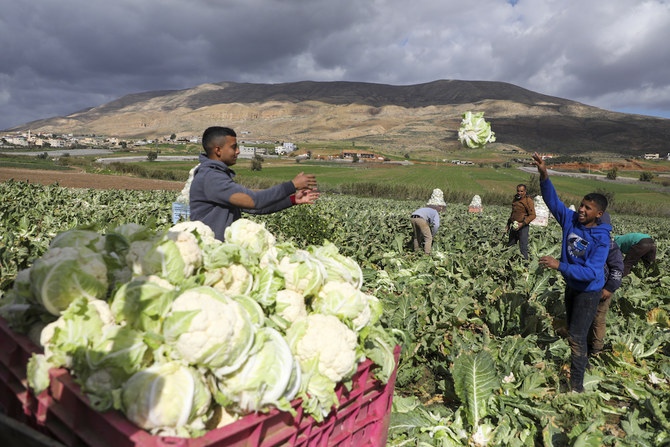
RAMALLAH: Israel on Sunday imposed a ban on Palestinian agricultural exports, in a move the Palestinians blasted as a “dangerous” escalation in a five-month trade war.
“Starting from today... export abroad of Palestinian agricultural product through the Allenby crossing will not be allowed,” COGAT, the Israel defense ministry unit that oversees civilian activities in the Palestinian territories, said in a statement.
The Israeli-controlled Allenby border crossing between Jordan and the occupied West Bank is the only route through which Palestinian goods can reach foreign markets.
Moein Ashtiyeh, a Palestinian farmer in the fertile Jordan Valley region, said he had 400 tons of dates set for export to Britain, Germany and Turkey, which he is currently unable to sell.
“If I can’t export these dates, the Israeli action will cost me 10 million shekels ($2.9 million),” he told AFP.
COGAT said the measure was in response to a Palestinian decision in October to stop importing calves from Israel.
That boycott “dramatically hurt Israeli cattle breeders,” COGAT said.
The Palestinians said at the time that they wanted to decrease their dependence on the Israeli market.
The trade dispute has escalated since US President Donald Trump released his controversial Middle East plan last month, which has been rejected by the Palestinians as overwhelmingly pro-Israeli.
Last week, Israel’s defense ministry halted all imports of agricultural products from the West Bank to Israel, cutting the Palestinians off from a market that accounts for roughly two-thirds of their agricultural exports.
The Palestinian Authority responded by banning the import of Israeli produce, soft drinks and mineral water.
Palestinian agriculture minister Reyad Attari told AFP that Israel’s latest block on goods crossing the Allenby Bridge “violated all the agreements” between the two sides.
“It’s a very dangerous action,” he said.
COGAT stressed that its ban would be reversed “the moment the Palestinian Authority took back its decision to harm cattle trade with Israel and the free market.”
Palestinian economic analyst Nasser Abdel Karim told AFP that despite the rising tensions neither side is seeking a full-blown trade war.
Unrest in the West Bank has surged since Trump unveiled his controversial peace proposal and the Israelis want to avoid any further “outbursts of violence in the Palestinian territories and ensure calm,” Abdel Karim said.
Among the Palestinian leadership, “there is no will for economic confrontation,” he added.
But even if both sides are keen to avoid major economic hostilities, Palestinian vegetable producer Nasser Abdel Razek said he remained worried.
“This is potato and onion season,” he told AFP. “If I can’t export I will lose a lot of money.”


![]()

Israel blocks Palestinian export in escalating trade crisis
Short Url
https://arab.news/93qj7
Israel blocks Palestinian export in escalating trade crisis
- Palestinian Authority says Israeli forces at checkpoints blocked vegetable shipments
- Palestinians decided to stop importing beef from Israel in Sept.


Latest updates



© 2026 SAUDI RESEARCH & PUBLISHING COMPANY, All Rights Reserved And subject to Terms of Use Agreement.