AZAZ, Syria: Cold weather, disease and a lack of shelter and medicine threaten hundreds of thousands of civilians as they flee fighting in Idlib province, in one of the biggest upheavals of Syria’s nine-year civil war, aid groups and doctors said.
The migrants, their numbers swelling by the day, are trapped between advancing Syrian government forces, keen to crush the last significant opposition stronghold, and Turkey’s closed border.
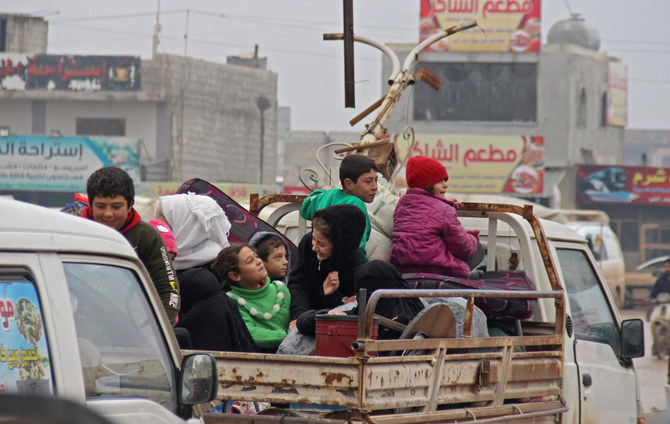
Some are having to flee by foot, while many others are having to sleep in their cars, as Syrian and Russian warplanes bombard the highways leading north toward Turkey.
A UN official appealed for emergency financial assistance to help an estimated 800,000 people in northwest Syria to survive the coming months.
“People are facing a tragedy. For the last two weeks it’s been very, very cold. There is rain and mud, and influenza is spreading,” said Wassim Zakaria, a doctor who works in a clinic in Idlib city that closed on Monday due to heavy bombardment.
The numbers on the move have increased in recent days as the forces of Syrian President Bashar Assad advanced to within 8 km (5 miles) of Idlib city, said Selim Tosun, the Turkish Humanitarian Relief Foundation’s (IHH) media adviser in Syria.
“If the cold weather continues...there is a risk of epidemics as a large migrant flow is coming,” he said.
Since November, 692,000 people have abandoned towns south of Idlib city, Tosun said. The number “is rising every hour” and could reach 1 million, he added.
Zakaria said people had also started to flee from Idlib city but their options for shelter were limited, with people forced to sleep in cars or tents, many near the walled-off border which prevents Syrians taking refuge in Turkey.
“It’s like people are imprisoned here. Last week women and children demonstrated at the border, asking to be allowed across,” he said.
Turkey’s IHH is distributing urgent aid and blankets to those traveling on the highway from Idlib city and has set up 2,000 tents, with plans to put up another 1,500, Tosun said.
Some 700 breeze-block dwellings have also been built out of a total 10,000 which Turkey is planning to erect in the region south of its border, he said.
He added that many people were now seeking shelter beyond Idlib province, already home to waves of civilians displaced earlier in Syria’s civil war, and were heading toward Afrin and Azaz, areas just to the northeast under the control of Turkish-led Syrian rebel forces.
AID APPEAL
David Swanson, UN regional spokesperson for the Syria crisis, said $336 million was urgently needed to help those being displaced, with shelter a critical problem.
“This crisis continues to deteriorate by the minute. This is easily one of the largest waves of displacements since the (Syrian civil war) began in March 2011,” Swanson said.
“Hundreds of thousands of people are in now in urgent need of critical, life-saving assistance,” he said.
The United Nations has put the number of displaced from the Idlib fighting since Dec. 1 at 520,000, with a further 280,000 seen at “imminent risk of displacement.”
Many of the displaced are staying with host communities who themselves are struggling to cope, while others have sought shelter in schools or mosques, or are sleeping in their vehicles or in the open air, said Swanson.
“The humanitarian situation in Syria is more catastrophic than ever before. Who would have imagined that entire cities would be displaced in a single month?” said Atef Nanou, manager of Molham Volunteering Team, a relief group in northern Syria.
He said he had encountered families unable to get away from the bombing because they couldn’t afford fuel for their car or transportation costs.
“So they either stayed despite the bombing or went out on foot on the international road that the Syrian regime and Russian warplanes are bombing around the clock,” Nanou added.


Cold, disease threaten more than half a million Syrians fleeing Idlib fighting
https://arab.news/9fuxg
Cold, disease threaten more than half a million Syrians fleeing Idlib fighting

- A UN official appealed for emergency financial assistance to help an estimated 800,000 people in northwest Syria to survive the coming months
- Since November, 692,000 people have abandoned towns south of Idlib city


Trump says Iran government change ‘best thing that could happen’
- US president's comments come after he ordered a second aircraft carrier to head to the Middle East
FORT BRAGG, United States: US President Donald Trump said a change of government in Iran would be the “best thing that could happen,” as he ordered a second aircraft carrier to head to the Middle East.
“Seems like that would be the best thing that could happen,” Trump told reporters at the Fort Bragg military base in North Carolina when a journalist asked if he wanted “regime change” in Iran.
“For 47 years, they’ve been talking and talking and talking. In the meantime, we’ve lost a lot of lives while they talk,” he told reporters.
Trump declined to say who he would want to take over in Iran from supreme leader Ayatollah Ali Khamenei, but he added that “there are people.”
He has previously backed off full-throated calls for a change of government in Iran, warning that it could cause chaos, although he has made threats toward Khamenei in the past.
Speaking earlier at the White House, Trump said that the USS Gerald R. Ford — the world’s largest warship — would be “leaving very soon” for the Middle East to up the pressure on Iran.
“In case we don’t make a deal, we’ll need it,” Trump said.
The giant vessel is currently in the Caribbean following the US overthrow of Venezuela’s Nicolas Maduro. Another carrier, the USS Abraham Lincoln, is one of 12 US ships already in the Middle East.
When Iran began its crackdown on protests last month — which rights groups say killed thousands — Trump initially said that the United States was “locked and loaded” to help demonstrators.
But he has recently focused his military threats on Tehran’s nuclear program, which US forces struck last July during Israel’s unprecedented 12-day war with Iran.
The protests have subsided for now but US-based Reza Pahlavi, the son of Iran’s last shah, urged international intervention to support the Iranian people.
“We are asking for a humanitarian intervention to prevent more innocent lives being killed in the process,” he told the Munich Security Conference.
It followed a call by the opposition leader, who has not returned to his country since before the revolution, for Iranians at home and abroad to continue demonstrations this weekend.
Iran and the United States, who have had no diplomatic relations since shortly after the revolution, held talks on the nuclear issue last week in Oman. No dates have been set for new talks yet.
The West fears the program is aimed at making a bomb, which Tehran denies.
The head of the UN nuclear watchdog, Rafael Grossi, said Friday that reaching an accord with Iran on inspections of its processing facilities was possible but “terribly difficult.”
Trump said after talks with Israeli Prime Minister Benjamin Netanyahu earlier this week that he wanted to continue talks with Iran, defying pressure from his key ally for a tougher stance.
The Israeli prime minister himself expressed skepticism at the quality of any agreement if it didn’t also cover Iran’s ballistic missiles and support for regional proxies.
According to the US-based Human Rights Activists News Agency, 7,008 people, mostly protesters, were killed in the recent crackdown, although rights groups warn the toll is likely far higher.
More than 53,000 people have also been arrested, it added.
The Norway-based Iran Human Rights (IHR) NGO said “hundreds” of people were facing charges linked to the protests that could see them sentenced to death.
Figures working within the Iranian system have also been arrested, with three politicians detained this week from the so-called reformist wing of Iranian politics supportive of President Masoud Pezeshkian.
The three — Azar Mansouri, Javad Emam and Ebrahim Asgharzadeh — were released on bail Thursday and Friday, their lawyer Hojjat Kermani told the ISNA news agency.




