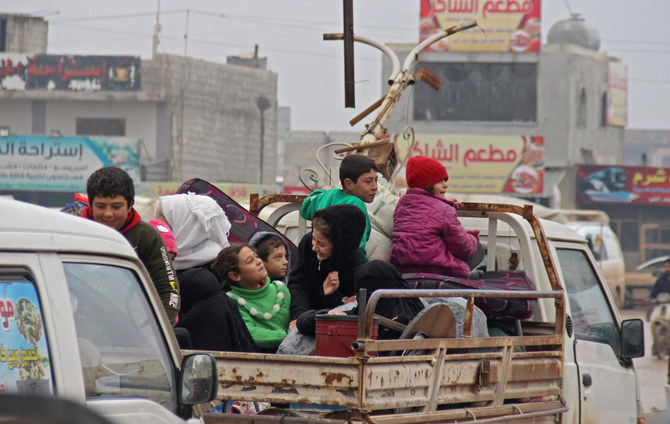
AZAZ, Syria: Cold weather, disease and a lack of shelter and medicine threaten hundreds of thousands of civilians as they flee fighting in Idlib province, in one of the biggest upheavals of Syria’s nine-year civil war, aid groups and doctors said.
The migrants, their numbers swelling by the day, are trapped between advancing Syrian government forces, keen to crush the last significant opposition stronghold, and Turkey’s closed border.
Some are having to flee by foot, while many others are having to sleep in their cars, as Syrian and Russian warplanes bombard the highways leading north toward Turkey.
A UN official appealed for emergency financial assistance to help an estimated 800,000 people in northwest Syria to survive the coming months.
“People are facing a tragedy. For the last two weeks it’s been very, very cold. There is rain and mud, and influenza is spreading,” said Wassim Zakaria, a doctor who works in a clinic in Idlib city that closed on Monday due to heavy bombardment.
The numbers on the move have increased in recent days as the forces of Syrian President Bashar Assad advanced to within 8 km (5 miles) of Idlib city, said Selim Tosun, the Turkish Humanitarian Relief Foundation’s (IHH) media adviser in Syria.
“If the cold weather continues...there is a risk of epidemics as a large migrant flow is coming,” he said.
Since November, 692,000 people have abandoned towns south of Idlib city, Tosun said. The number “is rising every hour” and could reach 1 million, he added.
Zakaria said people had also started to flee from Idlib city but their options for shelter were limited, with people forced to sleep in cars or tents, many near the walled-off border which prevents Syrians taking refuge in Turkey.
“It’s like people are imprisoned here. Last week women and children demonstrated at the border, asking to be allowed across,” he said.
Turkey’s IHH is distributing urgent aid and blankets to those traveling on the highway from Idlib city and has set up 2,000 tents, with plans to put up another 1,500, Tosun said.
Some 700 breeze-block dwellings have also been built out of a total 10,000 which Turkey is planning to erect in the region south of its border, he said.
He added that many people were now seeking shelter beyond Idlib province, already home to waves of civilians displaced earlier in Syria’s civil war, and were heading toward Afrin and Azaz, areas just to the northeast under the control of Turkish-led Syrian rebel forces.
AID APPEAL
David Swanson, UN regional spokesperson for the Syria crisis, said $336 million was urgently needed to help those being displaced, with shelter a critical problem.
“This crisis continues to deteriorate by the minute. This is easily one of the largest waves of displacements since the (Syrian civil war) began in March 2011,” Swanson said.
“Hundreds of thousands of people are in now in urgent need of critical, life-saving assistance,” he said.
The United Nations has put the number of displaced from the Idlib fighting since Dec. 1 at 520,000, with a further 280,000 seen at “imminent risk of displacement.”
Many of the displaced are staying with host communities who themselves are struggling to cope, while others have sought shelter in schools or mosques, or are sleeping in their vehicles or in the open air, said Swanson.
“The humanitarian situation in Syria is more catastrophic than ever before. Who would have imagined that entire cities would be displaced in a single month?” said Atef Nanou, manager of Molham Volunteering Team, a relief group in northern Syria.
He said he had encountered families unable to get away from the bombing because they couldn’t afford fuel for their car or transportation costs.
“So they either stayed despite the bombing or went out on foot on the international road that the Syrian regime and Russian warplanes are bombing around the clock,” Nanou added.


![]()


Cold, disease threaten more than half a million Syrians fleeing Idlib fighting
Short Url
https://arab.news/9fuxg
Cold, disease threaten more than half a million Syrians fleeing Idlib fighting
- A UN official appealed for emergency financial assistance to help an estimated 800,000 people in northwest Syria to survive the coming months
- Since November, 692,000 people have abandoned towns south of Idlib city


Village in southern Lebanon buries a child and father killed in Israeli drone strike
- Hassan Jaber, a police officer, and his 3-year-old son, Ali, were on foot when the strike hit a passing car in Yanouh on Monday
- The car’s driver, Ahmad Salami, was also killed. The Israeli military said Salami was an artillery official with Hezbollah
YANOUH: Mourners in southern Lebanon on Tuesday buried a father and his young son killed in an Israeli drone strike that targeted a Hezbollah member.
Hassan Jaber, a police officer, and his child, Ali, were on foot when the strike on Monday hit a passing car in the center of their town, Yanouh, relatives said. Lebanon’s health ministry said the boy was 3 years old. Both were killed at the scene along with the car driver, Ahmad Salami, who the Israeli military said in a statement was an artillery official with the Lebanese militant group.
It said it was aware of a “claim that uninvolved civilians were killed” and that the case is under review, adding it “makes every effort to reduce the likelihood of harm” to civilians.
Salami, also from Yanouh, was buried in the village Tuesday along with the father and son.
“There are always people here, it’s a crowded area,” with coffee shops and corner stores, a Shiite religious gathering hall, the municipality building and a civil defense center, a cousin of the boy’s father, also named Hassan Jaber, told The Associated Press.
When the boy and his father were struck, he said, they were going to a bakery making Lebanese breakfast flatbread known as manakish to see how it was made. They were standing only about 5 meters (5.5 yards) from the car when it was struck, the cousin said.
“It is not new for the Israeli enemy to carry out such actions,” he said. “There was a car they wanted to hit and they struck it in the middle of this crowded place.”
Jaber said the little boy, Ali, had not yet entered school but “showed signs of unusual intelligence.”
“What did this innocent child do wrong, this angel?” asked Ghazaleh Haider, the wife of the boy’s uncle. “Was he a fighter or a jihadi?”
Attendees at the funeral carried photos of Ali, a striking child with large green eyes and blond hair. Some also carried flags of Hezbollah or Amal, a Shiite party that is allied with but also sometimes a rival of Hezbollah.
Lebanon’s Internal Security Forces, of which the child’s father was a member, said in a statement that the 37-year-old father of three had joined in 2013 and reached the rank of first sergeant.
The strike came as Israel has stepped up its campaign against Hezbollah and its allies in Lebanon.
The night before the strike in Yanouh, Israeli forces launched a rare ground raid in the Lebanese village of Hebbarieh, several kilometers (miles) from the border, in which they seized a local official with the Sunni Islamist group Al-Jamaa Al-Islamiya, or the Islamic Group in English. The group is allied with Hezbollah and the Palestinian militant group Hamas.
The low-level conflict between Lebanon and Israel escalated into full-scale war in September 2024, later reined in but not fully stopped by a US-brokered ceasefire two months later.
Since then, Israel has accused Hezbollah of trying to rebuild and has carried out near-daily strikes in Lebanon that it says target Hezbollah militants and facilities.
Israeli forces also continue to occupy five hilltop points on the Lebanese side of the border. Hezbollah has claimed one strike against Israel since the ceasefire.
Hassan Jaber, a police officer, and his child, Ali, were on foot when the strike on Monday hit a passing car in the center of their town, Yanouh, relatives said. Lebanon’s health ministry said the boy was 3 years old. Both were killed at the scene along with the car driver, Ahmad Salami, who the Israeli military said in a statement was an artillery official with the Lebanese militant group.
It said it was aware of a “claim that uninvolved civilians were killed” and that the case is under review, adding it “makes every effort to reduce the likelihood of harm” to civilians.
Salami, also from Yanouh, was buried in the village Tuesday along with the father and son.
“There are always people here, it’s a crowded area,” with coffee shops and corner stores, a Shiite religious gathering hall, the municipality building and a civil defense center, a cousin of the boy’s father, also named Hassan Jaber, told The Associated Press.
When the boy and his father were struck, he said, they were going to a bakery making Lebanese breakfast flatbread known as manakish to see how it was made. They were standing only about 5 meters (5.5 yards) from the car when it was struck, the cousin said.
“It is not new for the Israeli enemy to carry out such actions,” he said. “There was a car they wanted to hit and they struck it in the middle of this crowded place.”
Jaber said the little boy, Ali, had not yet entered school but “showed signs of unusual intelligence.”
“What did this innocent child do wrong, this angel?” asked Ghazaleh Haider, the wife of the boy’s uncle. “Was he a fighter or a jihadi?”
Attendees at the funeral carried photos of Ali, a striking child with large green eyes and blond hair. Some also carried flags of Hezbollah or Amal, a Shiite party that is allied with but also sometimes a rival of Hezbollah.
Lebanon’s Internal Security Forces, of which the child’s father was a member, said in a statement that the 37-year-old father of three had joined in 2013 and reached the rank of first sergeant.
The strike came as Israel has stepped up its campaign against Hezbollah and its allies in Lebanon.
The night before the strike in Yanouh, Israeli forces launched a rare ground raid in the Lebanese village of Hebbarieh, several kilometers (miles) from the border, in which they seized a local official with the Sunni Islamist group Al-Jamaa Al-Islamiya, or the Islamic Group in English. The group is allied with Hezbollah and the Palestinian militant group Hamas.
The low-level conflict between Lebanon and Israel escalated into full-scale war in September 2024, later reined in but not fully stopped by a US-brokered ceasefire two months later.
Since then, Israel has accused Hezbollah of trying to rebuild and has carried out near-daily strikes in Lebanon that it says target Hezbollah militants and facilities.
Israeli forces also continue to occupy five hilltop points on the Lebanese side of the border. Hezbollah has claimed one strike against Israel since the ceasefire.
Latest updates


Recommended


© 2026 SAUDI RESEARCH & PUBLISHING COMPANY, All Rights Reserved And subject to Terms of Use Agreement.