

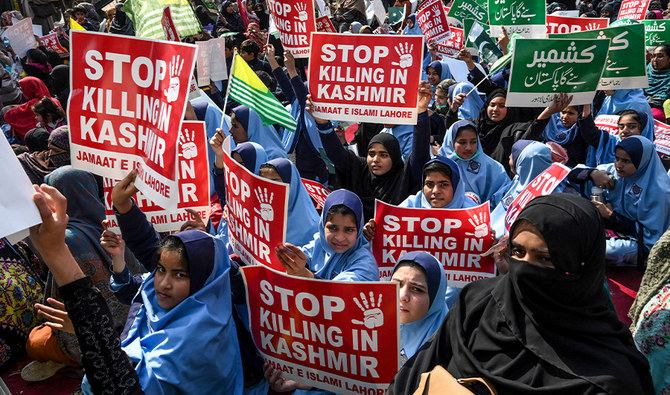

ISLAMABAD: As Pakistan observed the Kashmir Solidarity Day across the nation on Wednesday, Prime Minister Imran Khan lambasted India for its “scant regard of basic human norms” in the disputed region.
It follows New Delhi’s decision to take away Jammu and Kashmir’s special autonomous status on August 5 last year, leading to a subsequent curfew and a complete lockdown in the area.
“The unprecedented length of these restrictions has fully exposed the ‘fiction’ of India’s democracy and its scant regard for basic human norms,” PM Khan said in his address to the nation on Wednesday to mark the occasion.
He added that Kashmiris, the Muslim Ummah, Pakistan, and the international community had “rejected India’s travesty of law and justice” whereby eight million Kashmiris had been “turned into prisoners in their own land through the deployment of over 900,000 occupation troops.”
Following up on its decision taken on August 5, India formally split the region into two federal territories on October 31, in an attempt to fully integrate it with the rest of the country.
Khan said that tens of thousands of innocent people had been “arbitrarily detained and thousands of young boys abducted and incarcerated at undisclosed locations.”
“This is a true manifestation of Indian state-terrorism,” he said.
PM Khan was joined by President Arif Alvi who expressed solidarity with the people of Indian-administered Jammu and Kashmir, too.
“It has been a battle of hope against overwhelming odds, of courage against fear, and of sacrifice against tyranny; but through all of it, the Kashmiri people have persisted, unrelenting and proud as they have always been, to deny India the perverse gratification of subjugating them,” he said, before adding that New Delhi’s decision had “further strengthened the bond” between Pakistan and the people of the disputed region.
Earlier on Tuesday, the National Assembly unanimously passed a resolution urging India to reverse its decision and withdraw troops from the area.
The resolution calls on New Delhi to “immediately reverse and rescind its illegal action August 5, 2019, and October 31, 2019,” and withdraw “its occupation troops” from Indian-administered Kashmir and the Line of Control (LOC).
Tuesday’s resolution also asked India to lift a media ban in Kashmir with immediate effect, and allow the United Nations Military Observer Group in India and Pakistan (UNMOGIP) and the international media into the region, “to assess and report the human rights situation there.”
It also requested the Organization of Islamic Cooperation to convene a special summit on Kashmir, and called on the United Nations to enforce a peaceful settlement of the Kashmir dispute in accordance with the relevant Security Council resolutions, which provide for “a free and impartial plebiscite conducted under the auspices of the United Nations.”
The Kashmir issue is “not just a territorial dispute but a question of people’s inherent right to self-determination,” NA Speaker Asad Qaiser said, as quoted in a statement released on Tuesday.
Qaiser added that “each and every Pakistani child stood with their Kashmiri brethren,” as he requested all citizens and the Pakistani media to observe Kashmir Solidarity Day on Wednesday.


