

Pakistan pledges to buy more Malaysian palm oil to compensate for India’s withdrawal

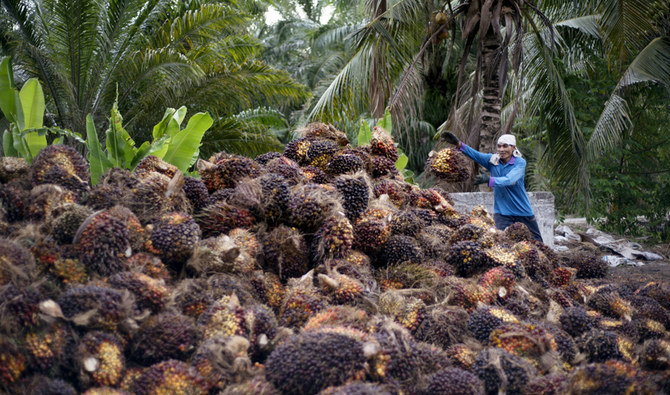
Pakistan will buy more palm oil from Malaysia, following controls imposed by the Indian government on refined palm oil imports. (Shutterstock)
Short Url
Updated 05 February 2020
Follow

Pakistan pledges to buy more Malaysian palm oil to compensate for India’s withdrawal

  • Aims to help offset lost sales after top buyer India put curbs amid a diplomatic row
  • Pakistan bought 1.1 million tons of palm oil from Malaysia last year

KUALA LUMPUR: Pakistan will buy more palm oil from Malaysia, Prime Minister Imran Khan said on Tuesday, aiming to help offset lost sales after top buyer India put curbs on Malaysian imports last month amid a diplomatic row.
India imposed restrictions on refined palm oil imports and informally asked traders to stop buying from Malaysia, the world’s biggest producer of the edible oil. Sources said the move was in retaliation for Malaysia’s criticism of India’s new religion-based citizenship law and its policy on Kashmir.
Malaysian Prime Minister Mahathir Mohamad said on Tuesday that he discussed palm oil with Khan who was on a visit to Malaysia and that Pakistan had indicated it would import more from Malaysia.
“That’s right, especially since we noticed India threatened Malaysia for supporting the Kashmir cause, threatened to cut palm oil imports,” Khan told a joint news conference, referring to India’s Muslim-majority region of Kashmir.
“Pakistan will do its best to compensate for that.”
India is a Hindu-majority country while Malaysia and Pakistan are mainly Muslim. India and Pakistan have been mostly hostile to each other since the partition of British India in 1947, and have fought two of their three wars over competing for territorial claims in Kashmir.
Pakistan may have bought around 135,000 tons of Malaysian palm oil last month, a record high, India-based dealers who track such shipments told Reuters on condition of anonymity.
The figure is close to estimates of 141,500 tons from Refinitiv, which show sales to India in January may have plunged 80% from a year earlier to 40,400 tons.
Malaysia will release official export data on Monday.
Pakistan bought 1.1 million tons of palm oil from Malaysia last year, while India bought 4.4 million tons, according to the Malaysian Palm Oil Council.
Malaysian palm oil futures rose on Tuesday after Khan’s comments and on expectations of a steep drop in production in January.

STRONG TIES
India has repeatedly objected to Mahathir speaking out against its move last year to strip Kashmir’s autonomy and make it easier for non-Muslims from neighboring Muslim-majority Bangladesh, Pakistan, and Afghanistan to gain citizenship.
At the news conference, Mahathir did not refer to Kashmir but Khan did.
“The way you, PM, have stood with us and spoken about this injustice going on, on behalf of Pakistan I really want to thank you,” Khan said.
He also said he was sad he had been unable to attend a summit of Muslim leaders in Malaysia in December. Saudi Arabia did not attend the summit, saying it was the wrong forum to discuss matters affecting the world’s Muslims and Khan belatedly pulled out.
Some Pakistani officials, unnamed because they were not authorized to speak to the media, said at the time that Khan pulled out under pressure from Saudi Arabia, a close ally, although local media reported his officials denied that was the reason for his absence.
“Unfortunately our friends, who are very close to Pakistan as well, felt that somehow the conference was going to divide the ummah,” Khan said, using the Arabic word for the Muslim community but not mentioning Saudi Arabia by name.
“It is clearly a misconception, as that was not the purpose of the conference.”


Pakistan FM discusses regional situation with Saudi counterpart, urges restraint and dialogue

Updated 5 sec ago
Follow

Pakistan FM discusses regional situation with Saudi counterpart, urges restraint and dialogue

  • This is the second time the two foreign ministers have spoken since the Arab Coalition targeted weapon shipments on Yemen’s Mukalla port
  • Saudi Arabia’s foreign ministry has invited factions in south Yemen to hold a dialogue in Riyadh to ‘discuss just solutions to southern cause’

ISLAMABAD: Pakistan’s foreign minister, Ishaq Dar, discussed the regional situation with his Saudi counterpart, Prince Faisal bin Farhan, and called for restraint and dialogue to resolve issues, the Pakistani foreign office said late Friday, amid tensions prevailing over Yemen.

This is the second time the two foreign ministers have spoken this week since the Saudi Arabia-led Coalition to Support Legitimacy in Yemen carried out a “limited” airstrike on Dec. 30, targeting two shipments of smuggled weapons and military equipment sent from the Emirati port of Fujairah to Mukalla in southern Yemen.

A coalition forces spokesperson said the weapons were meant to support the Southern Transitional Council (STC) forces, backed by the United Arab Emirates (UAE), in Yemen’s Hadramaut and Al-Mahra “with the aim of fueling the conflict.” The UAE has since announced withdrawal of its remaining troops from Yemen, rejecting any actions that could threaten the Kingdom or undermine regional stability.

In their telephonic conversation late Friday, the Pakistani and Saudi foreign ministers discussed the latest situation in the region, according to the Pakistani foreign office.

“FM [Dar] stressed that all concerned in the region must avoid any escalatory move and advised to resolve the issues through dialogue and diplomacy for the sake of regional peace and stability,” it added.

Separately, Saudi Arabia’s foreign ministry invited factions in south Yemen to hold a dialogue in Riyadh to “discuss just solutions to the southern cause.”

The ministry statement said the conference in the Saudi capital had been requested by Rashad Al-Alimi, President of the Yemeni Presidential Leadership Council, and the Kingdom urged all factions to participate “to develop a comprehensive vision” that would fulfill the aspirations of the southern people.

Disregarding previous agreements with the Arab Coalition, the STC separatist group launched a sweeping military campaign early in December, seizing the governorates of Hadramaut along the Saudi border and the eastern governorate of Al-Mahra in Yemen’s border with Oman. It also took control of the strategic PetroMasila oilfields, which account for a massive portion of Yemen’s remaining oil wealth.

The advance has raised the spectre of the return of South Yemen, a separate state from 1967 to 1990, while dealing a hammer-blow to slow-moving peace negotiations with Iran-backed Houthi rebels.

Saudi Arabia said the STC action poses a direct threat to the Kingdom’s national security, and regional stability. The Kingdom has reiterated the only way to bring the southern cause to a resolution is through dialogue.

On Thursday, Pakistan’s foreign office expressed solidarity with Saudi Arabia and reaffirmed Islamabad’s commitment to the Kingdom’s security, amid rising tensions in Yemen.

“Pakistan expresses complete solidarity with the Kingdom of Saudi Arabia and reaffirms its commitment to security of the Kingdom,” Pakistani foreign office spokesperson Tahir Andrabi told reporters at a weekly news briefing.

“Pakistan maintains its firm support for the resolution of Yemen issue through dialogue and diplomacy and hopes that Yemen’s people and regional powers work together toward inclusive and enduring settlement of the issue, safeguarding regional stability.”

Pakistan and Saudi Arabia signed a landmark defense pact in September last year, according to which aggression against one country will be treated as an attack against both. The pact signaled a push by both governments to formalize long-standing military ties into a binding security commitment.