KARACHI: Pakistan’s charity blood banks are bearing the brunt of Pakistan’s weakening currency, amid an increase in the cost of imported blood containers and other blood screening machinery, according to blood suppliers.
The unbreakable, vinyl blood containers which are not manufactured in Pakistan, and the equipment required for safe screening of donor’s blood have to be imported, and with the Pak rupee devalued by over 40 percent in the last two years, free blood services in the country say it is proving difficult to continue their charity provision.
Most blood banks in Pakistan offer services free of cost, with expenses borne by donations from private citizens and philanthropists.
“We are facing extremely difficult circumstances because of the rising cost of the import of blood bags and blood screening machinery,” Fawzia Siddiqui, chairperson of a welfare foundation that meets the blood requirements of the National Institute of Child Health (NICH), told Arab News on Friday.
The rupee depreciation, from Rs. 110 per USD to Rs. 154.85 by the end of 2019, has increased the costs of all imported raw materials across the board, including essential commodities and medicinal products.
“Since last year, the price of [a full] blood bag has increased from Rs. 1, 800 to Rs. 2, 200, which includes the screening of blood,” Siddiqui said. The difference comes from the higher price of the vinyl bags and screening equipment.
Iqbal Kasmani, head of a blood bank and Thalassemia center that offers free blood and blood components to the poor, said the prices of blood bags and medicines had gone up by between 30 to 40 percent in the last two years.
Kasmani’s blood bank offers services to approximately 400 registered children suffering from Thalassemia-- an inherited blood disorder.
At the NICH, there are 4,000 registered children with Thalassemia who regularly need blood transfusions. That blood is supplied free of cost to the poor, alongside other services including the provision of medicines for tuberculosis and cancer.
“We receive donations mostly in the holy month of Ramadan that are consumed throughout the year. 80 percent of our donors are ladies,” Siddiqui said.
Siddiqui, who wants to replace existing blood screening equipment with more modern machinery, says currently, it is difficult to manage even current operations due to the high cost of inputs.
“We need Rs. 6 million to replace the equipment, but high costs are making it difficult,” she said.
Additionally, imports of medicinal products have declined by more than 10 percent during the first 6 months of the current fiscal year to $515 million, according to the Pakistan Bureau of Statistics.
“Some of the machines used in the hospitals have become 50 percent costlier as compared to last year,” Abdul Samad Memon, Senior Vice Chairman of Pakistan Chemist and Druggists Association, told Arab News and added that the prices of most medicines had surged to over 23 percent.


Rising costs bleeding Pakistan’s charity blood banks dry, say suppliers

https://arab.news/9qyuf
Rising costs bleeding Pakistan’s charity blood banks dry, say suppliers

- Say vinyl blood containers and other machinery not made in Pakistan is making free-of-cost service difficult to sustain
- Most blood banks in Pakistan offer free services covered by donations from philanthropists

Qatar, Pakistan resolve to boost strategic, economic cooperation at Doha talks
- Both countries urge dialogue on Afghanistan amid renewed border tensions between Islamabad and Kabul
- Discussions focus on bilateral trade and investment, energy, defense, manpower and labor and culture
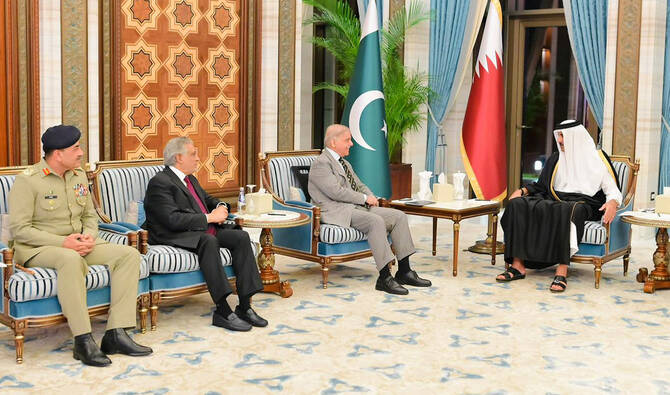
ISLAMABAD: Pakistan and Qatar on Tuesday agreed to deepen their strategic and economic cooperation during high-level talks between Prime Minister Shehbaz Sharif and his Qatari counterpart Sheikh Mohammed bin Abdulrahman bin Jassim Al Thani, Sharif’s office said.
Sharif visited Qatar along with a high-level delegation on the invitation of Qatari emir Sheikh Tamim bin Hamad Al Thani. The Pakistani premier also held meetings with Qatar’s trade and defense ministers to discuss cooperation in various domains.
The visit came at a time when Pakistan is seeking closer economic engagement with Gulf partners amid its broader push to stabilize the economy and attract investment, while maintaining security and defense cooperation with key regional states.
During their meeting in Doha, PM Sharif and Qatar’s Sheikh Mohammed discussed bilateral relations and exchanged views on regional and international developments, according to the Pakistan prime minister’s office.
“They reaffirmed the strong brotherly relations between Pakistan and Qatar and expressed satisfaction at the growing momentum in political, economic and institutional ties,” Sharif’s office said.
“Discussions focused on enhancing cooperation in the fields of trade and investment, energy, defense, manpower and labor and culture, with both sides stressing the importance of their task force to accelerate cooperation in all these areas.”
Pakistan and Qatar maintain strong trade and investment ties. In 2022, the office of Qatar’s emir said the Qatar Investment Authority planned to invest $3 billion in Pakistan, targeting sectors including transport, aviation, education, health, media, technology and labor.
Nearly 300,000 Pakistanis live and work in Qatar, according to Pakistan’s foreign office, with many employed in health, education, engineering and public services, as well as construction and transport. The two countries engage through forums such as the Bilateral Political Consultations and the Joint Ministerial Commission.
Sharif said he had productive discussions with Qatar’s emir, Sheikh Tamim bin Hamad Al Thani, on how the two sides could transform their brotherly ties into mutually beneficial economic relationships.
“We also took stock of the regional situation,” he said on X. “Pakistan and Qatar will continue to work together for peace and stability in the region and beyond.”
DIALOGUE WITH AFGHANISTAN
Earlier, Sharif and Qatar’s Deputy PM Sheikh Saoud Al-Thani discussed the situation in Afghanistan and called for dialogue to support regional stability.
The meeting took place amid renewed tensions after Islamabad carried out airstrikes last week on what it described as Tehreek-e-Taliban Pakistan (TTP) targets inside Afghanistan. Kabul said the strikes killed civilians and vowed to respond to what it called a violation of its sovereignty.
“Regional developments were also discussed, in particular the situation in Iran and Afghanistan,” Sharif’s office said in a statement. “Both sides emphasized the importance of dialogue, de-escalation and collective efforts to promote peace and stability in the region.”
This was the second time in less than six months that Pakistan conducted airstrikes in Afghanistan. The last strikes triggered heavy, weeklong clashes between the neighbors along their border before Qatar and Turkiye mediated a ceasefire between them in Oct. last year.
Separately, Sharif held meetings with Qatar’s State Minister for Trade Dr. Ahmed bin Mohammed Al-Sayed and a delegation of the Qatar Businessmen Association (QBA), highlighting Pakistan’s investment-friendly reforms.
He invited QBA members to explore opportunities in infrastructure, logistics, energy, agriculture, technology and export-oriented manufacturing, his office said.