

Thousands join Gaza protests against peace plan

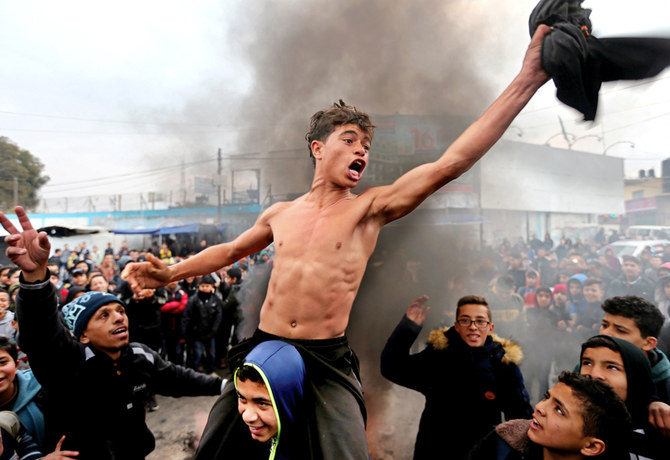
Palestinian students take part in a protest in the southern Gaza Strip, on Wednesday against the US President Donald Trump’s Middle East peace plan. (Reuters)
Short Url
Updated 30 January 2020
Follow

Thousands join Gaza protests against peace plan

  • ‘This plan poses a major challenge that requires us to change our approach to dealing with everything’

GAZA CITY: Thousands of Palestinians have taken to the streets of Gaza to protest against US President Donald Trump’s newly unveiled peace plan for the Middle East.

Youths set fire to tires and burned pictures of Trump and Israeli Prime Minister Benjamin Netanyahu during demonstrations on Tuesday and Wednesday.

Social media was also awash with angry backlashes to the deal which many posters claimed would only exert further pressure on the Palestinian people.

As part of the long-awaited plan, Trump has proposed a Palestinian state double the size of existing Palestinian territories, with East Jerusalem as its capital and a US Embassy there.

But Hamas official Raafat Morra said: “National unity and Palestinian popular steadfastness at home and abroad, adhering to the resistance project by all means, and cooperating with the living forces in the nation, are the best ways to confront the new American-Israeli plan.”

Reiterating Hamas’ comprehensive rejection of the plan, he added that it would lead to the “liquidation of the Palestinian cause, the confirmation of the Israeli occupation, and the cancelation of all Palestinian rights.”

Secretary-general of the Islamic Jihad, Ziyad Al-Nakhalah, said on Wednesday that the US president’s “deal of the century” threw up great challenges.

“This plan poses a major challenge that requires us to change our approach to dealing with everything. This challenge must make us leave the norm and push us to create new facts with our sacrifices and to have the willingness and motivation to confront and address this bullying without hesitation,” he added.

Shops closed and students stayed away from schools on Wednesday in Gaza after Palestinian factions called for a general strike.

Sama Ayoub, 45, said: “My children did not go to school today. We reject the deal of the century, which I believe to be the slap of the century. As (Palestinian) President Abu Mazen (Mahmoud Abbas) said, there will be no peace without obtaining the minimum of our rights.

“What do they want us to accept — that we give up Jerusalem and Al-Aqsa and all our rights, that our lands be confiscated without being refused, that we accept it for money?” she added.

But Raed Dabban, 35, said: “There are exciting aspects of the deal. Our current situation in Palestine is bad, especially in the Gaza Strip.

“Palestinian leaders must search for solutions to reality in the Gaza Strip in particular and strengthen the resilience of the Palestinians in the West Bank and Jerusalem, so that everyone can reject with all power the concessions that compromise our rights.

“We are on the threshold of a critical stage in our political life and our future, and our living conditions are bad. People cannot stand up without the ingredients for resilience. This is the role of leaders,” he added.

Following a phone conversation with Ismail Haniyeh, Hamas’ political bureau chief, Abbas announced on Tuesday that a delegation from Ramallah would be sent to Gaza for reconciliation talks. Palestinian diplomat Saeb Erekat also said that a delegation from the Fatah party would go to Gaza next week to meet with Hamas.


First rain of autumn falls in Iran’s capital, but the drought-ravaged nation needs far more

Updated 10 December 2025
Follow

First rain of autumn falls in Iran’s capital, but the drought-ravaged nation needs far more

  • Water service reportedly goes out for hours in some neighborhoods of Tehran, home to 10 million people

TEHRAN: Rain fell for the first time in months in Iran’s capital Wednesday, providing a brief respite for the parched Islamic Republic as it suffers through the driest autumn in over a half century.
The drought gripping Iran has seen its president warn the country it may need to move its government out of Tehran by the end of December if there’s not significant rainfall to recharge dams around the capital. Meteorologists have described this fall as the driest in over 50 years across the country — from even before its 1979 Islamic Revolution — further straining a system that expends vast amounts of water inefficiently on agriculture.
The water crisis has even become a political issue in the country, particularly as Israeli Prime Minister Benjamin Netanyahu has repeatedly offered his country’s help to Iran, a nation he launched a 12-day war against in June. Water shortages also have sparked localized protests in the past, something Iran has been trying to avoid as its economy struggles under the weight of international sanctions over its nuclear program.
“The water crisis in Iran has, in recent years, escalated from a recurring drought issue into a profound political and security problem that has the regime leadership concerned,” the New York-based Soufan Center said.
Drying reservoirs, light snowpack challenge Iran
The drought has been a long subject of conversation across Tehran and wider Iran, from government officials openly discussing it with visiting journalists to people purchasing water tanks for their homes. In the capital, government-sponsored billboards call on the public not to use garden hoses outside to avoid waste. Water service reportedly goes out for hours in some neighborhoods of Tehran, home to 10 million people.
Snowpack on the surrounding Alborz Mountains remains low as well, particularly after a summer that saw temperatures rise near 50 degrees Celsius (122 degrees Fahrenheit) in some areas of the country, forcing government buildings to shut down.
Ahad Vazifeh, an official in the government’s Iran Meteorological Organization office, called the drought “unprecedented” in an interview with the Fararu news outlet last week. Precipitation now stands at about 5 percent of what’s considered a normal autumn, he added.
“Even if rain in the winter and spring will be normal, we will have 20 percent shortage,” Vazifeh warned.
Social media videos show people standing in some reservoirs, the water lines clearly visible. Satellite pictures analyzed by The Associated Press also show reservoirs noticeably depleted. That includes the Latyan Dam — one of five key reservoirs — which is now under 10 percent full as Tehran has entered its sixth consecutive year of drought.
The state-owned Tehran Times newspaper, often following the theocracy’s line, was blunt about the scale of the challenge.
“Iran is facing an unprecedented water crisis that threatens not only its agricultural sector but also regional stability and global food markets,” the newspaper said in a story this past weekend. The faithful have also offered prayers for rain at the country’s mosques.
Long-arid Iran faces challenge of climate change
Iran, straddling the Mideast and Asia, long has been arid due to its geography. Its Alborz and Zagros mountain ranges cause a so-called “rain shadow” across much of the nation, blocking moisture coming from the Caspian Sea and the Arabian Gulf.
But the drain on the country’s water supplies has been self-inflicted. Agriculture uses an estimated 90 percent of the country’s water supplies. That hasn’t been stopped even through these recent drought years. That’s in part due to policies stemming from Iran’s 1979 Islamic Revolution and then-Supreme Leader Ayatollah Ruhollah Khomeini, who pledged water would be free for all. The intervening years of the Iran-Iraq war saw the country push for self-sufficiency above all else, irrigating arid lands to grow water-intensive crops like wheat and rice, and overdrilling wells.
Experts have described Iran as facing “water bankruptcy” over its decisions. In the past, Iranian officials have blamed their neighbors in part for their water shortage, with hard-line former President Mahmoud Ahmadinejad at one point falsely suggesting that “the enemy destroys the clouds that are headed toward our country and this is a war Iran will win.”
But that’s changed with the severity of the crisis leading to current President Masoud Pezeshkian warning the capital may need to be moved. However, such a decision would cost billions of dollars the country likely doesn’t have as it struggles through a major economic crisis.
Meanwhile, climate change likely has accelerated the droughts plaguing Iraq, which has seen the driest year on record since 1933, as well as Syria and Iran, said World Weather Attribution, a group of international scientists who study global warming’s role in extreme weather.
With the climate warmed by 1.3 degrees Celsius (2.3 degrees Fahrenheit) due to fossil fuel burning, the severity of drought seen in Iran over the last year can be expected to return every 10 years, the group said. If the temperature hadn’t risen by that much, it could be expected between every 50 to 100 years, it added.
“The current acute crisis is part of a longer term water crisis in Iran and the wider region that results from a range of issues including, frequent droughts with increasing evaporation rates, water-intensive agriculture and unsustainable groundwater extraction,” World Weather Attribution said in a recent report.
“These combined pressures contribute to chronic water stress in major urban centers including Tehran, reportedly at risk of severe water shortages and emergency rationing, while also straining agricultural productivity and heightening competition over scarce resources.”