

Fears rise among Pakistani students in China as coronavirus death toll mounts

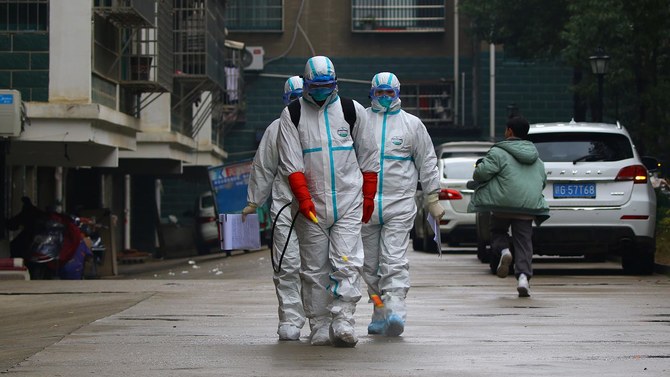
Workers from local disease control and prevention department in protective suits disinfect a residential area following the outbreak of a new coronavirus in China, Jan. 25, 2020. (CNSPHOTO via REUTERS)
Short Url
Updated 15 March 2020
Follow

Fears rise among Pakistani students in China as coronavirus death toll mounts

  • About 28,000 Pakistanis are studying in China
  • Pakistani authorities have not announced any evacuation plans

ISLAMABAD: Pakistani students in China said on Tuesday that they were living in fear as the number of known cases of the new coronavirus was rapidly rising, infecting thousands of people and killing at least 106.

According to China’s National Health Commission, 4,547 infections have been reported as of Tuesday, a surge from Monday’s figure of 2,835.

About 28,000 Pakistani students are studying China, with 500 of them in Wuhan – a city of 11 million in Hubei province and the epicenter of the coronavirus outbreak – according to Foreign Office data.

“Fear and panic is all around due to the mounting death toll and rapid spread of the virus,” Muhammad Sadiq, a doctoral student in Wuhan, told Arab News on the telephone. “But we have been trying to deal with it by remaining in close contact with other fellow students.”

He said that the Chinese government had suspended all vehicular traffic, closed shopping malls, educational institutions, and restricted outdoor activity to prevent further infections.

“We have been confined and isolated to our rooms … streets are deserted and the whole city is virtually locked down,” he said, adding that the Chinese authorities were “doing their best” to facilitate them.

Most of the coronavirus cases have been reported in Hubei, where 17 cities, including Wuhan, have been under lockdown.

The deadly virus has spread to other parts of the world as well, but so far no deaths have been reported outside China.

Hamid Hussain, a Pakistani student at Wuhan University, said that some students had approached the Pakistani Embassy and the Higher Education Commission, seeking their help to get out of the city.

“Some students have appealed for evacuation from the city, but so far it seems impossible as all plane, train and bus links to Wuhan have been suspended,” he said over the phone.

According to Hussain, there was a “mild food shortage” in some parts of the city last week, but now they are “provided with an abundance of food, medicines, masks and all other necessary items.”

Many countries, including the US, Japan, France, and Mongolia have announced their plans to evacuate citizens from Wuhan and other virus-hit areas. But Pakistani authorities have so far expressed satisfaction over the Chinese government’s disease control measures and approach to affected Pakistani nationals.

“We have approached Chinese foreign ministry over complaints about the food shortage and they have informed us that a three-time meal was being provided in the sealed areas,” Pakistani Foreign Minister Shah Mahmood Qureshi said in a statement on Monday night.

The minister added that the Chinese authorities were “fully cooperating” and Pakistan relied on their assistance. “We need their help to secure the lives of our citizens,” he said.


Pakistan reports current account surplus in Jan. owing to improved trade, remittances

Updated 17 February 2026
Follow

Pakistan reports current account surplus in Jan. owing to improved trade, remittances

  • Pakistan’s exports crossed the $3 billion mark in Jan. as the country received $3.5 billion in remittances
  • Last month, IMF urged Pakistan to accelerate pace of structural reforms to strengthen economic growth

ISLAMABAD: Pakistan recorded a current account surplus of more than $120 million in January, the country’s finance adviser said on Tuesday, attributing it to improved trade balance and remittance inflows.

Pakistan’s exports rebounded in January 2026 after five months of weak performance, rising 3.73 percent year on year and surging 34.96 percent month on month, according to data released by the country’s statistics bureau.

Exports crossed the $3 billion mark for the first time in January to reach $3.061 billion, compared to $2.27 billion in Dec. 2025. The country received $3.5 billion in foreign remittances in Jan. 2026.

Khurram Schehzad, an adviser to the finance minister, said Pakistan reported a current account surplus of $121 million in Jan., compared to a current account deficit of $393 million in the same month last year.

“Improved trade balance in January 2026, strong remittance inflows, and sustained momentum in services exports (IT/Tech) continue to reinforce the country’s external account position,” he said on X.

Pakistan has undergone a difficult period of stabilization, marked by inflation, currency depreciation and financing gaps, and international rating agencies have acknowledged improvements after Islamabad began implementing reforms such as privatizing loss-making, state-owned enterprises (SOEs) and ending subsidies as part of a $7 billion International Monetary Fund (IMF) loan program.

Late last month, the IMF urged Pakistan to accelerate the pace of these structural reforms to strengthen economic growth.

Responding to questions from Arab News at a virtual media roundtable on emerging markets’ resilience, IMF’s director of the Middle East and Central Asia Jihad Azour said Islamabad’s implementation of the IMF requirements had been “strong” despite devastating floods that killed more than 1,000 people and devastated farmland, forcing the government to revise its 4.2 percent growth target to 3.9 percent.

“What is important going forward in order to strengthen growth and to maintain the level of macroeconomic stability is to accelerate the structural reforms,” he said at the meeting.

Azour underlined Pakistan’s plans to privatize some of the SOEs and improve financial management of important public entities, particularly power companies, as an important way for the country to boost its capacity to cater to the economy for additional exports.

“This comes in addition to the effort that the authorities have made in order to reform their tariffs, which will allow the private sector of Pakistan to become more competitive,” the IMF official said.