LOS ANGELES: A baseball coach, two teenage girls and their parents and the pilot were among the victims of the helicopter crash that killed basketball legend Kobe Bryant and his daughter on Sunday.
Here is what we know so far about the victims.
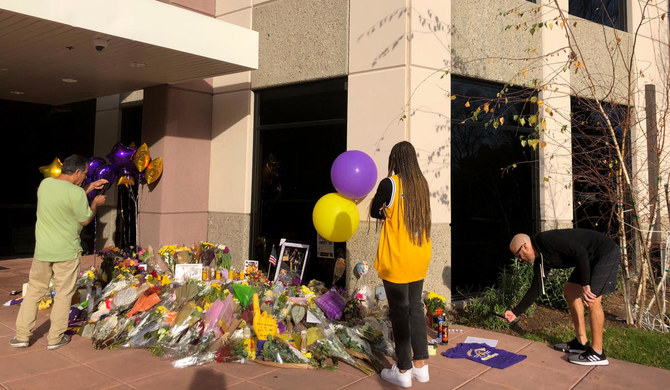
Authorities have not yet officially identified all the victims but family and friends have shared their grief in public announcements or postings on social media.
Bryant, 41, died in the crash along with his 13-year-old daughter Gianna as they were heading from Orange County, where he lives, to a youth basketball academy — Mamba Academy — northwest of Los Angeles.
John Altobelli, 56, the head baseball coach at Orange Coast College in Costa Mesa, California, died in the crash along with his wife Keri and their daughter Alyssa.
The college confirmed their deaths in a statement.
“John meant so much to not only Orange Coast College, but to baseball,” the college’s athletic director Jason Kehler said in a statement. “He truly personified what it means to be a baseball coach. The passion that he put into the game, but more importantly his athletes, was second to none — he treated them like family.”
Christina Mauser, 38, was the assistant coach for Gianni Bryant’s Mamba Academy basketball team.
“I got three small kids and am trying to figure out how to navigate life with three kids and no mom,” her husband Matt told NBC news.
Sarah and Payton Chester, a mother and daughter, lived in Orange County and died in the crash, family and friends said.
“They had to get on the helicopter as a convenience today, they usually drove by car,” Payton’s grandmother Catherine George told NBC.
Ara Zobayan, a commercial helicopter pilot and flight instructor, was flying Bryant’s private chopper when it crashed into a hillside near Los Angeles and burst into flames, according to media report and tributes posted online.

Teens, parents among victims of crash that killed Kobe Bryant
Short Url
https://arab.news/rtner
Teens, parents among victims of crash that killed Kobe Bryant
- Authorities have not yet officially identified all the victims but family and friends have shared their grief in public announcements or postings on social media
- Ara Zobayan, a commercial helicopter pilot and flight instructor, was flying Bryant’s private chopper when it crashed into a hillside near Los Angeles
Rubio to visit eastern Europe, bolster ties with pro-Trump leaders
- Energy cooperation and NATO commitments will be discussed
- Trump’s hard-right supporters view Hungary’s Orban as a model
MUNICH: US Secretary of State Marco Rubio is set to begin a two-day trip on Sunday, to bolster ties with Slovakia and Hungary, whose conservative leaders, often at odds with other European Union countries, have warm ties with President Donald Trump.
Rubio will use the trip to discuss energy cooperation and bilateral issues, including NATO commitments, the State Department said in an announcement last week.
“These are countries that are very strong with us, very cooperative with the United States, work very closely with us, and it’s a good opportunity to go see them and two countries I’ve never been in,” Rubio told reporters before departing for Europe on Thursday.
Rubio, who in his dual role also serves as Trump’s national security adviser, will meet in Bratislava on Sunday with Slovak Prime Minister Robert Fico, who visited Trump in Florida last month. The US diplomat’s trip follows his participation in the Munich Security Conference over the last few days.
WILL MEET VIKTOR ORBAN ON MONDAY
On Monday, Rubio is expected to meet with Hungarian leader Viktor Orban, who is trailing in most polls ahead of an election in April when he could be voted out of power.
“The President said he’s very supportive of him, and so are we,” Rubio said. “But obviously we were going to do that visit as a bilateral visit.”
Orban, one of Trump’s closest allies in Europe, is considered by many on the American hard-right as a model for the US president’s tough policies on immigration and support for families and Christian conservatism. Budapest has repeatedly hosted Conservative Political Action Conference events, which bring together conservative activists and leaders, with another due in March.
TIES WITH MOSCOW AND CLASHES WITH THE EU
Both Fico and Orban have clashed with EU institutions over probes into backsliding on democratic rules.
They have also maintained ties with Moscow, criticized and at times delayed the imposition of EU sanctions on Russia and opposed sending military aid to Ukraine.
Even as other European Union countries have secured alternative energy supplies after Moscow invaded Ukraine in 2022, including by buying US natural gas, Slovakia and Hungary have also continued to buy Russian gas and oil, a practice the United States has criticized.
Rubio said this would be discussed during his brief tour, but did not give any details.
Fico, who has described the European Union as an institution that is in “deep crisis”, has showered Trump with praise saying he would bring peace back to Europe.
But Fico criticized the US capture of Venezuelan President Nicolas Maduro in early January.
Hungary and Slovakia have also so far diverged from Trump on NATO spending.
They have raised defense spending to NATO’s minimum threshold of 2 percent of GDP.
Fico has, however, refused to raise expenditure above that level for now, even though Trump has repeatedly asked all NATO members to increase their military spending to 5 percent. Hungary has also planned for 2 percent defense spending in this year’s budget.
On nuclear cooperation, Slovakia signed an agreement with the United States last month and Fico has said US-based Westinghouse was likely to build a new nuclear power plant.
He also said after meeting the chief of France’s nuclear engineering company Framatome during the week he would welcome more companies taking part in the project.
Rubio will use the trip to discuss energy cooperation and bilateral issues, including NATO commitments, the State Department said in an announcement last week.
“These are countries that are very strong with us, very cooperative with the United States, work very closely with us, and it’s a good opportunity to go see them and two countries I’ve never been in,” Rubio told reporters before departing for Europe on Thursday.
Rubio, who in his dual role also serves as Trump’s national security adviser, will meet in Bratislava on Sunday with Slovak Prime Minister Robert Fico, who visited Trump in Florida last month. The US diplomat’s trip follows his participation in the Munich Security Conference over the last few days.
WILL MEET VIKTOR ORBAN ON MONDAY
On Monday, Rubio is expected to meet with Hungarian leader Viktor Orban, who is trailing in most polls ahead of an election in April when he could be voted out of power.
“The President said he’s very supportive of him, and so are we,” Rubio said. “But obviously we were going to do that visit as a bilateral visit.”
Orban, one of Trump’s closest allies in Europe, is considered by many on the American hard-right as a model for the US president’s tough policies on immigration and support for families and Christian conservatism. Budapest has repeatedly hosted Conservative Political Action Conference events, which bring together conservative activists and leaders, with another due in March.
TIES WITH MOSCOW AND CLASHES WITH THE EU
Both Fico and Orban have clashed with EU institutions over probes into backsliding on democratic rules.
They have also maintained ties with Moscow, criticized and at times delayed the imposition of EU sanctions on Russia and opposed sending military aid to Ukraine.
Even as other European Union countries have secured alternative energy supplies after Moscow invaded Ukraine in 2022, including by buying US natural gas, Slovakia and Hungary have also continued to buy Russian gas and oil, a practice the United States has criticized.
Rubio said this would be discussed during his brief tour, but did not give any details.
Fico, who has described the European Union as an institution that is in “deep crisis”, has showered Trump with praise saying he would bring peace back to Europe.
But Fico criticized the US capture of Venezuelan President Nicolas Maduro in early January.
Hungary and Slovakia have also so far diverged from Trump on NATO spending.
They have raised defense spending to NATO’s minimum threshold of 2 percent of GDP.
Fico has, however, refused to raise expenditure above that level for now, even though Trump has repeatedly asked all NATO members to increase their military spending to 5 percent. Hungary has also planned for 2 percent defense spending in this year’s budget.
On nuclear cooperation, Slovakia signed an agreement with the United States last month and Fico has said US-based Westinghouse was likely to build a new nuclear power plant.
He also said after meeting the chief of France’s nuclear engineering company Framatome during the week he would welcome more companies taking part in the project.
© 2026 SAUDI RESEARCH & PUBLISHING COMPANY, All Rights Reserved And subject to Terms of Use Agreement.


