

Pakistan says Afghan president’s comments on Pashteen’s arrest 'unwarranted'

This photograph taken on Jan. 22, 2020, shows the external view of the Ministry of Foreign Affairs in Islamabad. (AN photo)
Short Url
Updated 28 January 2020
Follow

Pakistan says Afghan president’s comments on Pashteen’s arrest 'unwarranted'

  • Ghani said he was ‘troubled’ by the arrest
  • Ghani’s tweets ‘are a clear interference in Pakistan’s internal affairs’ – FO

ISLAMABAD: Pakistan has condemned Afghan President Ashraf Ghani’s statement on the arrest of Manzoor Pashteen, the leader of Pashtun Tahafuz Movement (PTM).
“We have noted with serious concern the recent tweets by President Ashraf Ghani, which are a clear interference in Pakistan’s internal affairs and hence, unwarranted,” the Foreign Office said in a statement, adding that Pakistan wishes to maintain close relations with Afghanistan “based on the principles of non-intervention and non-interference.”
The words came after Ghani’s Twitter post on Monday, in which he expressed his worry over the PTM leader’s detention.
“I am troubled by the arrest of Manzoor Pashteen and his colleagues. I fully echo the concerns raised by Amnesty International in this regard and hope for their immediate release,” Ghani said, adding that while the region is suffering due to violent extremism, “must support and encourage peaceful civilian movements for justice and must avoid any means of force and violence against these movements.”

PTM is a movement that says it advocates Pashtun rights in Khyber Pakhtunkhwa and Balochistan provinces, which have significant Pashtun populations. The Pashtuns are also the largest ethnic group in Afghanistan.
Following Pashteen’s arrest by police in Peshawar on Monday, the PTM called for a countrywide protest, while lawmakers from tribal areas requested his release.
Addressing a press conference in Islamabad, Mohsin Dawar, a National Assembly (MNA) member from North Waziristan tribal district, said that Pashteen had been “abducted by police.”
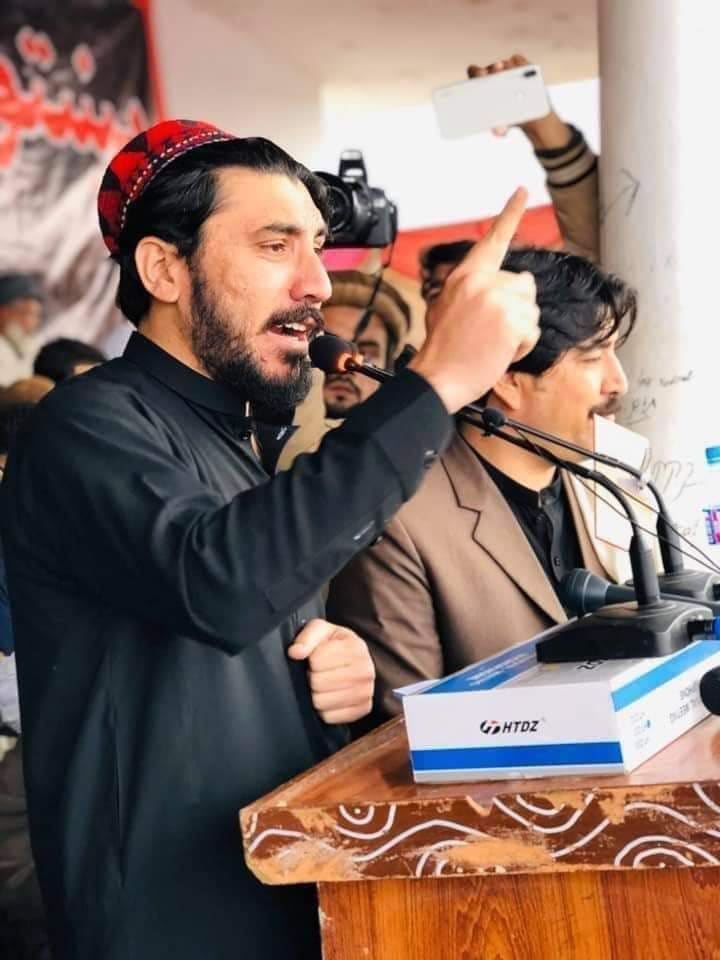


In this undated file photo, Pashtun Tahaffuz Movement (PTM) central leader Manzoor Pashteen addresses a crowd in Peshawar. (Photo courtesy: PTM)

Another lawmaker, Ali Wazir from South Waziristan tribal district, said that police did not provide information why Pashteen was detained.
“A day earlier, Defense Minister Pervez Khattak has approached us for negotiations to resolve our problems, but the arrest of our central leader soon after Khattak’s talks offer is a big question mark. We will offer stout resistance if Pashteen is not released soon,” Wazir said.


Pakistan reports current account surplus in Jan. owing to improved trade, remittances

Updated 4 sec ago
Follow

Pakistan reports current account surplus in Jan. owing to improved trade, remittances

  • Pakistan’s exports crossed the $3 billion mark in Jan. as the country received $3.5 billion in remittances
  • Last month, IMF urged Pakistan to accelerate pace of structural reforms to strengthen economic growth

ISLAMABAD: Pakistan recorded a current account surplus of more than $120 million in January, the country’s finance adviser said on Tuesday, attributing it to improved trade balance and remittance inflows.

Pakistan’s exports rebounded in January 2026 after five months of weak performance, rising 3.73 percent year on year and surging 34.96 percent month on month, according to data released by the country’s statistics bureau.

Exports crossed the $3 billion mark for the first time in January to reach $3.061 billion, compared to $2.27 billion in Dec. 2025. The country received $3.5 billion in foreign remittances in Jan. 2026.

Khurram Schehzad, an adviser to the finance minister, said Pakistan reported a current account surplus of $121 million in Jan., compared to a current account deficit of $393 million in the same month last year.

“Improved trade balance in January 2026, strong remittance inflows, and sustained momentum in services exports (IT/Tech) continue to reinforce the country’s external account position,” he said on X.

Pakistan has undergone a difficult period of stabilization, marked by inflation, currency depreciation and financing gaps, and international rating agencies have acknowledged improvements after Islamabad began implementing reforms such as privatizing loss-making, state-owned enterprises (SOEs) and ending subsidies as part of a $7 billion International Monetary Fund (IMF) loan program.

Late last month, the IMF urged Pakistan to accelerate the pace of these structural reforms to strengthen economic growth.

Responding to questions from Arab News at a virtual media roundtable on emerging markets’ resilience, IMF’s director of the Middle East and Central Asia Jihad Azour said Islamabad’s implementation of the IMF requirements had been “strong” despite devastating floods that killed more than 1,000 people and devastated farmland, forcing the government to revise its 4.2 percent growth target to 3.9 percent.

“What is important going forward in order to strengthen growth and to maintain the level of macroeconomic stability is to accelerate the structural reforms,” he said at the meeting.

Azour underlined Pakistan’s plans to privatize some of the SOEs and improve financial management of important public entities, particularly power companies, as an important way for the country to boost its capacity to cater to the economy for additional exports.

“This comes in addition to the effort that the authorities have made in order to reform their tariffs, which will allow the private sector of Pakistan to become more competitive,” the IMF official said.