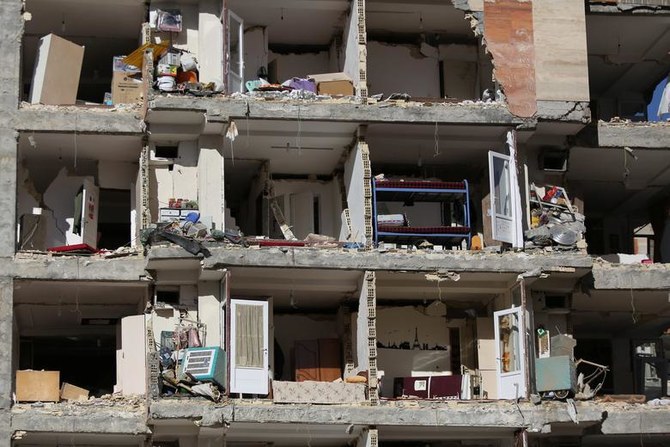
Magnitude 5.4 quake hits southern Iran — state TV

A damaged building is seen following an earthquake in Sarpol-e Zahab county in Kermanshah, Iran. (Reuters)
Short Url
Updated 27 January 2020
Follow

Magnitude 5.4 quake hits southern Iran — state TV

  • There were no fatalities, but there was structural damage to homes in the area of the quake

DUBAI: A magnitude 5.4 earthquake struck Fars province in southern Iran on Monday, Iranian state TV reported.
There were no fatalities, but there was structural damage to homes in the area of the quake, which hit near the town of Khane Zenian, the head of emergency services for Fars province said, according to the semi-official Fars news agency.
Assessment teams have been dispatched to the quake site, which is not a very populous area, the head of rescue for Iran’s Red Crescent, Morteza Salimi, told state TV.
Posts on social media said that the earthquake had been felt by residents of the provincial capital Shiraz, approximately 50 km (30 miles) away from the epicenter.


World not ready for rise in extreme heat, scientists say

A man drinks water under the sun on a beach in Puerto Madryn, Chubut province, Argentina on January 26, 2024. (AFP)
Updated 5 sec ago
Follow

World not ready for rise in extreme heat, scientists say

  • In a new study, they looked at different global warming scenarios to project how often people in the future might experience temperatures considered uncomfortably hot or cold

PARIS: Nearly 3.8 billion people could face extreme heat by 2050, and while tropical countries will bear the brunt, cooler regions will also need to adapt, scientists said Monday.

Demand for cooling will “drastically” increase in large countries like Brazil, Indonesia, and Nigeria, where hundreds of millions of people lack air conditioning or other means to beat the heat.

But even a moderate increase in hotter days could have a “severe impact” in nations not accustomed to such conditions, such as Canada, Russia, and Finland, said scientists from the University of Oxford.

In a new study, they looked at different global warming scenarios to project how often people in the future might experience temperatures considered uncomfortably hot or cold.

They found “that the population experiencing extreme heat conditions is projected to nearly double” by 2050 if global average temperatures rise 2°C above preindustrial times.

But most of the impact would be felt this decade as the world fast approaches the 1.5°C mark, said the study’s lead author Jesus Lizana.

“The key takeaway from this is that the need for adaptation to extreme heat is more urgent than previously known,” said Lizana, an environmental scientist.

“New infrastructure, such as sustainable air conditioning or passive cooling, needs to be built out within the next few years to ensure people can cope with dangerous heat.”

Prolonged exposure to extreme heat can overwhelm the body’s natural cooling systems, causing symptoms ranging from dizziness and headaches to organ failure and death.

It is often called a silent killer because most heat deaths occur gradually as high temperatures and other environmental factors work together to undermine the body’s internal thermostat.

Climate change is making heatwaves longer and stronger, and access to cooling — especially air conditioning — will be vital in the future.

The study, published in the journal Nature Sustainability, projected that 3.79 billion people worldwide could be exposed to extreme heat by mid century.

This would “drastically” increase energy demand for cooling in developing nations where the gravest health consequences would be felt. India, the Philippines, and Bangladesh would be among the countries with the largest populations affected.

The most significant change in “cooling degree days” — temperatures hot enough to require cooling, such as air conditioning or fans — was projected in tropical or equatorial countries, particularly in Africa.

Central African Republic, Nigeria, South Sudan, Laos, and Brazil saw the biggest rise in dangerously hot temperatures.

“Put simply, the most disadvantaged people are the ones who will bear the brunt of this trend, our study shows for ever hotter days,” said urban climate scientist and research co-author Radhika Khosla.

But wealthier countries in traditionally cooler climates also “face a major problem — even if many do not realize it yet,” she added.

Countries like Canada, Russia, and Finland may experience steep drops in “heating degree days” — temperatures low enough to require indoor heating — under a 2°C scenario.

But even a moderate rise in hotter temperatures would be felt more acutely in countries not designed to withstand heat, the authors said.

In these countries, homes and buildings are usually built to maximize sunlight and minimize ventilation, and public transport runs without air conditioning.

Some cold-climate nations may see a drop in heating bills, Lizana said, but over time these savings would likely be replaced by cooling costs, including in Europe, where air conditioning is still rare.

“Wealthier countries cannot sit back and assume they will be OK — in many cases, they are dangerously underprepared for the heat that is coming over the next few years,” he said.