

Palestinians call on world to reject Trump peace plan

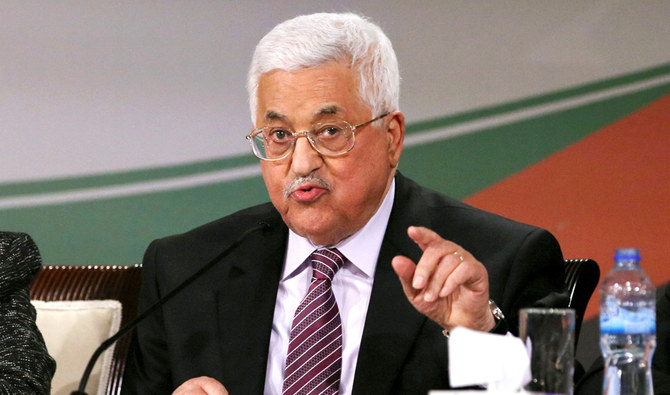
Palestinian President Mahmoud Abbas. (REUTERS file photo)
Short Url
Updated 28 January 2020
Follow

Palestinians call on world to reject Trump peace plan

  • The US proposal may also seek to give Israel the green light to annex the Jordan Valley, a key territory that constitutes around 30 percent of the West Bank

RAMALLAH: The Palestinians on Monday urged world powers to reject Donald Trump’s peace plan, which they said President Mahmud Abbas had refused to discuss with his US counterpart despite several outreaches.
Trump is due to unveil his proposal for Middle East peace this week in Washington, where he is scheduled to meet Israeli Prime Minister Benjamin Netanyahu and opposition leader Benny Gantz.
Palestinian leaders, who have not been invited to the White House, have already rejected the US initiative and insist that Trump’s administration has forfeited its role as an honest broker in the conflict due to what they say is the president’s pro-Israel bias.
“We call on the international community to not be partners in this (plan) because it contravenes international law,” Palestinian Prime Minister Mohammed Shtayyeh told journalists ahead of a weekly cabinet meeting.
The details of Trump’s initiative, which has been in the works since 2017, are not yet public.
But his administration has already recognized Israeli sovereignty over the Golan Heights, which the Jewish state captured from Syria in the Six-Day War of 1967 and stopped referring to the West Bank as “occupied” territory.
It also no longer considers Israeli settlements there as inconsistent with international law and most analysts expect his proposal to reaffirm his administration’s positions.
Trump also broke with decades of international consensus that the fate of Jerusalem should be negotiated between the parties when he recognized the disputed city as Israel’s capital in December 2017.
He is releasing the plan as he faces impeachment hearings over abuse of office and while Netanyahu battles serious corruption charges during a neck-and-neck election against Gantz.
“This a plan to protect Trump from impeachment and protect Netanyahu from prison. It is not a Middle East peace plan,” Shtayyeh told a Cabinet meeting.
Previously released parts of the Trump initiative purport to offer the Palestinians substantial economic incentives.

FASTFACT

US President Donald Trump is due to unveil his proposal for Middle East peace this week in Washington, where he is scheduled to meet Israeli Prime Minister Benjamin Netanyahu and opposition leader Benny Gantz.

“The rights of the Palestinian people are not for sale,” Shtayyeh said. “This plan gives Israel sovereignty over Palestinian territory.”
Three Palestinian officials, speaking on condition of anonymity, told AFP on Monday that Trump had made several attempts to discuss the plan with Abbas in recent weeks, but the Palestinian president had rejected those outreaches.
“There will be no discussion with the Americans until they recognize the two-state solution,” one senior official said.
A spokesperson for the American Embassy in Jerusalem was not immediately available for comment.
Some have speculated that the US proposal could pull back from supporting the creation of a Palestinian state with its capital in East Jerusalem, the common definition of the two-state solution.
The US proposal may also seek to give Israel the green light to annex the Jordan Valley, a key territory that constitutes around 30 percent of the West Bank.
Israeli Interior Minister Aryeh Deri toured the Jordan Valley Monday, saying they were taking steps toward the move — a central election promise of right winger Netanyahu.
“As interior minister I’d like to tell you, we’ve started to prepare for an annexation — we are getting the paper-work ready,” Deri said in a statement.
In Gaza on Monday a few hundred Palestinians protested against the Trump plan, which Palestinians ironically call the “Deal of the Century.”
Further protests were expected on Wednesday, when the plan is expected to be public.


Israel’s settler movement takes victory lap as a sparse outpost becomes a settlement within a month

Updated 21 January 2026
Follow

Israel’s settler movement takes victory lap as a sparse outpost becomes a settlement within a month

  • Smotrich, who has been in charge of Israeli settlement policy for the past three years, has overseen an aggressive construction and expansion binge aimed at dismantling any remaining hopes of establishing a Palestinian state in the occupied West Bank

YATZIV SETTLEMENT, West Bank: Celebratory music blasting from loudspeakers mixed with the sounds of construction, almost drowning out calls to prayer from a mosque in the Palestinian town across this West Bank valley.
Orthodox Jewish women in colorful head coverings, with babies on their hips, shared platters of fresh vegetables as soldiers encircled the hilltop, keeping guard.
The scene Monday reflected the culmination of Israeli settlers’ long campaign to turn this site, overlooking the Palestinian town of Beit Sahour, into a settlement. Over the years, they fended off plans to build a hospital for Palestinian children on the land, always holding tight to the hope the land would one day become theirs.
That moment is now, they say.
Smotrich goes on settlement spree
After two decades of efforts, it took just a month for their new settlement, called “Yatziv,” to go from an unauthorized outpost of a few mobile homes to a fully recognized settlement. Fittingly, the new settlement’s name means “stable” in Hebrew.
“We are standing stable here in Israel,” Finance Minister and settler leader Bezalel Smotrich told The Associated Press at Monday’s inauguration ceremony. “We’re going to be here forever. We will never establish a Palestinian state here.”
With leaders like Smotrich holding key positions in Israel’s government and establishing close ties with the Trump administration, settlers are feeling the wind at their backs.
Smotrich, who has been in charge of Israeli settlement policy for the past three years, has overseen an aggressive construction and expansion binge aimed at dismantling any remaining hopes of establishing a Palestinian state in the occupied West Bank.
While most of the world considers the settlements illegal, their impact on the ground is clear, with Palestinians saying the ever-expanding construction hems them in and makes it nearly impossible to establish a viable independent state. The Palestinians seek the West Bank, captured by Israel in 1967, as part of a future state.
With Netanyahu and Trump, settlers feel emboldened
Settlers had long set their sights on the hilltop, thanks to its position in a line of settlements surrounding Jerusalem and because they said it was significant to Jewish history. But they put up the boxy prefab homes in November because days earlier, Palestinian attackers had stabbed an Israeli to death at a nearby junction.
The attack created an impetus to justify the settlement, the local settlement council chair, Yaron Rosenthal, told AP. With the election of Israel’s far-right government in late 2022, Trump’s return to office last year and the November attack, conditions were ripe for settlers to make their move, Rosenthal said.
“We understood that there was an opportunity,” he said. “But we didn’t know it would happen so quickly.”
“Now there is the right political constellation for this to happen.”
Smotrich announced approval of the outpost, along with 18 others, on Dec. 21. That capped 20 years of effort, said Nadia Matar, a settler activist.
“Shdema was nearly lost to us,” said Matar, using the name of an Israeli military base at the site. “What prevented that outcome was perseverance.”
Back in 2006, settlers were infuriated upon hearing that Israel’s government was in talks with the US to build a Palestinian children’s hospital on the land, said Hagit Ofran, a director at Peace Now, an anti-settlement watchdog group, especially as the US Agency for International Development was funding a “peace park” at the base of the hill.
The mayor of Beit Sahour urged the US Consulate to pressure Israel to begin hospital construction, while settlers began weekly demonstrations at the site calling on Israel to quash the project, according to consulate files obtained through WikiLeaks.
It was “interesting” that settlers had “no religious, legal, or ... security claim to that land,” wrote consulate staffer Matt Fuller at the time, in an email he shared with the AP. “They just don’t want the Palestinians to have it — and for a hospital no less — a hospital that would mean fewer permits for entry to Jerusalem for treatment.”
The hospital was never built. The site was converted into a military base after the Netanyahu government came to power in 2009. From there, settlers quickly established a foothold by creating makeshift cultural center at the site, putting on lectures, readings and exhibits
Speaking to the AP, Ehud Olmert, the Israeli prime minister at the time the hospital was under discussion, said that was the tipping point.
“Once it is military installation, it is easier than to change its status into a new outpost, a new settlement and so on,” he said.
Olmert said Netanyahu — who has served as prime minister nearly uninterrupted since then — was “committed to entirely different political directions from the ones that I had,” he said. “They didn’t think about cooperation with the Palestinians.”
Palestinians say the land is theirs
The continued legalization of settlements and spiking settler violence — which rose by 27 percent in 2025, according to Israel’s military — have cemented a fearful status quo for West Bank Palestinians.
The land now home to Yatziv was originally owned by Palestinians from Beit Sahour, said the town’s mayor, Elias Isseid.
“These lands have been owned by families from Beit Sahour since ancient times,” he said.
Isseid worries more land loss is to come. Yatziv is the latest in a line of Israeli settlements to pop up around Beit Sahour, all of which are connected by a main highway that runs to Jerusalem without entering Palestinian villages. The new settlement “poses a great danger to our children, our families,” he said.
A bypass road, complete with a new yellow gate, climbs up to Yatziv. The peace park stands empty.