

Two Iraq protesters killed as anti-government unrest persists

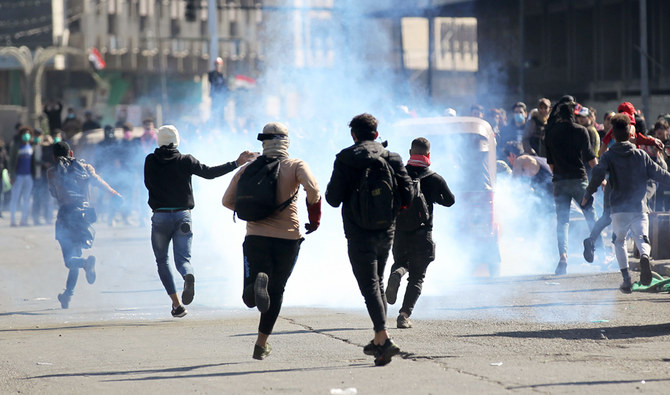
Iraqi protesters rush to catch a tear gas canisters fired by security forces during clashes following an anti-government demonstration in Al-Khilani square in the capital Baghdad, on January 26, 2020. (AFP)
Short Url
Updated 27 January 2020
Follow

Two Iraq protesters killed as anti-government unrest persists

  • The unidentified gunmen fired on protesters, killing 1 and wounding 4 others
  • The main protest camp in the holy city of Najaf was also burned down overnight by unidentified gunmen

BAGHDAD: Unidentified gunmen shot dead two protesters in the southern Iraqi city of Nassiriya after security forces began a crackdown on months-long demonstrations against the country's largely Iran-backed ruling elite.
At least 75 protesters were wounded, mainly by live bullets, in clashes in Nassiriya overnight when security forces attempted to move them away from bridges in the city, police and health source said.
On Monday morning, clashes resumed in central Baghdad as police fired tear gas at demonstrators, Reuters reporters said.

HIGHLIGHT

The mass protests started in October over widespread government corruption and a lack of public services and jobs.

Hours later, determined protesters had rallied again and shut down two main bridges in the city, some 350 kilometers south of the capital Baghdad.

The main protest camp in the holy city of Najaf was also burned down overnight by unidentified gunmen, AFP’s correspondent there said on Monday.

Mass protests erupted on October 1 in Baghdad and across Iraq’s Shiite-majority south in outrage over lack of jobs, poor services and corruption.

They spiraled into calls for a total government overhaul and are now specifically demanding snap polls, an independent prime minister and the prosecution of anyone implicated in corruption or recent bloodshed.

Protesters tried to ramp up pressure on the government starting a week ago by sealing streets with burning tires and metal barricades, but riot police responded with force.

They fired live rounds and tear gas to disperse clusters of young demonstrators, and 21 protesters have been killed and hundreds wounded in the last week.

That brought the toll from the last four months of rallies close to 480 dead, according to an AFP rally.

On Friday, security forces began moving in on the main protest camps across the country after influential Shiite cleric Moqtada Sadr said he would drop support for the youth-dominated reform campaign.

Sadr supporters swiftly began dismantling their own tents, prompting fears by the remaining activists that they had lost their political cover and would face a crackdown.

But thousands of students turned out Sunday across Iraqi cities to insist on their movement’s resilience and political independence.

Demonstrators have feared that their movement may be eclipsed by tensions between neighboring Iran and the US, which spiraled after the killing early this month of a senior Iranian commander in a US drone strike in Baghdad.

On Sunday evening, three Katyusha rockets slammed into the US embassy in the Iraqi capital, a security source said.

A senior Iraqi official and US diplomatic sources said one person was wounded, but no details were immediately available on whether it was a US national or an Iraqi member of staff at the mission.


Saad Hariri pledges to contest May election

Updated 14 February 2026
Follow

Saad Hariri pledges to contest May election

  • Beirut rally draws large crowds on anniversary of his father’s assassination

BEIRUT: Lebanon’s former Prime Minister Saad Hariri announced on Saturday that his movement, which represents the majority of Lebanon’s Sunni community, would take part in upcoming parliamentary elections scheduled for May.

The Future Movement had suspended its political activities in 2022.

Hariri was addressing a large gathering of Future Movement supporters as Lebanon marked the 21st anniversary of the assassination of his father and former Prime Minister Rafik Hariri, at Martyrs’ Square in front of his tomb.

He said his movement remained committed to the approach of “moderation.”

A minute’s silence was observed by the crowd in Martyrs’ Square at the exact time when, in 2005, a suicide truck carrying about 1,000 kg of explosives detonated along Beirut’s seaside road as Rafik Hariri’s motorcade passed, killing him along with 21 others, including members of his security guards and civilians, and injuring 200 people.

Four members of Hezbollah were accused of carrying out the assassination and were tried in absentia by the Special Tribunal for Lebanon.

The crowd waved Lebanese flags and banners of the Future Movement as they awaited Saad Hariri, who had returned to Beirut from the UAE, where he resides, specifically to commemorate the anniversary, as has been an annual tradition.

Hariri said that “after 21 years, the supporters of Hariri’s approach are still many,” denouncing the “rumors and intimidation” directed at him.

He added: “Moderation is not hesitation … and patience is not weakness. Rafik Hariri’s project is not a dream that will fade. He was the model of a statesman who believed, until martyrdom, that ‘no one is greater than their country.’ The proof is his enduring place in the minds, hearts and consciences of the Lebanese people.”

Hariri said he chose to withdraw from political life after “it became required that we cover up failure and compromise the state, so we said no and chose to step aside — because politics at the expense of the country’s dignity and the project of the state has no meaning.”

He said: “The Lebanese are weary, and after years of wars, divisions, alignments and armed bastions, they deserve a normal country with one constitution, one army, and one legitimate authority over weapons — because Lebanon is one and will remain one. Notions of division have collapsed in the face of reality, history and geography, and the illusions of annexation and hegemony have fallen with those who pursued them, who ultimately fled.”

Hariri said the Future Movement’s project is “One Lebanon, Lebanon first — a Lebanon that will neither slide back into sectarian strife or internal fighting, nor be allowed to do so.”

He added that the Taif Agreement is “the solution and must be implemented in full,” arguing that “political factions have treated it selectively by demanding only what suits them — leaving the agreement unfulfilled and the country’s crises unresolved.”

He said: “When we call for the full implementation of the Taif Agreement, we mean: weapons exclusively in the hands of the state, administrative decentralization, the abolition of political sectarianism, the establishment of a senate and full implementation of the truce agreement. All of this must be implemented — fully and immediately — so we can overcome our chronic problems and crises together.

“Harirism will continue to support any Arab rapprochement, and reject any Arab discord. Those who seek to sow discord between the Gulf and Arab countries will harm only themselves and their reputation.

“We want to maintain the best possible relations with all Arab countries, starting with our closest neighbor, Syria — the new Syria, the free Syria that has rid itself of the criminal and tyrannical regime that devastated it and Lebanon, and spread its poison in the Arab world.”

Hariri said he saluted “the efforts of unification, stabilization and reconstruction led by Syrian President Ahmad Al-Sharaa.”

When asked about the Future Movement’s participation in parliamentary elections following his withdrawal from politics, he said: “Tell me when parliamentary elections will be held, and I will tell you what the Future Movement will do. I promise you that, when the elections take place, they will hear our voices, and they will count our votes.”

The US Embassy in Lebanon shared a post announcing that Ambassador Michel Issa laid a wreath at the grave of Rafik Hariri.

Hariri’s legacy “to forge peace and prosperity continues to resonate years later with renewed significance,” the embassy said.