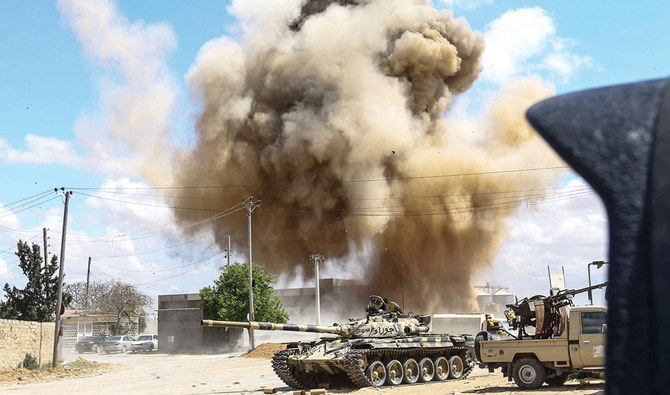

CAIRO: Officials from Libya’s two rival governments said fighting erupted Sunday as the country’s east-based forces advanced toward the strategic western city of Misrata, further eroding a crumbling cease-fire agreement brokered earlier this month.
The clashes came just hours after the UN decried “continued blatant violations” of an arms embargo on Libya by several unspecified countries. The violations fly in the face of recent pledges to respect the embargo made by world powers at an international conference in Berlin last week.
Libya sits on Africa’s Mediterranean coast, and is divided between rival governments, each supported by various armed militias and foreign backers. It has the ninth largest known oil reserves in the world and the biggest oil reserves in Africa.
Turkey has backed the Tripoli-based GNA, while Haftar, who backs a rival administration in the country’s east, has had support from Russia and some Middle Eastern countries.
Haftar’s forces were advancing some 120 km east of Misrata, near the town of Abugrain, according to the media office of militias allied with the Tripoli administration. It said clashes were still taking place in the outskirts of Abugrein.
An official with Haftar’s forces said they have wrested control of two towns, Qaddaheya and Wadi Zamzam, on their way to Abugrein. The official spoke on condition of anonymity.
Misrata, in western Libya, is the country’s second largest city and is home to militias who oppose Haftar and have been extremely important in the government’s defense of Tripoli. Haftar’s forces have laid siege to the capital since last April. The nationwide truce, brokered by Russia and Turkey, marked the first break in fighting in months, but there have been repeated violations.
SPEEDREAD
Haftar’s forces were advancing some 120 km east of Misrata, near the town of Abugrain, according to the media office of militias allied with the Tripoli administration.
Jalel Harchaoui, a Libya expert at The Netherlands Institute of International Relations, said Haftar’s swing toward Misrata was a tactic calculated to draw away the Misratan militias defending the capital toward their hometown. He said it had a “good chance of succeeding” and weakening the UN-government’s defenses in Tripoli as a result.
Haftar’s forces captured Sirte earlier this month, a major below to Tripoli-based administration. Sirte is located about 370 km east of Tripoli.
Late Saturday, the UN support mission in Libya released a statement saying “several (countries) who participated in the Berlin Conference” have been violating the arms embargo.
“Over the last ten days, numerous cargo and other flights have been observed landing at Libyan airports in the western and eastern parts of the country providing the parties with advanced weapons, armored vehicles, advisers and fighters,” the UN statement said.
Among those who attended the Berlin conference were Russian President Vladimir Putin, Turkish President Recep Tayyip Erdogan, French President Emmanuel Macron, Egyptian President Abdel Fattah El-Sisi, Italian Premier Giuseppe Conte, and US Secretary of State Mike Pompeo.
The peace push followed a surge in Haftar’s offensive against Tripoli, which threatened to plunge Libya into chaos rivaling the 2011 conflict that ousted and killed longtime ruler Muammar Qaddafi.
Earlier this month, powerful tribal groups loyal to Haftar also seized several large oil export terminals along the eastern coast as well as southern oil fields. The closure of Libya’s major oil fields and production facilities has resulted in losses of more than $255 million in the six-day period ending Jan. 23, the country’s national oil company said on Saturday.