

Soleimani’s successor faces same fate if he kills Americans Iran warned

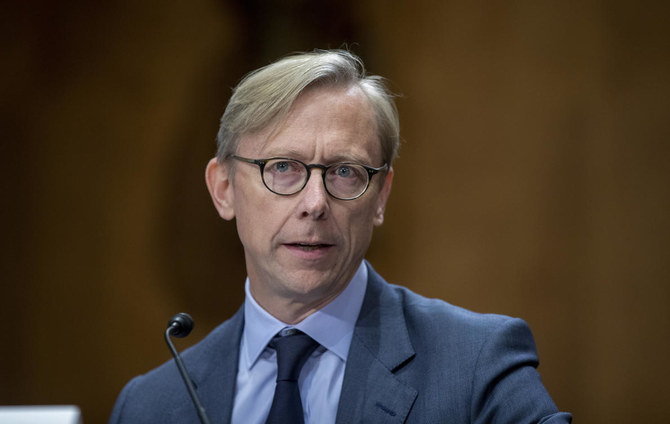
Iran responded to the killing of Soleimani, who was charged with expanding Tehran’s influence across the Middle East, by launching missile strikes on US targets in Iraq, although no US soldiers were killed. (File/AFP)
Short Url
Updated 23 January 2020
Follow

Soleimani’s successor faces same fate if he kills Americans Iran warned

  • Ghaani promised to “continue in this luminous path” taken by Soleimani

DUBAI: The US special representative for Iran said the successor to Qassem Soleimani, who was killed in a US drone strike, would suffer the same fate if he followed a similar path of killing Americans, Asharq Al-Awsat newspaper reported.

Washington blamed Soleimani for masterminding attacks by Iran-aligned militias against US forces in the region. US President Donald Trump ordered the Jan. 3 drone strike in Iraq after a build up of tension over Iran’s nuclear program.

Iran responded to the killing of Soleimani, who was charged with expanding Tehran’s influence across the Middle East, by launching missile strikes on US targets in Iraq, although no US soldiers were killed.

After Soleimani’s death, Tehran swiftly appointed Esmail Ghaani as the new head of the Quds Force, an elite unit in the Revolutionary Guards that handles actions abroad. The new commander pledged to pursue Soleimani’s course.

“If (Esmail) Ghaani follows the same path of killing Americans then he will meet the same fate,” Brian Hook told the Arabic-language daily Asharq Al-Awsat.

He said in the interview in Davos that US President Donald Trump had long made it clear “that any attack on Americans or American interests would be met with a decisive response.”

“This isn’t a new threat. The president has always said that he will always respond decisively to protect American interests,” Hook said. “I think the Iranian regime understands now that they cannot attack America and get away with it.”

After his appointment, Ghaani promised to “continue in this luminous path” taken by Soleimani and said the goal was to drive US forces out of the region, which has long been Iran’s stated policy.

Tensions between Washington and Tehran have steadily increased since Trump withdrew from Iran’s nuclear deal with world powers in 2018 and imposed tough news sanctions that have hammered the Iranian economy.

This month’s military flare-up began in December when rockets fired at US bases in Iraq killed a US contractor. Washington blamed pro-Iran militia and launched air strikes that killed at least 25 fighters. After the militia surrounded the US embassy in Baghdad for two days, Trump ordered the drone strike on Soleimani.


Jailed Turkish Kurd leader calls on government to broker deal for Syrian Kurds

Updated 7 sec ago
Follow

Jailed Turkish Kurd leader calls on government to broker deal for Syrian Kurds

  • Clashes between Syrian forces and the SDF have cast doubt over a deal to integrate the group’s fighters into the army
ANKARA: Jailed Turkish Kurd leader Abdullah Ocalan said Tuesday that it was “crucial” for Turkiye’s government to broker a peace deal between the Kurdish-led Syrian Democratic Forces (SDF) and the Damascus government.
Clashes between Syrian forces and the SDF have cast doubt over a deal to integrate the group’s fighters into the army, which was due to take effect by the end of the year.
Ocalan, founder of the Kurdistan Workers’ Party (PKK) militant group, called on Turkiye to help ensure implementation of the deal announced in March between the SDF and the Syrian government, led by former jihadist Ahmed Al-Sharaa, whose forces ousted longtime ruler Bashar Assad last year.
“It is essential for Turkiye to play a role of facilitator, constructively and aimed at dialogue,” he said in a message released by Turkiye’s pro-Kurdish DEM party.
“This is crucial for both regional peace and to strengthen its own internal peace,” Ocalan, who has been jailed for 26 years, added.
“The fundamental demand made in the agreement signed on March 10 between the SDF and the government in Damascus is for a democratic political model permitting (Syria’s) peoples to govern together,” he added.
“This approach also includes the principle of democratic integration, negotiable with the central authorities. The implementation of the March 10 agreement will facilitate and accelerate that process.”
The backbone of the US-backed SDF is the YPG, a Kurdish militant group seen by Turkiye as an extension of the PKK.
Turkiye and Syria both face long-running unrest in their Kurdish-majority regions, which span their shared border.
In Turkiye, the PKK agreed this year at Ocalan’s urging to end its four-decade armed struggle.
In Syria, Sharaa has agreed to merge the Kurds’ semi-autonomous administration into the central government, but deadly clashes and a series of differences have held up implementation of the deal.
The SDF is calling for a decentralized government, which Sharaa rejects.
Turkish Foreign Minister Hakan Fidan, whose country sees Kurdish fighters across the border as a threat, urged the SDF last week not to be an “obstacle” to stability.
Syrian Kurdish leader Mazloum Abdi said Thursday that “all efforts” were being made to prevent the collapse of talks.