

Pakistani rickshaw driver gives free rides to schoolgirls in Peshawar

Schoolgirls board Arab Shah's auto-rickshaw in Pir Bala on the outskirts of Peshawar on Jan. 21, 2020. (AN photo)
Short Url
Updated 24 January 2020
Follow

Pakistani rickshaw driver gives free rides to schoolgirls in Peshawar

  • Shah supports over 100 schoolgirls from his neighborhood by driving them to school
  • He believes transportation is the biggest obstacle to women’s education in his region

PESHAWAR: When his five sisters were at school age, Arab Shah was not able to support them. Now that he drives an auto-rickshaw, he devotes his time and modest means to help the sisters and daughters of others receive a proper education. 

In Pir Bala on the outskirts of Peshawar, the 29-year-old rickshaw driver takes to school girls from his village.

“I regret I couldn’t be supportive of my sisters in their schooling,” he told Arab News on Tuesday while cleaning his vehicle and getting ready to work. “For spiritual satisfaction, I want to spend my earnings, time and all belongings for the education of poor girls in my village.”
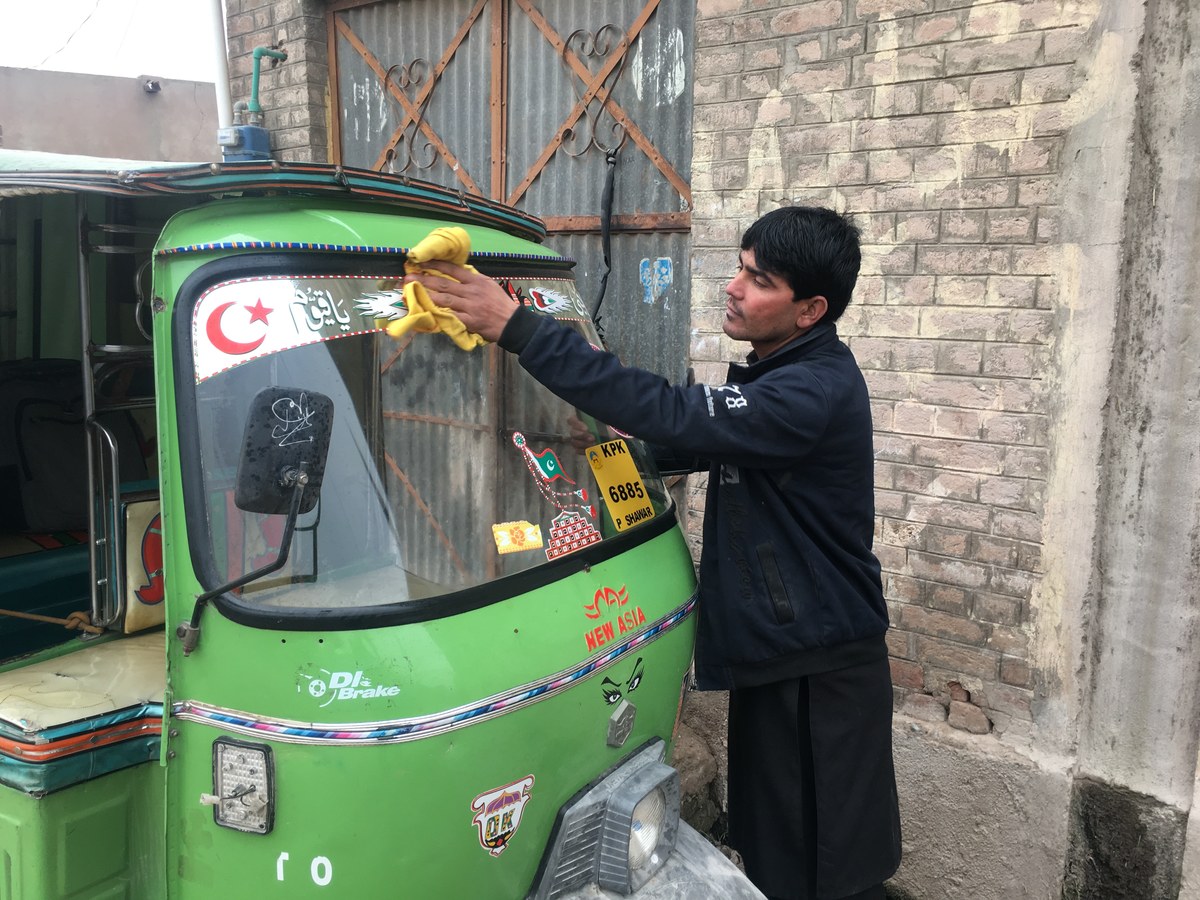


Before starting his day, Arab Shah cleans his vehicle in front of his family home in Pir Bala, Khyber Pakhtunkhwa, Jan. 21, 2020 (AN photo)

With the auto-rickshaw he rents for Rs5,000 a month, Shah supports over 100 schoolgirls from his neighborhood by driving them to school and back home after classes, free of charge. 

Kashmala Ilyas, an eighth-grader whose father works as a watchman at a marble factory, says that “bhaijan” (older brother) Shah is a blessing. “For the past three years, without paying a single rupee, I was able to be at school without any delay,” she said.

When he started in 2014, Shah’s family was not very enthusiastic. But now he is a village hero and elder brothers have taken responsibility for the household, giving him the freedom to continue the voluntary service. “I take my mother to school and madrassa functions, there she receives messages of gratitude, which makes her proud,” he said.

In the beginning, Shah was only giving free school rides to three of his poorer neighbors, but he soon realized that many more need it or they would not be able to attend school at all. He now starts his day at 7:00 a.m. with a series of school trips. When children have classes, he works as a regular driver to earn for gas and his rickshaw rent. In the afternoon, he picks up his young passengers and drives them back to their homes. When some of them need to attend at a local madrassa in the after-school time, they can also rely on him.

When all children are already done with their tuition, Shah goes back to the roads of Peshawar to make sure he can earn enough to keep the rickshaw.
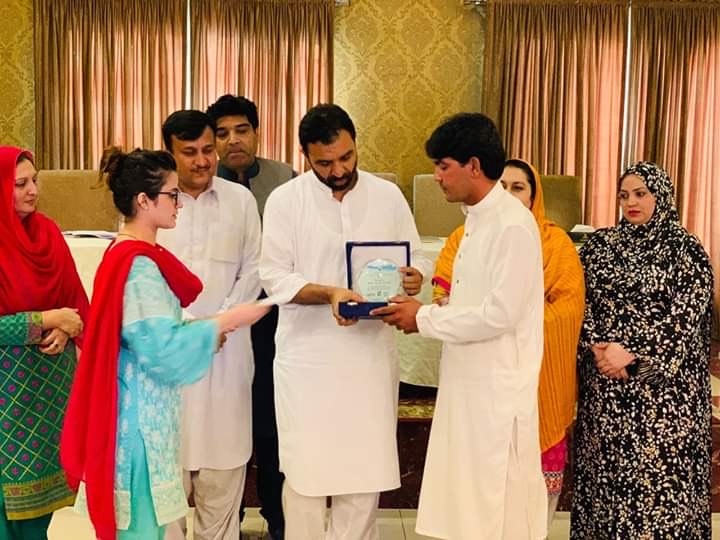


Arab Shah receives a recognition award from Zia Ullah Bangash, the then education adviser to the chief minister of Khyber Pakhtunkhwa, in Peshawar of Aug. 6, 2019. (Photo courtesy: Arab Shah)

“It is becoming difficult with jumping fuel prices, so I work till late night to manage it,” he said. 

Shah believes transportation is the biggest obstacle to women’s education in his region. “It hurts me when girls stop going to school after eighth grade,” he said, expressing hope that one day he will be able to buy a bigger vehicle to do more.

Misri Khan, the mother of a girl whom Shah regularly took to a madrassa, always keeps him in her prayers as her daughter has just completed religious courses. “It wouldn’t be possible without Arab Shah’s commitment. We pray for him to get his own bigger vehicle and help the poor in the neighborhood.” 

Abdul Salam, 23, who works as a welder, has his five sisters brought to school every day by Shah. “Arab Shah is a great man he really reduced the burden on me, our family is grateful to him,” he said. “When it’s is raining, cold or scorching hot, my sisters always reach their school thanks to him.”

Shah’s efforts were noticed beyond his community. In August, a former adviser on education to the KP chief minister, Zia Ullah Bangash, presented him with a recognition shield and prize.


Islamabad dismisses claims about paying up to 8 percent interest on foreign loans as ‘misleading’

Updated 22 February 2026
Follow

Islamabad dismisses claims about paying up to 8 percent interest on foreign loans as ‘misleading’

  • Pakistan has long relied on external loans to help bridge persistent gaps in public finances and foreign exchange reserves
  • Pakistan’s total external debt, liabilities stand at $138 billion at an overall average cost of around 4 percent, ministry says

KARACHI: Pakistan’s finance ministry on Sunday dismissed as “misleading” claims that the country is paying up to 8 percent interest on external loans, saying the overall average cost of external public debt is approximately 4 percent.

Pakistan has long relied on external loans to help bridge persistent gaps in public finances and foreign exchange reserves, driven largely by a narrow tax base, chronic trade deficits, rising debt-servicing costs and repeated balance-of-payments pressures.

Over the decades, successive governments have turned to multilateral and bilateral lenders, including the International Monetary Fund, the World Bank and the Asian Development Bank, to support budgetary needs and shore up foreign exchange reserves.

The finance ministry on Sunday issued a clarification in response to a “recent press commentary” regarding the country’s external debt position and associated interest payments, and said the figures required contextual explanation to ensure accurate understanding of Pakistan’s external debt profile.

“Pakistan’s total external debt and liabilities currently stand at $138 billion. This figure, however, encompasses a broad range of obligations, including public and publicly guaranteed debt, debt of Public Sector Enterprises (both guaranteed and non-guaranteed), bank borrowings, private-sector external debt, and intercompany liabilities to direct investors. It is therefore important to distinguish this aggregate figure from External Public (Government) Debt, which amounts to approximately $92 billion,” it said.

“Of the total External Public Debt, nearly 75 percent comprises concessional and long-term financing obtained from multilateral institutions (excluding the IMF) and bilateral development partners. Only about 7 percent of this debt consists of commercial loans, while another 7 percent relates to long-term Eurobonds. In light of this composition, the claim that Pakistan is paying interest on external loans ‘up to 8 percent’ is misleading.

The overall average cost of External Public Debt is approximately 4 percent, reflecting the predominantly concessional nature of the borrowing portfolio.”

With respect to interest payments, public external debt interest outflows increased from $1.99 billion in Fiscal Year (FY) 2022 to $3.59 billion in FY2025, representing an increase of 80.4 percent, not 84 percent as reported. In absolute terms, interest payments rose by $1.60 billion over this period, not $1.67 billion, it said.

According to the State Bank of Pakistan’s records, Pakistan’s total debt servicing payments to specific creditors during the period under reference were as follows: the IMF received $1.50 billion, of which $580 million constituted interest; Naya Pakistan Certificates payments totaled $1.56 billion, including $94 million in interest; the Asian Development Bank received $1.54 billion, including $615 million in interest; the World Bank received $1.25 billion, including $419 million in interest; and external commercial loans amounted to nearly $3 billion, of which $327 million represented interest payments.

“While interest payments have increased in absolute terms, this rise cannot be attributed solely to an expansion in the debt stock,” the ministry said. “Although the overall debt stock has increased slightly since FY2022, the additional inflows have primarily originated from concessional multilateral sources and the IMF’s Extended Fund Facility (EFF) under the ongoing IMF-supported program.”

Pakistan secured a $7 billion IMF bailout in Sept. 2024 as part of Prime Minister Shehbaz Sharif’s efforts to stabilize the South Asian economy that narrowly averted a default in 2023. The government has since been making efforts to boost trade and bring in foreign investment to consolidate recovery.

“It is also important to note that the increase in interest payments reflects prevailing global interest rate dynamics. In response to the inflation surge of 2021–22, the US Federal Reserve raised the federal funds rate from 0.75-1.00 percent in May 2022 to 5.25–5.50 percent by July 2023. Although rates have since moderated to around 3.75 percent, they remain significantly higher than 2022 levels,” the finance ministry said.

“The government remains committed to prudent debt management, transparency, and the continued strengthening of Pakistan’s macroeconomic stability,” it added.