

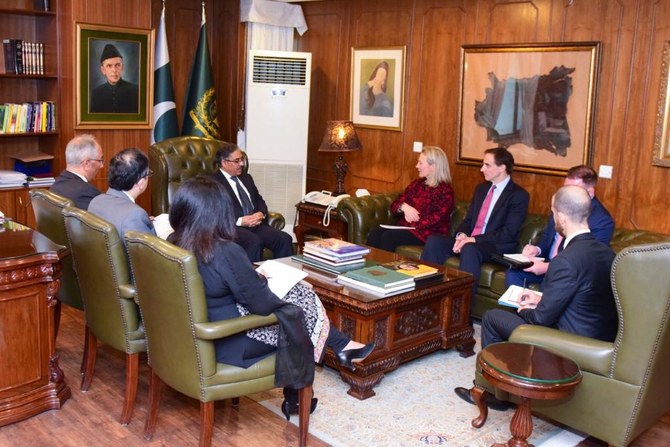
Alice Wells discusses Afghan peace process with Islamabad

US Principal Deputy Assistant Secretary Alice Wells holds talks with Pakistani Foreign Secretary Sohail Mahmood in Islamabad on Jan. 21, 2020. (Photo courtesy: Pakistan Foreign Office)
Short Url
Updated 22 January 2020
Follow

Alice Wells discusses Afghan peace process with Islamabad

  • Islamabad reaffirms commitment to the Afghan peace process, says FO
  • Wells is in Islamabad since Sunday on a four-day visit

ISLAMABAD: The chief US diplomat for South Asian affairs, Alice G. Wells, on Tuesday discussed the ongoing Afghan reconciliation process with Pakistan’s Foreign Secretary Sohail Mahmood in Islamabad, ahead of an expected US-Taliban peace agreement.

The principal deputy assistant secretary for South and Central Asian affairs at the US State Department has been in Pakistan since Sunday on a four-day visit to discuss a host of issues of bilateral interest, including the Afghan peace process.

US-Taliban talks have been ongoing in the Qatari capital, Doha, where they are moving toward a peace deal.

Pakistan has been involved in bringing the Afghan Taliban to the negotiating table with the US to restore peace in the region.

“The two sides (Pakistan and the US) ... discussed recent developments regarding the Afghan peace and reconciliation process,” Pakistan’s Foreign Office said in a statement after the hours-long meeting between Wells and Mahmood.

During the meeting, the statement said Pakistan, has “reaffirmed its resolve to continue to support the peace process and pursue positive development of Pakistan-Afghanistan relations.”

This is the second time in recent months the US and Taliban have appeared close to announcing a peace deal.

In a tweet quoting Wells, the US Bureau of South and Central Asian Affairs said: “A full agenda with #Pakistan MFA (Ministry of Foreign Affairs) FS (Foreign Secretary) Mahmood on expanding important #USPAK cooperation on regional security. With improved bilateral relations, restored military training programs and significant trade & investment opportunities to follow.”

Meanwhile, in a separate post Wells acknowledged that it was “great to hear from business & think tank leaders on ways to further facilitate econ connectivity between #Pakistan & #Afghanistan.”

“In fact, co-production would allow for duty-free export of many items to the US under Generalized System of Preferences--a win-win-win for all,” she added.

In September, President Donald Trump abruptly called off the talks in response to a suicide bombing in Kabul that killed an American soldier.

Taliban spokesman Suhail Shaheen said on Monday in a Twitter post that a three-member team representing the Taliban – Mullah Baradar Akhund, Sher Muhammad Abbas Stanekzai and Amir Khan Muttaqqi – met with US special envoy for Afghan reconciliation Zalmay Khalilzad and Gen. Scott Miller, the US and NATO commander in Afghanistan.

Experts have termed the recent negotiations between the US and Taliban decisive and are expecting them to reach an agreement by the end of this month.

“Taliban have already agreed on a violence reduction in Afghanistan that was one of the key demands of the US. So, it means both sides are close to a significant peace pact,” Rahimullah Yousafzai, an expert on Afghanistan and Taliban affairs, told Arab News.

He said that Pakistan has played a crucial role in bringing the Taliban to the negotiating table by using its influence over the militants. “Alice Wells may discuss the pros and cons of the proposed peace agreement with Pakistan’s top civilian and military leadership during her meetings,” he said.


Afghan leadership vows action against militants using its soil for cross-border attacks

Updated 5 sec ago
Follow

Afghan leadership vows action against militants using its soil for cross-border attacks

  • Foreign minister says Islamic Emirate has not authorized any individual or group to carry out military operations in other countries
  • Pakistan and Afghanistan have struggled to maintain a fragile truce after border clashes killed dozens in October this year

ISLAMABAD: The government in Kabul has pledged this week that Afghan territory will not be used to harm other countries and warned that anyone found violating that directive would face action by the Islamic Emirate.

The remarks by Foreign Minister Amir Khan Muttaqi came after a gathering of Afghan religious scholars who reportedly passed a resolution barring the use of Afghan soil for attacks abroad. According to Afghan broadcaster Tolo News, around 1,000 scholars attended the meeting and endorsed measures allowing the government to act against violators.

Pakistan and Afghanistan have struggled to maintain a fragile truce after border clashes killed dozens in October, their worst fighting since the Afghan Taliban took control of Kabul in 2021. Islamabad has blamed a surge in violence in Pakistan on militants who use Afghan soil to plan their attacks on security forces across the border. Kabul denies the charges, saying Pakistan’s security is an internal problem.

Kabul and Islamabad, once longtime allies, have engaged in intermittent border skirmishes since October, including heavy firing on Friday that killed at least five people. Three rounds of peace talks hosted by Qatar, Turkiye and Saudi Arabia have failed to produce a lasting agreement.

“Officials, leaders, and leadership of the Islamic system have pledged that the territory of Afghanistan will not be used to harm anyone,” Muttaqi said in a speech on Thursday. 

“All scholars and hadith experts also agree that obeying this command is obligatory for all Muslims, and if anyone uses Afghan soil to harm others, the Islamic Emirate has the right to stop them.”

He said the Afghan leadership had not authorized any individual or group to carry out military operations in other countries and the Islamic Emirate was entitled to take action against anyone who violated that directive.

Muttaqi also urged unity within the Muslim world, saying scholars had repeatedly advised against internal hostility. 

“Muslims must pay attention to unity and harmony among themselves, avoid hostility toward one another, and act with brotherhood and fraternity,” he said, calling adherence to scholars’ guidance a “shared duty.”

Pakistan on Thursday welcomed reports of the Afghan scholars’ resolution but said it still required formal, written assurances from Afghanistan’s leadership. 

Foreign Office spokesperson Tahir Andrabi told reporters on Thursday he had not seen the full text of the scholars’ resolution and that similar commitments had been made in the past but were not honored.

“Any developments with regards to the fact that Afghan leadership, the segment of Afghan society, realized the gravity of the situation that their soil is being used by not just TTP, but also by their own nationals to perpetrate terrorism in Pakistan, any realization to this effect is positive and one would certainly welcome it,” Andrabi said. 

However, he added that the resolution did not explicitly mention Pakistan or militant groups Islamabad has accused of launching cross-border attacks.

The shared mountainous border regions between Pakistan and Afghanistan are home to militants from the Tehreek-e-Taliban (TTP), also known as the Pakistani Taliban, who have waged a war against the Pakistani state for nearly 20 years.

The TTP adheres to a strict interpretation of Islamic law akin to their counterparts in Kabul, although the Afghan Taliban maintains that they do not share an operational relationship with the group.