

Locust outbreak, worst in decades, hits northwestern Pakistan

A locust is captured on camera sitting on the ground in Kerri Shamozai, a small town on the outskirts of Dera Ismail Khan, on Jan. 20, 2020. (AN photo)
Short Url
Updated 21 January 2020
Follow

Locust outbreak, worst in decades, hits northwestern Pakistan

  • Locust swarms entered Pakistan in March
  • KP government says will introduce emergency measures against the insect attack

PESHAWAR: Having devastated crops in parts of Sindh last year, large flocks of the desert locust are invading the swathes of neighboring Dera Ismail Khan in Khyber Pakhtunkhwa (KP), farmers said on Monday.

“I’m almost 55 today, but I have never seen or heard of locusts or other insects devastating crops on such a massive scale. A huge swarm of locusts is like a well-armed battalion,” said Faiz Muhammad Khan, a farmer from Kerri Shamozai hamlet on the outskirts of Dera Ismail Khan.

“We are helpless before these locusts. We were beating drums in the middle of our crops to frighten them away. But this didn’t it work,” he told Arab News.

Desert locusts, swarming short-horned grasshoppers, have been destroying crops in Africa and Asia for centuries. Their ability to move in huge swarms with great speed makes them one of the most devastating agricultural plagues.

In January last year, the locusts flew from the Red Sea coast of Sudan and Eritrea to hit Saudi Arabia and Iran. Their swarms entered Pakistan’s southwestern Balochistan province in March.

Earlier this month, the KP provincial government requested 33 districts to present preventive and mitigation strategies against the outbreak of locusts, said Muhammad Naveed, deputy director for plant protection at the KP Agriculture Extension Department.

According to the letter – of which copy was seen by Arab News – following the insect attacks in Sindh, Balochistan and Punjab, all KP districts were required to chalk out plans for the mobilization of their field staff, and to ensure that they had sufficient amounts of pesticides.
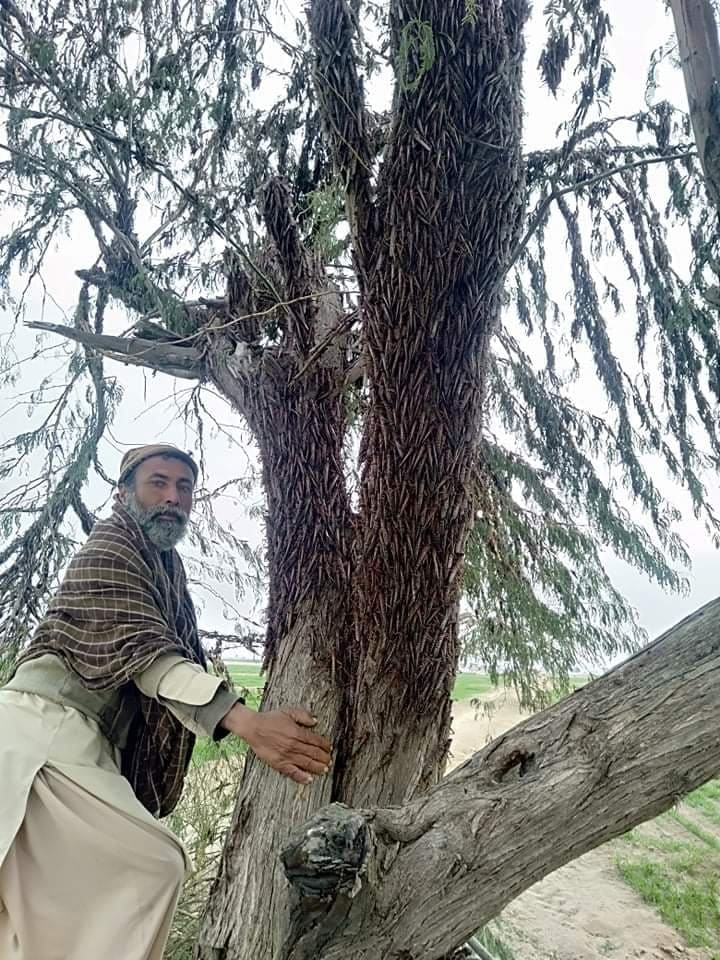


A man poses for a photo with a locust-covered tree in Kerri Shamozai on the outskirts of Dera Ismail Khan, Jan. 20, 2020. (AN photo)

He told Arab News the KP administration is now coordinating with district agriculture officers to introduce emergency measures.

“We are working out plans to control the insects’ further spread. The local agriculture officers have been issued directives already that measures be finalized to control the insects and impede their movement,” he said.

Meanwhile, farmers say the insects have been mercilessly devouring their crops and trees for the past two days.

“The locust attack is taking place in this remote region and in the bordering parts of Punjab,” said Abdul Mateen Babar, a farmer from Chad Wan, southwest of Dera Ismail Khan.

“The huge swarms of locusts have already played havoc with our crops and the KP government should adopt measures to control their further spillover,” he said, suggesting that the agriculture department should share information with farmers through social media channels and WhatsApp groups.


Daesh media chief for ISKP in Pakistan’s custody — state media

Updated 18 December 2025
Follow

Daesh media chief for ISKP in Pakistan’s custody — state media

  • Sultan Aziz Azzam, a senior member of ISKP, used to head its Al Azzam media outlet, says state media
  • Azzam was arrested in May while attempting to cross into Pakistan from Afghanistan, says state media

ISLAMABAD: Pakistani authorities have taken into custody Sultan Aziz Azzam, the head of Daesh regional affiliate ISKP’s media outlet, state media reported on Thursday citing intelligence sources. 

The state-run Pakistan TV Digital reported that Azzam was a senior member of ISKP and hailed from Afghanistan’s Nangarhar province. As per the state media report, he is also a graduate of the University of Nangarhar where he studied Islamic jurisprudence. 

Pakistan TV Digital reported Azzam joined ISKP in 2016 and later became a prominent member of its leadership council.

“He was arrested in May 2025 while attempting to cross from Afghanistan into Pakistan,” Pakistan TV Digital reported, citing intelligence sources. 

“He is believed to have overseen media operations and headed ISKP’s Al Azzam media outlet.”

In November 2021, Washington listed Azzam as a “Specially Designated Global Terrorist” (SDGT). The move bars American citizens from engaging in transactions with persons designated as SDGTs. 

According to a report on the UN Security Council’s website, Azzam has played an “instrumental role” in spreading Daesh’s violent ideology, glorifying and justifying “terrorist acts.” 

“Building on his former experience as an Afghan journalist, his activity as ISIL-K’s spokesperson has increased ISIL-K’s visibility and influence among its followers,” the report states. 

The report further states Azzam claimed responsibility on behalf of Daesh for the suicide attack near Hamid Karzai International Airport on Aug. 26, 2021, which killed at least 170 Afghans and 13 US service members and injured 150 more. 

The development takes place amid tense relations between Pakistan and Afghanistan, with Islamabad alleging militants use Afghan soil to carry out attacks against Pakistan. Kabul denies the allegations.

Tensions surged in October when Pakistan and Afghanistan engaged in fierce border clashes, claiming to have killed dozens of soldiers of the other side.

Pakistan has urged the Afghan Taliban-led government to take “decisive action” against militants it says operate from its soil. Afghanistan says it cannot be held responsible for Pakistan’s security challenges.