

Alice Wells in Pakistan to discuss Afghan peace, regional security

Adviser to the Prime Minister on Commerce, Industries & Production and Investment Abdul Razak Dawood, 3rd left, is seen in a meeting with Alice Wells, 2nd right, Acting Assistant Secretary of State, Bureau of South & Central Asia Affairs alongwith Ambassador Paul Jones, right, in Islamabad on Jan. 20, 2020. (Supplied)
Short Url
Updated 20 January 2020
Follow

Alice Wells in Pakistan to discuss Afghan peace, regional security

  • The US deputy secretary of state for South and Central Asia visited Sri Lanka and India prior to her arrival
  • On Friday, FM Qureshi reminded Washington of Pakistan's help in Afghan peace process and asked for help in FATF issue

ISLAMABAD: Alice G. Wells, chief US diplomat for South Asian affairs, arrived in Islamabad on Sunday on a four-day visit centered on discussions regarding the peace process in Afghanistan, bilateral and regional issues, the US embassy in Islamabad said in a statement on Sunday.
Wells — US Deputy Assistant Secretary of State for South and Central Asian Affairs — was received at the airport by foreign office and US embassy officials. She has been on a tour of South Asia since Jan. 13 and has been to Sri Lanka and India prior to her arrival in Pakistan.
Wells’ visit to Islamabad comes immediately after Pakistan’s Foreign Minister Qureshi concluded his trip to the US where he interacted with senior United Nations and American officials in New York and Washington. 
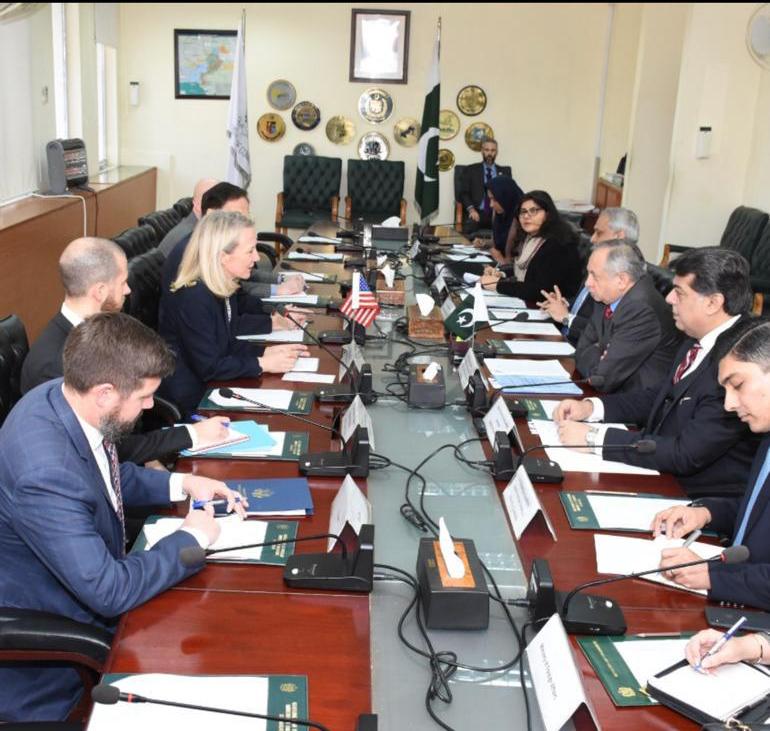


The U.S, Acting Assistant Secretary of State for South and Central Asian Affairs, Ms. Alice Wells met with Adviser to Prime Minister of Pakistan for Commerce, Textile, Industry & Production and Investment in Islamabad on January 20, 2020. (Photo Courtesy: Abdul Razak Dawood Twitter Account)

According to Amir Rana, director of prominent Islamabad-based think tank, Pakistan Institute of Peace Studies, the Afghan peace deal will be top of Wells’ agenda during her Pakistan tour.
Pakistan’s role in recent developments in the Middle East has positioned it as “an effective backdoor communication channel between Iran and the United States,” he added. 
In a news briefing in Washington on Friday, Qureshi strongly urged the US to help get Pakistan off the grey-list of global anti-money laundering watchdog, the Financial Action Task Force (FATF) at a decisive meeting in Beijing next month. A downgrade from the grey-list could result in crippling economic sanctions.
During the briefing, Qureshi said Pakistan had fulfilled its commitments to the US on facilitating the Afghanistan peace process, brought the Taliban to the negotiating table and assisted in releasing western hostages from insurgents — and had met FATF’s demands. 
The foreign minister reminded Washington: “Pakistan fulfilled your expectations. Now, we too had some expectations, what have you done (for us)?”— hinting Pakistan expected the US would help Islamabad in turn.
The US has consistently enlisted Pakistan’s help in facilitating rocky US-Taliban negotiations, which are reported to be inching near a peace deal this month.
“This is a sequel to Foreign Minister Qureshi’s visit, to coordinate the expected peace deal signing with the Taliban and potential US troops’ pullout from Afghanistan,” leading security analyst, Imtiaz Gul, told Arab News. 
Political expert Taimur Shamil told Arab News: “FATF is a tool to politically pressure Pakistan to do America’s bidding in Afghanistan. It... will likely continue till the Afghan issue is resolved.” 
Wells is expected to meet Prime Minister Imran Khan and army chief General Qamar Javed Bajwa during her visit, as well as foreign minister Qureshi.
Her last visit to Pakistan was in August last year.


Pakistan to promote mineral sector at Saudi forum this month with 13 companies

Updated 02 January 2026
Follow

Pakistan to promote mineral sector at Saudi forum this month with 13 companies

  • Delegation will take part in the Future Minerals Forum in Riyadh from Jan. 13-15
  • Petroleum minister will lead Pakistan, participate in a 90-minute country session

ISLAMABAD: Around 13 Pakistani state-owned and private companies will attend the Future Minerals Forum (FMF) in Saudi Arabia from Jan. 13 to 15, an official statement said on Friday, as the country seeks to ramp up global engagement to develop its mineral resources.

The FMF is an international conference and investment platform for the mining sector, hosted by mineral-rich countries to attract global investors, companies and governments.

Petroleum Minister Ali Pervaiz Malik confirmed Pakistan’s participation in a meeting with the Saudi envoy, Nawaf bin Said Al-Malki.

Pakistan hosts one of the world’s largest copper-gold zones. The Reko Diq mine in southwestern Balochistan, with an estimated 5.9 billion tons of ore, is partly owned by Barrick Gold, which calls it one of the world’s largest underdeveloped copper-gold deposits. Its development is expected to boost Pakistan’s struggling economy.

“Upon an invitation of the Government of the Kingdom of Saudi Arabia, the Federal Minister informed the Ambassador that Pakistan will fully participate in the upcoming Future Minerals Forum (FMF), scheduled to be held in Riyadh later this month,” Pakistan’s Press Information Department (PID) said in an official statement.

The Pakistani minister will lead his country’s delegation at the FMF and take part in a 90-minute country showcase session titled “Unleashing Potential: Accelerating Pakistan’s Mineral Revolution” along with local and foreign investors.

Pakistan will also establish a dedicated pavilion to highlight the vast potential of its rich geological landscape to the global mineral community.

The Saudi envoy welcomed Pakistan’s decision to participate in the forum and discussed enhancing bilateral cooperation in the minerals and energy sectors during the meeting.

According to the statement, he highlighted the potential for cooperation between Saudi Arabia and Pakistan in the minerals and energy sectors, expressing confidence that the FMF would provide a platform to expand collaboration.
Pakistan’s mineral sector, despite its rich reserves of salt, copper, gold and coal, contributes only 3.2 percent to the country’s GDP and just 0.1 percent to global mineral exports.

However, many countries, including the United States, have shown interest in Pakistan’s underdeveloped mineral sector, particularly in copper, gold and other critical resources.

In October, Pakistan dispatched its first-ever shipment of rare earth and critical minerals to the United States, according to a Chicago-based US public relations firm’s report.