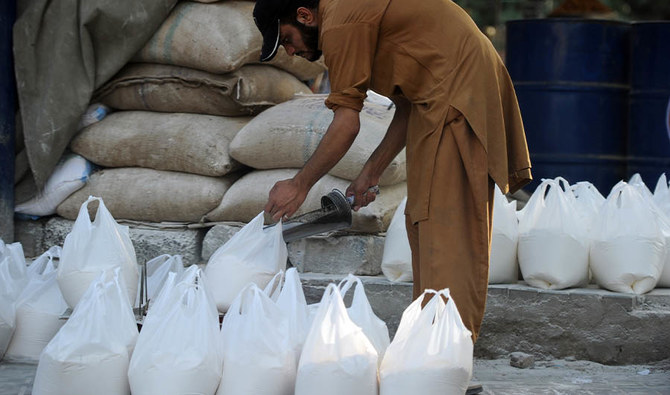
ISLAMABAD: Prime Minister Imran Khan has directed provincial chief secretaries to launch a “grand operation” against wheat hoarders and profiteers to bring down spiraling flour prices.
The PM’s directive comes days after the rate of wheat flour rose from Rs43 per kilogram to Rs75 per kilogram in different parts of the country, triggering sharp public criticism and outcry against the government.
“As per the prime minister’s instructions, we have been working closely with provincial administrations to resolve the crisis as quickly as possible,” Dr. Javed Humayun, senior joint-secretary at the Ministry of National Food Security and Research, told Arab News on Sunday.
He said the federal government had also started releasing additional wheat stocks to provinces to meet their demand. “Provincial governments have also been directed to launch a crackdown against hoarders and profiteers to overcome this artificial crisis,” he said.
The prime minister has also constituted a two-member committee comprising a senior party leader Jahangir Khan Tareen and Federal Minister for National Food Security Khusro Bakhtiar to take measures to control the commodity’s price.
The government’s chief spokesperson Firdous Ashiq Awan has called the crisis “negative propaganda” that was driven by media outlets.
“Action will be taken against those who sell a 20kg flour bag above the government’s rate of Rs805,” Awan said on Sunday while addressing a press conference. She added that the government had set up 368 sale points to provide flour at the officially prescribed rate.
“The government will take action against hoarders and profiteers,” she continued. “It is our responsibility to fulfill all basic needs of the people and we are trying our best to do it.”
On the other hand, the country’s major opposition parties have criticized the government for its “failure” to control food prices and losing its writ against the hoarding mafia.
“Only in December, prices of basic food items registered a sharp increase of 82 percent and this is a clear proof of the failure of this government,” Marriyum Aurangzeb, spokesperson of the Pakistan Muslim League-Nawaz (PML-N), said.
Bilawal Bhutto Zardari, chairperson of the Pakistan Peoples Party, accused the authorities of “intentionally” creating a wheat flour crisis in the country by allowing the export of 40,000 metric tons of wheat to Afghanistan.
“Flour prices have increased the second time in one week which proves that the government has no control over things,” he said. “Today the country is facing the worst kind of price hike after increase in power and gas tariffs and petroleum prices.”
Pakistan’s inflation rate was recorded at 12.63 percent in December, the highest in the last nine years.
Economists and food security experts believe the crisis was caused by the “mismanagement” of federal and provincial administrations and urged them to resolve it quickly to ensure food security in the country.
“If the crisis is not resolved soon, it will definitely add to food insecurity and undernourishment of a large population that has already limited economic access to quality diet,” Dr. Abid Qayyum Suleri, executive-director of the Sustainable Development Policy Institute (SDPI) in Islamabad, told Arab News.


Pakistan launches nationwide crackdown against hoarders to tackle wheat crisis
https://arab.news/4qqus
Pakistan launches nationwide crackdown against hoarders to tackle wheat crisis

- Sudden jump in wheat prices triggered sharp public criticism and outcry against the government
- The government will take action against hoarders and profiteers, PM’s aide says

Babar Azam dropped for scoring too slowly, says Pakistan coach Hesson
- Shaheen Shah Afridi was left out after conceding 101 runs in three matches
- Pakistan will now face New Zealand in the opening match of the second phase
COLOMBO: Batting great Babar Azam was dropped for Pakistan’s final T20 World Cup group game against Namibia for scoring too slowly, said head coach Mike Hesson on Friday.
Azam, who is the highest run-scorer in T20 international history with 4,571 runs, was left out for the must-win game against Namibia as Pakistan racked up 199-3 and secured a place in the Super Eights by 102 runs.
The 2009 champions face New Zealand in Colombo on Saturday in the opening match of the second phase.
“I think Babar is well aware that his strike rate in the power play in the World Cup is less than 100 and that’s clearly not the role we think we need,” Hesson told reporters after Pakistan’s final practice session on Friday was washed out by rain.
Pakistan left out Azam for the same reason at last year’s Asia Cup and even after dismal showing in the Big Bash League, he was still selected for the T20 World Cup.
“We brought Babar back in for a specific role post the Asia Cup,” said Hesson.
“We’ve got plenty of other options who can come in and perform that role toward the end.
“Babar is actually the first to acknowledge that.
“He knows that he’s got a certain set of skills that the team requires and there are certain times where other players can perform that role more efficiently.”
Hesson also defended dropping pace spearhead Shaheen Shah Afridi after he conceded 101 runs in three matches, including 31 in two overs against India.
“We made a call that Salman Mirza was coming in for Shaheen, and he bowled incredibly well,” said Hesson.
“To be fair, he was probably really unlucky to not be playing the second and third games.”
Hesson was wary of Pakistan’s opponents on Saturday.
“New Zealand have played a huge amount in the subcontinent in recent times so we have to play at our best.”


