

Erdogan issues new terror warning to Europe over conflict in Libya

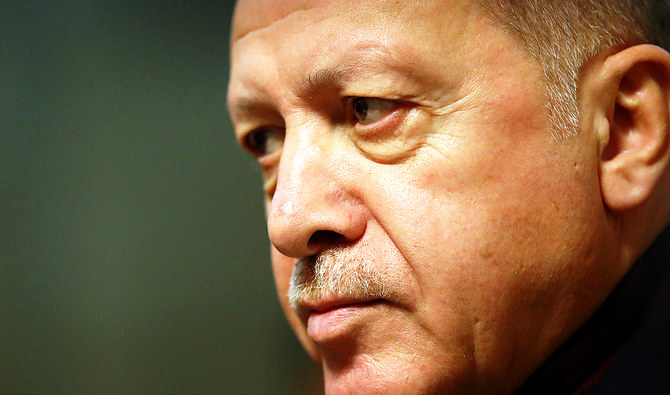
Turkey's President Recep Tayyip Erdogan. (Reuters)
Short Url
Updated 19 January 2020
Follow

Erdogan issues new terror warning to Europe over conflict in Libya

  • Support government in Tripoli or Daesh will be unleashed again, Turkish president says

JEDDAH: Europe will face a new terrorist threat unless it steps up its support for the beleaguered Libyan government in Tripoli, Recep Tayyip Erdogan warned on Saturday.

The Turkish president spoke on the eve of a UN-sponsored summit of world leaders in Berlin aimed at resolving the conflict between Tripoli’s UN-backed Government of National Accord (GNA) and the Libya National Army (LNA) led by eastern military strongman Khalifa Haftar.

“Europe will encounter a fresh set of problems and threats if Libya’s legitimate government were to fall,” Erdogan said.

“Terrorist organizations such as Daesh and Al-Qaeda, which suffered a military defeat in Syria and Iraq, will find fertile ground to get back on their feet. “To leave Libya at the mercy of a warlord would be a mistake of historic proportions.”

Europe is unlikely to be impressed by Erdogan’s threats, analysts told Arab News. 

“Erdogan bets on military support for the government whereas Germany, in line with the UN, wants to implement the previously agreed arms embargo. This is where Europe and Turkey need to find a common line on Sunday,” said Mercator-IPC senior fellow Michael Thumann.

BACKGROUND

In a veiled rebuke to Erdogan, the UN special envoy for Libya said the involvement of foreign forces was making matters worse.

The GNA, led by Fayez Al-Sarraj, has been under siege by Haftar’s forces since April. Erdogan has sent Turkish military advisers and trainers to help Al-Sarraj’s forces, and has also redeployed up to 2,000 Turkish-backed mercenary fighters from the conflict in Syria.

In a veiled rebuke to Erdogan, the UN special envoy for Libya said the involvement of foreign forces was making matters worse.

“All foreign interference can provide some aspirin effect in the short term, but Libya needs all foreign interference to stop. That’s one of the objectives of this conference,” Ghassan Salame said.

The UN envoy also said he hoped but “could not predict” whether closed eastern oil ports would be reopened soon. 

Terminals across eastern and central Libya were shut on Friday by tribesmen allied to Haftar, in an attempt to choke off revenue to the government in Tripoli.

The closures are likely to be discussed at the summit. “If the thing is not solved between today and tomorrow I expect the issue to be raised, yes,” Salame said.

He said he hoped Haftar would consider extending a truce that has largely held for a week, despite the two sides failing to sign a deal at talks last week in Moscow.

The aims of Sunday’s summit are a permanent cease-fire, enforcement of a widely ignored UN arms embargo and a return to political efforts for peace.


Ramadan brings a season of grief after an Israeli strike wiped out most of a Gaza family

Updated 4 sec ago
Follow

Ramadan brings a season of grief after an Israeli strike wiped out most of a Gaza family

  • In the Gaza Strip, Ramadan has become a season when wartime losses hit especially deep for the many families grieving loved ones killed by Israeli forces
GAZA CITY, Gaza Strip: As the sun sets, Saddam Al-Yazji, his wife and their daughter sip a noodle soup, breaking their daily Ramadan fast in Gaza City. They sit around a folding table set up in the dirt at the foot of a towering pile of rubble, twisted metal and concrete slabs that was once their home.
Buried under the debris are the bodies of much of their family.
The three are virtually the family’s only survivors. Al-Yazji’s parents, his three brothers and his sister, along with most of their children, and his wife’s parents and siblings — 40 relatives in total — were all killed in a single strike when Israeli forces bombed the house in December 2023.
The Islamic holy month of Ramadan is traditionally a time for family, with large, festive gatherings for iftar, the sunset meal that ends the daily fast. In the Gaza Strip, it has become a season when wartime losses hit especially deep for the many families grieving loved ones killed by Israeli forces, which have been fighting Hamas for more than two years.
“I look at photos of our gatherings in Ramadan and cry,” the 35-year-old Al-Yazji said. “Where is my family? All are wiped out.”
“It’s the third Ramadan without them.”
Family once had large Ramadan meals
During Ramadans before the war, Al-Yazji’s father, Kamel Al-Yazji, brought all his children and grandchildren together for iftar around a large table piled with meat and rice and other dishes, recalled Saddam’s wife, Heba Al-Yazji.
Ramadan, when Muslims fast from dawn to dusk, is a month dedicated to religious reflection and worship. It also builds community, with the giving of charity.
The elder Al-Yazji was a former judge with the Palestinian Authority and a well-known sports figure in Gaza, serving as chairman of the Palestinian Athletics Federation. Saddam Al-Yazji earned a living running a supermarket on the ground floor of the four-story family home in Gaza City’s Rimal neighborhood.
The airstrike came only a few months into the ferocious Israeli bombardment that was launched after the Hamas-led attack on southern Israel in October 2023. The house was leveled on top of everyone inside.
“We were in the same house, in other part of the house,” Saddam Al-Yazji said. “We survived miraculously.”
The only other survivors were the daughter and the pregnant wife of one of his brothers. Among the dead were 22 children.
Some of the bodies were retrieved at the time. One of Al-Yazji’s brothers is buried in a grave marked with sticks at the foot of the destroyed house. Around 20 relatives remain buried under the rubble.
After the strike, the couple and their daughter, 11-year-old Maryam, lived in a tent elsewhere in Gaza City for much of the war. During the previous two Ramadans, they tried as much as possible to come visit the rubble of their home and have iftar there.
When a ceasefire deal came into effect in October, the three moved to a tent next to their old home.
“Life is empty,” Heba Al-Yazji said. “The war took everything from me. We wish we had died with them rather than remain alone.”
Most families feel a loss
Throughout the war, Israel has struck homes and tent camps sheltering Palestinians, often killing large numbers of families at once. Israel says it targets Hamas militants, though it rarely says who were the specific targets.
Israel’s campaign has killed more than 72,000 people, nearly half of them women and children, according to the Gaza Health Ministry. The ministry, which is part of the Hamas-led government, maintains detailed casualty records seen as generally reliable by UN agencies and independent experts, though it does not give a breakdown of civilians and militants.
Around 8,000 more are still buried under the rubble of destroyed homes, according to the ministry. Retrieving most of those bodies was out of the question when airstrikes and ground assaults were raging. Under the ceasefire, recovery efforts have increased, though they are still hampered by a lack of heavy equipment.
The Israeli campaign was triggered by the Hamas attack that killed some 1,200 people in Israel and took more than 250 others hostage. The hostages have been released, mostly as part of ceasefire agreements.
Almost everyone in Gaza has lost at least extended family members. Nearly the entire population of 2.1 million is homeless, with most living in vast tent camps. More than 80 percent of the strip’s buildings have been damaged or destroyed.
A landscape of rubble that was once the Rimal district extended all around the small Ramadan table where the three surviving Al-Yazjis ate their meal.
Saddam Al-Yazji recalled the “great dining table” of his family’s past Ramadan gatherings and how they all looked forward to it every year.
“I feel like I have betrayed them by being alive,” he said.