

We can’t wait: Maldives seek funds as sea levels rise

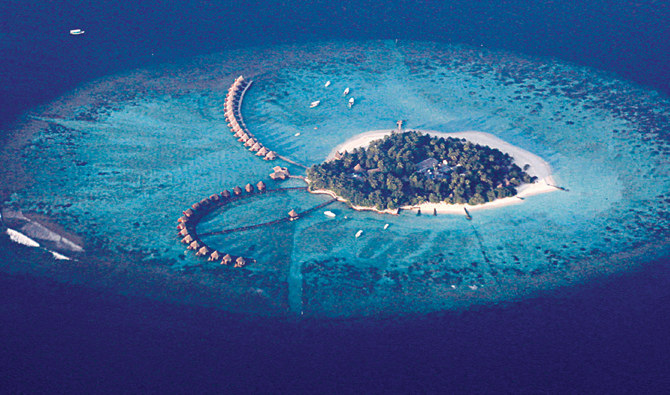
The low-lying Maldives are very vulnerable to storm surges, sea swells and severe weather. (Reuters)
Short Url
Updated 18 January 2020
Follow

We can’t wait: Maldives seek funds as sea levels rise

  • The islands say they are paying the price for the developed world’s pollution

NEW DELHI: The tropical Maldives may lose entire islands unless it can quickly find cheap financing to fight the impact of climate change, its foreign minister said.

The archipelago’s former president Mohamed Nasheed famously held a cabinet meeting underwater to draw attention to submerging land and global warming a decade ago.

Yet the Maldives, best known for its white sands and palm-fringed atolls that draw luxury holiday-makers, has struggled to find money to build critical infrastructure such as sea walls.

“For small states, it is not easy,” Foreign Minister Abdulla Shahid told Reuters in New Delhi. “By the time the financing is obtained, we may be underwater.”

At the UN climate talks in Madrid in December, the Maldives and other vulnerable countries pushed for concrete progress on fresh funding to help them deal with disasters and longer-term damage linked to climate change — but failed.

Shahid is hopeful the next round of talks, slated to take place in Glasgow in November this year, will yield better results.

One of the world’s lowest-lying countries, more than 80 percent of the Maldives’ land is less than one meter above mean sea level, making its population of around 530,000 people extremely vulnerable to storm surges, sea swells and severe weather.

In 2004, the Indian Ocean tsunami ravaged the Muslim-majority state, causing financial losses of around $470 million — 62 percent of GDP — and hitting infrastructure, including its only international airport, which was shut for several days.

Two of the country’s main industries — tourism and fishing — are heavily dependent on coastalresources, and most settlements and critical infrastructure is concentrated along the coast.

In 2014, more than 100 of the archipelago’s inhabited islands were reporting erosion, and around 30 islands are identified as severely eroded.

The Maldives spends around $10 million annually on coastal protection works, but will need up to $8.8 billion in total to shield all of its inhabited islands, according to a 2016 estimate by its environment ministry.

“In order to protect the islands, we need to start building sea walls,” Shahid said. “It’s expensive, but we need it. We can’t wait until all of them are being taken away.”

The United Nations has created a pot to help developing nations, called the Green Climate Fund, which has already approved nearly $24 million in funding to the Maldives, according to its website.

Some individual nations have also offered help, including Japan, which contributed to a sea wall round the Maldives’ capital Male. Shahid did not specify where his government was pushing for more funding.

However, Environment Minister Hussain Rasheed Hassan said recently that his country would have to turn to banks, given inadequate funding elsewhere despite the fact small nations like his were paying the price for the developed world’s pollution.

“We have to beg some of these (big) emitters to provide money for us. Is that fair?” he said.


Jordan’s industry fuels 39% of Q2 GDP growth

Updated 31 December 2025
Follow

Jordan’s industry fuels 39% of Q2 GDP growth

JEDDAH: Jordan’s industrial sector emerged as a major contributor to economic performance in 2025, accounting for 39 percent of gross domestic product growth in the second quarter and 92 percent of national exports.

Manufactured exports increased 8.9 percent year on year during the first nine months of 2025, reaching 6.4 billion Jordanian dinars ($9 billion), driven by stronger external demand. The expansion aligns with the country’s Economic Modernization Vision, which aims to position the country as a regional hub for high-value industrial exports, the Jordan News Agency, known as Petra, quoted the Jordan Chamber of Industry President Fathi Jaghbir as saying.

Export growth was broad-based, with eight of 10 industrial subsectors posting gains. Food manufacturing, construction materials, packaging, and engineering industries led performance, supported by expanded market access across Europe, Arab countries, and Africa.

In 2025, Jordanian industrial products reached more than 144 export destinations, including emerging Asian and African markets such as Ethiopia, Djibouti, Thailand, the Philippines, and Pakistan. Arab countries accounted for 42 percent of industrial exports, with Saudi Arabia remaining the largest market at 955 million dinars.

Exports to Syria rose sharply to nearly 174 million dinars, while shipments to Iraq and Lebanon totaled approximately 745 million dinars. Demand from advanced markets also strengthened, with exports to India reaching 859 million dinars and Italy about 141 million dinars.

Industrial output also showed steady improvement. The industrial production index rose 1.47 percent during the first nine months of 2025, led by construction industries at 2.7 percent, packaging at 2.3 percent, and food and livestock-related industries at 1.7 percent.

Employment gains accompanied the sector’s expansion, with more than 6,000 net new manufacturing jobs created during the period, lifting total industrial employment to approximately 270,000 workers. Nearly half of the new jobs were generated in food manufacturing, reflecting export-driven growth.

Jaghbir said industrial exports remain among the economy’s highest value-added activities, noting that every dinar invested generates an estimated 2.17 dinars through employment, logistics, finance, and supply-chain linkages. The sector also plays a critical role in narrowing the trade deficit and supporting macroeconomic stability.

Investment activity accelerated across several subsectors in 2025, including food processing, chemicals, pharmaceuticals, mining, textiles, and leather, as manufacturers expanded capacity and upgraded production lines to meet rising demand.

Jaghbir attributed part of the sector’s momentum to government measures aimed at strengthening competitiveness and improving the business environment. Key steps included freezing reductions in customs duties for selected industries, maintaining exemptions for production inputs, reinstating tariffs on goods with local alternatives, and imposing a 16 percent customs duty on postal parcels to support domestic producers.

Additional incentives in industrial cities and broader structural reforms were also cited as improving the investment climate, reducing operational burdens, and balancing consumer needs with protection of local industries.