



JEDDAH: The Royal Commission for AlUla has collaborated with Desert X to bring an interactive installation to the area for the first time.
Desert X began in 2017, in California’s Coachella Valley, as a way to connect modern art with desert communities and cultures.
It is Desert X’s first international collaboration and starts on Jan. 31, running through to March 7, as part of AlUla’s Winter at Tantora festival.
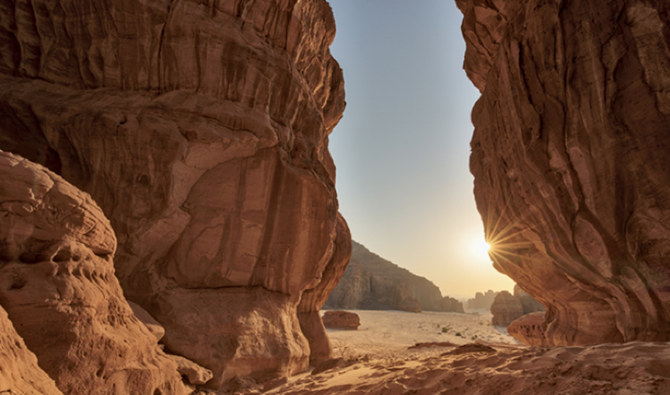
AlUla Valley is famed for its rock formations, dramatic desert landscape and archaeological treasures.
Neville Wakefield, artistic director and co-curator for Desert X, said the exhibition would bring together local artists and ones from further afield.
“You discover that the same things that we find artists following in southern California — the interest in the environment, natural resources, cultural memory, trade and migration — they’re common for everyone,” he told Arab News. “What’s interesting to me about Saudi Arabia is the demographic, it’s a very young nation. I hope this opens the door to encourage a new generation of artists to emerge and take (their) place on an international stage and vice versa.”
Outdoor exhibition
Site-specific exhibitions differ greatly from a gallery setup in a museum with a controlled or fixed environment. Curators and artists face more external factors that could hinder the installation process from the weather to safety measures such as falling rocks. Wakefield said the uncertainty made shows such as Desert X exciting. “It really is about engaging with the landscape.”
Artists were brought to the Kingdom on a site visit last year to process the surroundings and create their own installation proposals.
They were selected based on their response to the landscape, not only its physical nature but culturally, historically and socially.
Riyadh-based artist Muhannad Shono said he would have done anything to take part in Desert X.
“I wasn’t going to let it slip through my fingers,” he told Arab News. “We don’t get a lot of chances with free access and support to visualize and bring to life something in the desert — an enchanting and romantic place to set up an installation.”
He changed his mind about the concept several times before finally embracing his design — a sculptural path.
HIGHLIGHTS
• Desert X began in 2017, in California’s Coachella Valley, as a way to connect modern art with desert communities and cultures.
• Artists were brought to the Kingdom on a site visit last year to process the surroundings and create their own installation proposals.
• They were selected based on their response to the landscape, not only its physical nature but culturally, historically and socially.
“I wanted to trigger things we’ve experienced as children in the audience. For example, finding a treasure map of the desert and an X that marks the spot where oftentimes, you reach the spot and find nothing there. The chest is empty — either with nothing there or that someone got there first. But the journey and adventure are amazing,” said Shono.
The Saudi artist wanted to give people a chance to unleash an inner curiosity that would set them on a purposeful discovery, not one of materialistic value but to find meaning in themselves.
He said the installation was not easy to find. “It goes further and higher and the more you go, the more you discover yourself. Alone with yourself and that’s what’s important,” he added.
Humans and nature
Tunisian-born and US-based artist Lita Albuquerque has often explored the relationship between humans and nature. Her AlUla project also draws on her passion for cosmology.
“I’ve been working on a narrative about a female astronaut who comes to this planet to see interstellar consciousness. She wants to teach us about our relationship to the stars,” she told Arab News.
The astronaut visits through different periods of time, the artist explained. She comes from the future but also visits the past “as if she’s birthing astronomy, giving us this whole map of the stars down the valley.”
The astronaut sits on a boulder positioned at the western end of the valley, looking eastward down the entire valley.
“It looks as if she is offering something, and below her are 99 blue circles of different diameters that correspond to the aligned stars above. She’s a little bit bigger than life-sized. It’s surprising to see her in such a grand space,” Albuquerque said.
She first visited AlUla last September and got to see the whole region while scouting for sites.
She has worked in desert sites since the start of her career, so Desert X was a natural step for her. “I felt like I was part of Desert X from the very beginning,” she added.


