

Pakistan gets investment from Bahrain, UAE for $29 mln model farm

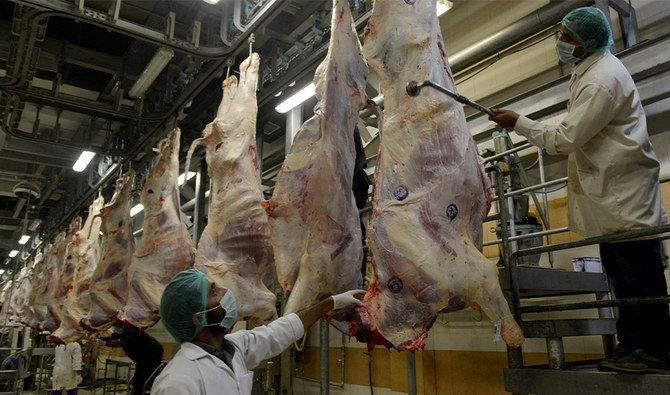
This photograph taken on April 9, 2015, shows Pakistani health inspectors as they certify meat by placing stamps at a government slaughterhouse in Lahore. (AFP)
Short Url
Updated 17 January 2020
Follow

Pakistan gets investment from Bahrain, UAE for $29 mln model farm

  • The money will be spent on farm and slaughter house projects
  • Pakistan’s exports of meat and meat preparations increased by 53.4 percent during 5MFY20

KARACHI: In collaboration with its partners in Bahrain and the United Arab Emirates, a Pakistani meat processor and exporter is investing Rs4.5 billion, or approximately $29 million, to establish a modern farm and slaughter house to breed animals and produce meat, company officials said on Thursday.

“We have acquired 135 acres of land in Chunian, near Lahore, to set up a modern animal production farm that will have state-of-the-art facilities,” Abdul Hannan, the managing partner of Tazij Meat and Foods, told Arab News.

“We have acquired a barren land for the livestock and agriculture project that will initially cost Rs4.5 billion,” he continued. “The work on the project will start in March 2020.”

The company, which mostly exports meat to the Middle East, has attracted investment from individual investors belonging to Gulf states. “Our foreign partners are from Bahrain and the UAE,” Hannan informed.

The South Asian nation mainly exports meat to the Gulf region along with Malaysia and Vietnam, but remains out of the Chinese market due to the stringent quarantine standards.

The export of meat and meat preparations has shown unusual growth during the current fiscal year, though the country’s overall exports have declined by one percent.

During July-November 2019, the exports of meat and meat preparations increased by 53.4 percent to $126.5 million as compared to the same period during the last fiscal year (FY19). Overall, meat and meat preparations exports went up by eight percent to $242.8 million during FY20, according to the Pakistan Bureau of Statistics.

Hannan informed that the company already had a slaughter house with modern facilities that could process up to 500 heads of cattle and 1000 sheep/goats every day. “To meet the future export and local demand, however, we are going to set up a state-of-the-art slaughter house in Lahore,” he added.

Explaining the concept of the project, he said that the idea was to raise animals in their natural environment amid plants that grow on all types of land. “Keeping in view the nutritious value of food, cheap and organic fodder for animals is a major focus of the project.”

Livestock, a subarea of the agriculture sector, has surpassed the crop sub-sector with a contribution of 60.5 percent. It also added 11.2 percent to the Gross Domestic Product (GDP) of the country during 2018-19.

The gross value addition of livestock has increased from Rs1.38 trillion to Rs1.44 trillion in fiscal year 2018-19, recording a four percent growth over the same period in the last year, according to the Economic Survey of Pakistan.


Pakistan to promote mineral sector at Saudi forum this month with 13 companies

Updated 02 January 2026
Follow

Pakistan to promote mineral sector at Saudi forum this month with 13 companies

  • Delegation will take part in the Future Minerals Forum in Riyadh from Jan. 13-15
  • Petroleum minister will lead Pakistan, participate in a 90-minute country session

ISLAMABAD: Around 13 Pakistani state-owned and private companies will attend the Future Minerals Forum (FMF) in Saudi Arabia from Jan. 13 to 15, an official statement said on Friday, as the country seeks to ramp up global engagement to develop its mineral resources.

The FMF is an international conference and investment platform for the mining sector, hosted by mineral-rich countries to attract global investors, companies and governments.

Petroleum Minister Ali Pervaiz Malik confirmed Pakistan’s participation in a meeting with the Saudi envoy, Nawaf bin Said Al-Malki.

Pakistan hosts one of the world’s largest copper-gold zones. The Reko Diq mine in southwestern Balochistan, with an estimated 5.9 billion tons of ore, is partly owned by Barrick Gold, which calls it one of the world’s largest underdeveloped copper-gold deposits. Its development is expected to boost Pakistan’s struggling economy.

“Upon an invitation of the Government of the Kingdom of Saudi Arabia, the Federal Minister informed the Ambassador that Pakistan will fully participate in the upcoming Future Minerals Forum (FMF), scheduled to be held in Riyadh later this month,” Pakistan’s Press Information Department (PID) said in an official statement.

The Pakistani minister will lead his country’s delegation at the FMF and take part in a 90-minute country showcase session titled “Unleashing Potential: Accelerating Pakistan’s Mineral Revolution” along with local and foreign investors.

Pakistan will also establish a dedicated pavilion to highlight the vast potential of its rich geological landscape to the global mineral community.

The Saudi envoy welcomed Pakistan’s decision to participate in the forum and discussed enhancing bilateral cooperation in the minerals and energy sectors during the meeting.

According to the statement, he highlighted the potential for cooperation between Saudi Arabia and Pakistan in the minerals and energy sectors, expressing confidence that the FMF would provide a platform to expand collaboration.
Pakistan’s mineral sector, despite its rich reserves of salt, copper, gold and coal, contributes only 3.2 percent to the country’s GDP and just 0.1 percent to global mineral exports.

However, many countries, including the United States, have shown interest in Pakistan’s underdeveloped mineral sector, particularly in copper, gold and other critical resources.

In October, Pakistan dispatched its first-ever shipment of rare earth and critical minerals to the United States, according to a Chicago-based US public relations firm’s report.