

Pakistan gets investment from Bahrain, UAE for $29 mln model farm

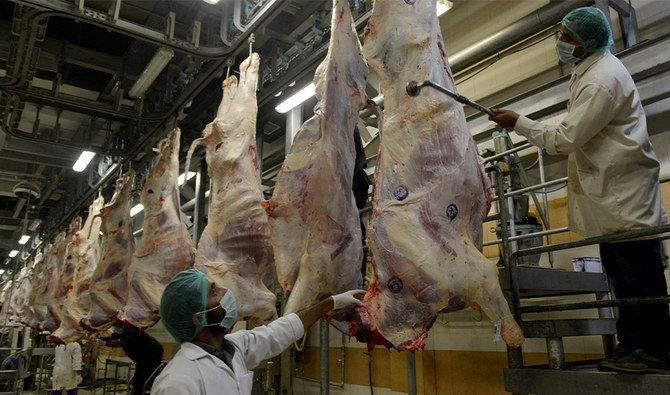
This photograph taken on April 9, 2015, shows Pakistani health inspectors as they certify meat by placing stamps at a government slaughterhouse in Lahore. (AFP)
Short Url
Updated 17 January 2020
Follow

Pakistan gets investment from Bahrain, UAE for $29 mln model farm

  • The money will be spent on farm and slaughter house projects
  • Pakistan’s exports of meat and meat preparations increased by 53.4 percent during 5MFY20

KARACHI: In collaboration with its partners in Bahrain and the United Arab Emirates, a Pakistani meat processor and exporter is investing Rs4.5 billion, or approximately $29 million, to establish a modern farm and slaughter house to breed animals and produce meat, company officials said on Thursday.

“We have acquired 135 acres of land in Chunian, near Lahore, to set up a modern animal production farm that will have state-of-the-art facilities,” Abdul Hannan, the managing partner of Tazij Meat and Foods, told Arab News.

“We have acquired a barren land for the livestock and agriculture project that will initially cost Rs4.5 billion,” he continued. “The work on the project will start in March 2020.”

The company, which mostly exports meat to the Middle East, has attracted investment from individual investors belonging to Gulf states. “Our foreign partners are from Bahrain and the UAE,” Hannan informed.

The South Asian nation mainly exports meat to the Gulf region along with Malaysia and Vietnam, but remains out of the Chinese market due to the stringent quarantine standards.

The export of meat and meat preparations has shown unusual growth during the current fiscal year, though the country’s overall exports have declined by one percent.

During July-November 2019, the exports of meat and meat preparations increased by 53.4 percent to $126.5 million as compared to the same period during the last fiscal year (FY19). Overall, meat and meat preparations exports went up by eight percent to $242.8 million during FY20, according to the Pakistan Bureau of Statistics.

Hannan informed that the company already had a slaughter house with modern facilities that could process up to 500 heads of cattle and 1000 sheep/goats every day. “To meet the future export and local demand, however, we are going to set up a state-of-the-art slaughter house in Lahore,” he added.

Explaining the concept of the project, he said that the idea was to raise animals in their natural environment amid plants that grow on all types of land. “Keeping in view the nutritious value of food, cheap and organic fodder for animals is a major focus of the project.”

Livestock, a subarea of the agriculture sector, has surpassed the crop sub-sector with a contribution of 60.5 percent. It also added 11.2 percent to the Gross Domestic Product (GDP) of the country during 2018-19.

The gross value addition of livestock has increased from Rs1.38 trillion to Rs1.44 trillion in fiscal year 2018-19, recording a four percent growth over the same period in the last year, according to the Economic Survey of Pakistan.


Pakistani stocks breach 176,000 points barrier as investors expect further rate cuts

Updated 01 January 2026
Follow

Pakistani stocks breach 176,000 points barrier as investors expect further rate cuts

  • Pakistani financial analyst attributes surge to falling inflation, investors expecting further policy rate cuts
  • Pakistan’s finance ministry said Thursday that inflation had slowed to 5.6 percent year-on-year in December 

KARACHI: Pakistani stocks continued their bullish run on Thursday, breaching the 176,000 points barrier for the first time after trading ended, with analysts attributing the surge to investors expecting further cuts in the policy rate. 

The KSE-100 benchmark gained 2,301.17 points at close of business on Thursday, marking an increase of 1.32 percent to settle at 176,355.49 points. 

Pakistan’s central bank cut its key policy rate by 50 basis points to 10.5 percent last ‌month, breaking a four-meeting ‌hold in a move ‌that ⁠surprised ​markets. Pakistan’s consumer price inflation slowed to 5.6 percent year-on-year in December, while prices fell on a monthly basis as per data from the finance ministry. 

“Upbeat data for consumer price index (CPI) inflation at 5.6pc in December 2025 [with] investors expecting a further State Bank of Pakistan rate cuts on falling inflation data,” Ahsan Mehanti, CEO of Arif Habib Commodities Ltd., told Arab News. 

The stock market witnessed a trading volume of 1,402.650 million shares, with a traded value of Rs48.424 billion ($173 million), compared with 957.239 million shares valued at Rs44.231 billion ($158 million) during the previous session.

Topline Securities, a leading brokerage firm in Pakistan, credited the surge to strong buying at the first session.

“This positivity can be accredited to buying by local institutions on the start of the new calendar year,” it said. 

Pakistan’s Finance Adviser Khurram Schehzad highlighted that the bullish trend at the stock market reflected “strong investor confidence.”

“With lower inflation, affordable fuel, stronger reserves, rising digitization and a buoyant capital market, Pakistan’s economic outlook is clearly improving--supporting greater confidence, better investment sentiment and more positive momentum for 2026,” he said on social media platform X.