

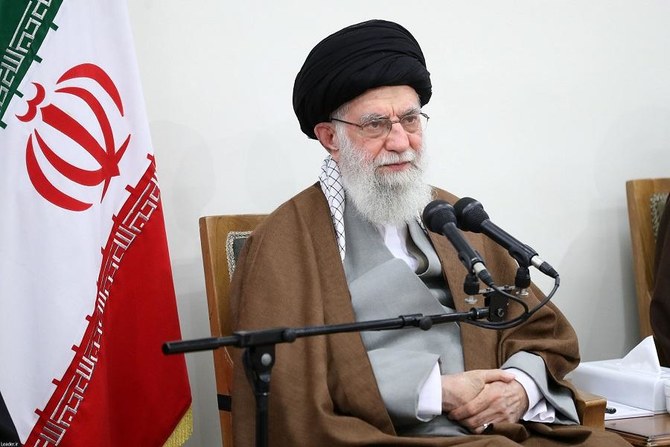
Iran’s top leader praises attack on US bases in Iraq

The 80-year-old leader openly wept at the funeral of Gen. Qassem Soleimani and vowed “harsh retaliation” against the United States. (File/AFP)
Short Url
Updated 17 January 2020
Follow

Iran’s top leader praises attack on US bases in Iraq

  • Iran’s supreme leader delivered a Friday sermon in Tehran for the first time since 2012

DUBAI: Supreme Leader Ayatollah Ali Khamenei said in a Friday prayers sermon that Iran’s missile strikes on US targets in Iraq showed it had divine support in delivering a “slap on the face” to a world power.

Making the main weekly sermon in Tehran for the first time since 2012, with Iran and its clerical rulers under pressure at home and abroad, Khamenei also said that US sanctions imposed in a row over its nuclear program would not make Iran yield.

Thousands had gathered inside a large prayer hall in central Tehran and packed the area and streets outside the building, chanting “Death to America.”

The sermon was delivered after Iran’s rulers faced days of often violent protests after the military admitted to mistakenly shooting down an airliner in the tense hours after the missile strikes, which were in turn launched in retaliation for the US killing on Jan. 3 of a top Iranian commander, close to Khamenei.

“The fact that Iran has the power to give such a slap to a world power shows the hand of God,” Khamenei, saying the US killing of Qassem Soleimani, commander of the Quds Force, showed Washington’s “terrorist nature.”

US President Donald Trump, who pulled Washington out of a nuclear deal with Iran in 2018 and ratcheted up tension by reimposing US sanctions, had ordered the drone strike that killed Soleimani, who built up proxy militias across the region.

After days of denying a role in the plane crash, the Revolutionary Guards, a parallel military force answering directly to Khamenei that acts as guardian of Islamic Republic, finally admitted on Jan. 11 that one of its air defense operators mistakenly shot down Ukraine Airlines International flight 752.

Vigils for the 176 victims swiftly turned into protests against Iran’s rulers. “Death to Khamenei” was chanted at protests and spray painted on walls of Tehran and other cities. Such public criticism can result in a jail term in Iran.

Khamenei described the crash as a tragedy and a very sad incident that was used by Iran’s “enemies,” used to describe the United States and its allies, to overshadow the killing of Soleimani, whose funeral drew huge crowds onto the streets.

In the demonstrations after the downing of the airliner, police launched a sometimes crackdown and deployed riot police outside universities, where many students had protested.


Morocco to open two deepwater ports in 2026 and 2028, minister says

Updated 6 sec ago
Follow

Morocco to open two deepwater ports in 2026 and 2028, minister says

  • The facility will be surrounded by 1,600 hectares for industrial activities and 5,200 hectares for farmland irrigated by desalinated water, Baraka said

MARRAKECH: Morocco will open a new deepwater Mediterranean port next year and another on the Atlantic in 2028, Equipment and Water minister Nizar Baraka said, as the North African country aims to replicate the success of Africa’s largest port, Tanger Med.
Nador West Med, under construction on the Mediterranean, is scheduled to be operational in the second half of 2026, Baraka told Reuters in an interview.
It will offer 800 hectares for industrial activity, with plans to expand to 5000 hectares, surpassing Tanger Med’s industrial zones, he said.
The port will also host Morocco’s first liquefied natural gas (LNG) terminal — a floating storage and regasification unit (FSRU) — linked by a pipeline to industrial hubs in the northwest, as Morocco pushes investments in natural gas and renewable energy to reduce dependence on coal.
Further south on the Atlantic coast, Morocco is building a $1 billion port in Dakhla, in the disputed Western Sahara region.
The facility will be surrounded by 1,600 hectares for industrial activities and 5,200 hectares for farmland irrigated by desalinated water, Baraka said.
“The port will be ready in 2028 and will be Morocco’s deepest at 23 meters,” Baraka said. Such depth would support heavy industries focused on processing raw materials from Sahel countries, he said.
Officials have marketed Dakhla as a gateway for landlocked Sahel nations to global trade.
Both Nador and Dakhla ports will include quays dedicated to exporting green hydrogen once production begins, Baraka said.
Nador and Dakhla would be Morocco’s third and fourth deepwater ports after Tanger Med and Jorf Lasfar, an energy, bulk cargo and phosphates exports port on the Atlantic.
By 2024, industrial zones near Tanger Med hosted 1,400 firms employing 130,000 people across sectors including automotive, aeronautics, textiles, agri-food and renewable energy, official figures show.
Morocco is also considering building a port in Tan-Tan on the Atlantic in partnership with green hydrogen investors, Baraka said. “We are conducting studies to decide the appropriate size of the port,” Baraka said.