Egypt, Ethiopia, Sudan to finalize Blue Nile dam agreement this month

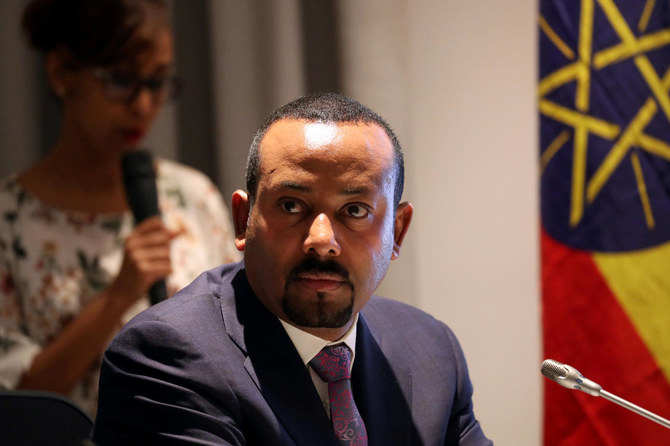
Ethiopia's Prime Minister Abiy Ahmed attends a signing ceremony with European Commission President Ursula von der Leyen in Addis Ababa, Ethiopia December 7, 2019. (Reuters)
Short Url
Updated 16 January 2020
Follow

Egypt, Ethiopia, Sudan to finalize Blue Nile dam agreement this month

WASHINGTON: Ministers from Egypt, Ethiopia and Sudan have agreed to reconvene in Washington later this month to finalize an agreement on a giant hydropower dam on the Blue Nile that sparked a diplomatic crisis between Cairo and Addis Ababa.
The ministers met in Washington this week and agreed to fill the $4 billion Grand Ethiopian Renaissance Dam (GERD) in stages during the wet season, taking into account the impact on downstream reservoirs, the US Treasury Department, which hosted the meeting, said in a statement.
They will meet again in Washington on Jan. 28-29 to finalize the agreement with technical and legal discussions, the statement said.
Cairo fears the dam, announced in 2011 and under construction on the Blue Nile near Ethiopia’s border with Sudan, will restrict supplies of already scarce Nile waters on which its population of more than 100 million people is almost entirely dependent.
Addis Ababa denies the dam will undermine Egypt’s access to water and says the project is crucial to its economic development, as it aims to become Africa’s biggest power exporter with a projected capacity of more than 6,000 megawatts.
The three regional powers convened in Washington for the third time on Monday, aiming to reach a deal before Wednesday’s deadline the nations had agreed to following a November meeting with US Treasury Secretary Steven Mnuchin and World Bank President David Malpass.


Saudi, Arab and muslim ministers voice deep concern over worsening humanitarian crisis in Gaza

Updated 18 sec ago
Follow

Saudi, Arab and muslim ministers voice deep concern over worsening humanitarian crisis in Gaza

DUBAI: The foreign ministers of Saudi Arabia, Jordan, the United Arab Emirates, Indonesia, Pakistan, Turkiye, Qatar and Egypt expressed deep concern over the rapidly deteriorating humanitarian situation in the Gaza Strip on Friday.

A statement published by the Saudi Ministry of Foreign Affairs on X cited severe weather conditions and restrictions on humanitarian access as key factors exacerbating civilian suffering.

It said flooded camps, collapsed structures, damaged tents and exposure to cold temperatures had significantly increased risks to civilian lives, particularly among children, women, the elderly and those with medical vulnerabilities.

The ministers warned that the combination of malnutrition, poor shelter and lack of clean water has heightened the risk of disease outbreaks, placing additional strain on Gaza’s fragile health system.

The statement commended the efforts of UN agencies, particularly UNRWA, as well as international humanitarian organizations, for continuing to provide assistance under extremely challenging conditions.

The ministers stressed that humanitarian organizations must be allowed to operate in Gaza and the occupied West Bank in a sustained, predictable and unrestricted manner, describing any obstruction of their work as unacceptable.

The statement highlighted support for UN Security Council Resolution 2803 and US President Donald Trump’s “Comprehensive Plan,” as well as the ministers’ intention to contribute to efforts aimed at sustaining the ceasefire, ending the war in Gaza, and enabling early recovery and reconstruction.

The ministers also called on the international community to fulfill its legal and moral responsibilities, urging Israel, as the occupying power, to immediately lift restrictions on the entry and distribution of essential supplies, including shelter materials, medical aid, fuel, clean water and sanitation support.

They also demanded the immediate, full, and unhindered delivery of humanitarian assistance into Gaza through the UN and its agencies, the rehabilitation of critical infrastructure and hospitals, and the opening of the Rafah Crossing in both directions, in line with Trump’s plan.