

North Pakistan forests in peril from illegal logging

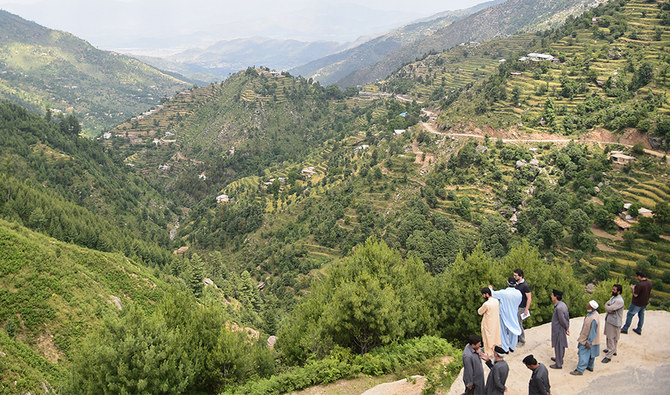
The Swat Valley forests in northern Pakistan are seen in this picture taken on May 18, 2018. (AFP)
Short Url
Updated 15 January 2020
Follow

North Pakistan forests in peril from illegal logging

  • KP Forest Minister says the province has zero tolerance for illegal logging and wood smuggling
  • Pakistan’s national tree, the deodar cedar, may disappear in the next few decades

PESHAWAR: Illegal logging, lack of regulation, and alleged complicity of local officials result in massive deforestation in Khyber Pakhtunkhwa (KP), with some tree species facing the threat of extinction, timber industry stakeholders and forestry experts warn.

“It is high time to implement the country’s forest laws in letter and spirit. Talking about the subject is like committing suicide because the timber mafia is very powerful,” said Mukaram Saba, secretary general of the timber association of Dargai, a sprawling timber market on the outskirts of Peshawar, the provincial capital of KP. He alleged that many forestry officials collude with wood smugglers.

However, KP Forest Minister Ishtiaq Urmar told Arab News that his government had zero tolerance for illegal logging and wood smuggling, and that the province’s forests were divided into three categories – reserved, protected and guzara (community-managed) forests – for better conservation.

Reserved forests belong to the state, and local communities have no rights to their management, conservation or revenue distribution. Protected forests also belong to the government, but local communities have certain rights to them. In guzara forests, local communities are recognized as key stakeholders in conservation and management and have specified rights, privileges and obligations with regard to forest resources.

“There may be some cases of timber smuggling but it is totally out of question that massive tree cutting and smuggling (is taking place) because we have strict checks in place,” Urmar said.

According to Pakistan’s Ministry of Climate Change report from 2015, the country has a high rate of deforestation and forest degradation, particularly in Gilgit-Baltistan and KP, as local communities depend upon forests for livelihood.

Dr. Sultan-i-Rome, a retired academic who wrote extensively on forest conservation, told Arab News that the growing population, burgeoning construction industry, and illegal logging coupled with smuggling were the main factors behind the province’s tree cover loss.

“The trees are not only cut for the benefit of the people living close to forests, but also by the timber mafia, which should be controlled,” he said, adding that the provincial government had its forest ordinance passed in 2002, but it has not been implemented.

Meanwhile, Pakistan’s national tree, the deodar cedar know locally as “dyar,” may disappear in the next few decades.

It is widely smuggled and sought-after, said Saba, the Dargai Timber Association’s secretary.

“A decade ago, dyar was sold for Rs1,500 per foot but now its price surges to Rs4,500 per foot,” he said.

Forestry expert, Dr. Lal Badshah, assistant professor at the University of Peshawar, told Arab News that the slowly growing tree species needs several hundred years to reach its full height.

“Dyar is durable, resistant to termite attacks, water, and not bendable. But if the trend of its cutting and smuggling continues, then we may lose the species in a few decades,” he said.


Pakistan’s deputy PM says country seeks to convert $1 billion UAE deposit into investment

Updated 17 sec ago
Follow

Pakistan’s deputy PM says country seeks to convert $1 billion UAE deposit into investment

  • Ishaq Dar says the UAE will acquire shares in Pakistani companies using the amount, with transaction to be completed by March 31
  • The UAE’s remaining $2 billion in deposits, part of funds used to shore up Pakistan’s foreign reserves, are due for rollover in January

ISLAMABAD: Pakistan is seeking to convert part of its financial support from the United Arab Emirates into long-term investment to reduce external debt, Deputy Prime Minister Ishaq Dar said on Saturday, following talks with UAE President Sheikh Mohamed bin Zayed Al Nahyan during his visit to Islamabad.

Dar said Pakistan was engaged with the UAE on converting $1 billion in deposits into equity investment, potentially involving stakes in companies linked to the Fauji Fertilizer Group, a move that would end Pakistan’s repayment obligation on that portion of the funds.

The UAE has been one of Pakistan’s key financial backers in recent years, providing $3 billion in deposits to the central bank as part of a broader effort to stabilize the country’s external finances and unlock support from the International Monetary Fund.

Speaking at a year-end briefing, Dar said Pakistan had already begun discussions with the UAE on rolling over the first $1 billion tranche, but Islamabad now wanted to replace short-term borrowing with investment.

“They will be acquiring some shares, and this liability will end,” Dar said, adding that discussions were under way for the transaction to be completed by March 31.

Dar said the Fauji Foundation Group was taking the lead in the process, with plans for partial disinvestment by Fauji-linked and other companies to facilitate the deal.

He added that Pakistan also raised the issue of a separate $2 billion rollover due in January during talks with the UAE leadership, saying Islamabad had conveyed that converting debt into investment would be preferable to repeated rollovers.

The issue was discussed during Al Nahyan’s visit, which Dar described as cordial, adding that the UAE had expressed willingness to expand its investment footprint in Pakistan.

Pakistan has relied on repeated rollovers of deposits from friendly countries to manage its balance-of-payments pressures, a practice economists say provides short-term relief but adds to debt vulnerabilities unless replaced with foreign direct investment.

The country acquired $5 billion from Saudi Arabia and $4 billion from China, which, along with the UAE, helped shore up its foreign reserves and meet IMF conditions at a time when its external account was under severe pressure.

Dar said Pakistan was now focused on shifting from temporary financing toward longer-term capital inflows to stabilize its economy and reduce reliance on external borrowing.