

North Pakistan forests in peril from illegal logging

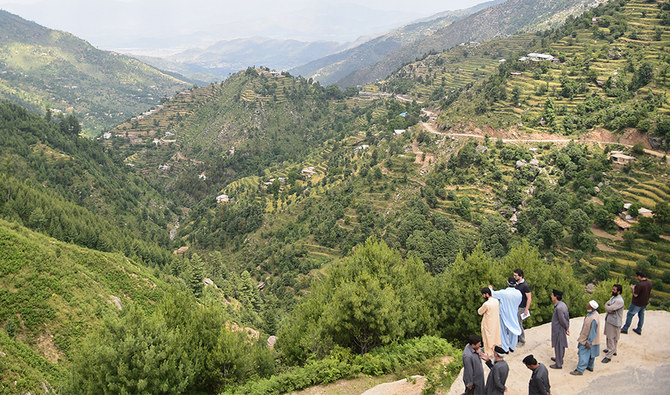
The Swat Valley forests in northern Pakistan are seen in this picture taken on May 18, 2018. (AFP)
Short Url
Updated 15 January 2020
Follow

North Pakistan forests in peril from illegal logging

  • KP Forest Minister says the province has zero tolerance for illegal logging and wood smuggling
  • Pakistan’s national tree, the deodar cedar, may disappear in the next few decades

PESHAWAR: Illegal logging, lack of regulation, and alleged complicity of local officials result in massive deforestation in Khyber Pakhtunkhwa (KP), with some tree species facing the threat of extinction, timber industry stakeholders and forestry experts warn.

“It is high time to implement the country’s forest laws in letter and spirit. Talking about the subject is like committing suicide because the timber mafia is very powerful,” said Mukaram Saba, secretary general of the timber association of Dargai, a sprawling timber market on the outskirts of Peshawar, the provincial capital of KP. He alleged that many forestry officials collude with wood smugglers.

However, KP Forest Minister Ishtiaq Urmar told Arab News that his government had zero tolerance for illegal logging and wood smuggling, and that the province’s forests were divided into three categories – reserved, protected and guzara (community-managed) forests – for better conservation.

Reserved forests belong to the state, and local communities have no rights to their management, conservation or revenue distribution. Protected forests also belong to the government, but local communities have certain rights to them. In guzara forests, local communities are recognized as key stakeholders in conservation and management and have specified rights, privileges and obligations with regard to forest resources.

“There may be some cases of timber smuggling but it is totally out of question that massive tree cutting and smuggling (is taking place) because we have strict checks in place,” Urmar said.

According to Pakistan’s Ministry of Climate Change report from 2015, the country has a high rate of deforestation and forest degradation, particularly in Gilgit-Baltistan and KP, as local communities depend upon forests for livelihood.

Dr. Sultan-i-Rome, a retired academic who wrote extensively on forest conservation, told Arab News that the growing population, burgeoning construction industry, and illegal logging coupled with smuggling were the main factors behind the province’s tree cover loss.

“The trees are not only cut for the benefit of the people living close to forests, but also by the timber mafia, which should be controlled,” he said, adding that the provincial government had its forest ordinance passed in 2002, but it has not been implemented.

Meanwhile, Pakistan’s national tree, the deodar cedar know locally as “dyar,” may disappear in the next few decades.

It is widely smuggled and sought-after, said Saba, the Dargai Timber Association’s secretary.

“A decade ago, dyar was sold for Rs1,500 per foot but now its price surges to Rs4,500 per foot,” he said.

Forestry expert, Dr. Lal Badshah, assistant professor at the University of Peshawar, told Arab News that the slowly growing tree species needs several hundred years to reach its full height.

“Dyar is durable, resistant to termite attacks, water, and not bendable. But if the trend of its cutting and smuggling continues, then we may lose the species in a few decades,” he said.


Pakistan, ADB sign $730 loan agreements to boost SOE reforms, energy infrastructure

Updated 25 December 2025
Follow

Pakistan, ADB sign $730 loan agreements to boost SOE reforms, energy infrastructure

  • Both sign $330 million Power Transmission Strengthening Project and $400 million SOE Transformation Program loan agreements
  • Economic Affairs Division official says Transmission Project will secure Pakistan’s energy future by strengthening national grid’s backbone

KARACHI: Pakistan and the Asian Development Bank (ADB) on Thursday signed two loan agreements totaling $730 million to boost reforms in state-owned enterprises (SOEs) and energy infrastructure in the country, the bank said.

The first of the two agreements pertains to the SOE Transformation Program worth $400 million while the second loan, worth $330 million, is for a Power Transmission Strengthening Project, the lender said. 

The agreements were signed by ADB Country Director for Pakistan Emma Fan and Pakistan’s Secretary of Economic Affairs Division Humair Karim. 

“The agreements demonstrate ADB’s enduring commitment to supporting sustainable and inclusive economic growth in Pakistan,” the ADB said. 

Pakistan’s SOEs have incurred losses worth billions of dollars over the years due to financial mismanagement and corruption. These entities, including the country’s national airline Pakistan International Airlines, which was sold to a private group this week, have relied on subsequent government bailouts over the years to operate.

The ADB approved the $400 million loan for SOE reforms on Dec. 12. It said the program seeks to improve governance and optimize the performance of Pakistan’s commercial SOEs. 

Karim highlighted that the Power Transmission Strengthening Project will enable reliable evacuation of 2,300 MW from Pakistan’s upcoming hydropower projects, relieve overloading of existing transmission lines and enhance resilience under contingency conditions, the Press Information Department (PID) said. 

“The Secretary emphasized that both initiatives are transformative in nature as the Transmission Project will secure Pakistan’s energy future by strengthening the backbone of the national grid whereas the SOE Program will enhance transparency, efficiency and sustainability of state-owned enterprises nationwide,” the PID said. 

The ADB has supported reforms by Pakistan to strengthen its public finance and social protection systems. It has also undertaken programs in the country to help with post-flood reconstruction, improve food security and social and human capital. 

To date, ADB says it has committed 764 public sector loans, grants and technical assistance totaling $43.4 billion to Pakistan.